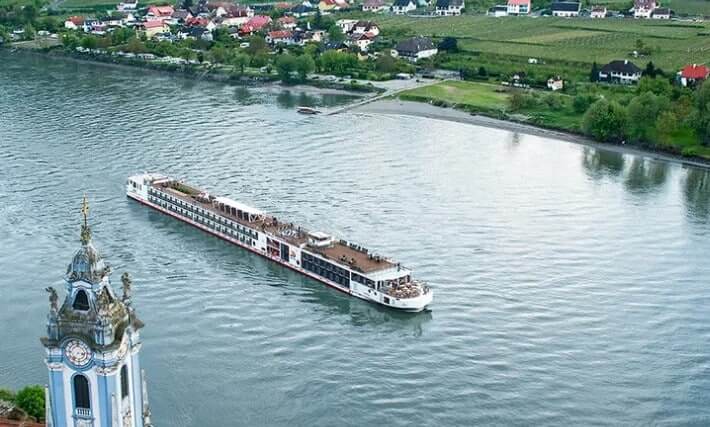
Viking River Boat cruise along the Danube, visiting the Eastern European countries of the Czech Republic (Czechia), Hungary, Croatia, Serbia, Bulgaria, and Romania, during September 2024.
If anyone asks me if I would recommend a Viking cruise, the answer is unequivocally YES! We were treated like royalty, and the arrangements and experiences were all first-class. What a memorable trip. Please read on to learn more.
This is a lengthy report. If you need a concise summary, understand that this has been a fascinating learning experience with an opportunity to visit countries with a challenging history. Yet, you have Putin invading Ukraine, not a country that we visited, but a threat to the region. It was a highly educational experience, with great onshore tours, a fun cruise, and meeting remarkably interesting people. A big plus was making new friends. An experience I would encourage one and all to have.
By the way, we enjoyed the great weather, which was unseasonably warm. After our return, the region was hit by torrential rains.
I was born in South Africa and traveled to all its provinces, plus the nearby countries of Zimbabwe, Zambia, Namibia, and Mozambique (the only country in the world with all 5 vowels in its name).
After relocating to the United States forty years ago, I have slept in over 30 of the 50 states, including Hawaii and Alaska, and driven through many more. We visited Canada and Mexico on a few occasions and traveled to the Caribbean visiting Puerto Rico and St Thomas.
Our European trips took us to England, Spain, France, Belgium, Italy, Luxembourg, Germany, and Denmark. We enjoy traveling.
Our flights to and from South Africa included stops in the Cape Verde Islands and Sao Paulo, Brazil during the Apartheid era. Since the end of apartheid, South African Airways and other carriers have flown over Africa, via Amsterdam or Paris to fly to New York and other American cities.
In preparing for this trip, we had to plan to purchase items in stores along the way and tip our tour guides. We needed to understand what currency they use in each country, and how it compares to the US dollar.
| Country | Days | Currency | Symbol | Equivalent US$ | US$ = |
| Czech Republic | 4 | Czech Koruna | CZK | 0.044009517 | 22.723956 |
| Hungry | 2 | Hungarian Forint | HUF | 0.0027783049 | 359.94076 |
| Croatia | 1 | Croatian Kuna | HRK | 0.14371468 | 7.02062 |
| Serbia | 2 | Serbian Dinar | RSD | 0.009248208 | 108.12811 |
| Bulgaria | 2 | Bulgarian Lev | BGN | 0.5537279 | 1.8059513 |
| Romania | 2 | Romanian Lei | RON | 0.21759204 | 4.5957563 |
| As of June 7, 2024 | |||||
| Czech Republic | 4 | Czech Koruna | CZK | 0.043140995 | 23.179808 |
| Hungry | 2 | Hungarian Forint | HUF | 0.002785371 | 359.01862 |
| Croatia | 1 | Croatian Kuna | HRK | 0.14441149 | 6.9246566 |
| Serbia | 2 | Serbian Dinar | RSD | 0.0092980846 | 107.54903 |
| Bulgaria | 2 | Bulgarian Lev | BGN | 0.55632054 | 1.7975249 |
| Romania | 2 | Romanian Lei | RON | 0.21883096 | 4.5697374 |
| As of June 21, 2024 | |||||
I checked the conversion rate two weeks apart to determine if there was much volatility. The conclusion is that there was not a material difference.
Next was to understand if these Eastern European countries were members of the European Union.
Currently, of the countries we visited, the following are members of the EU:
- Czech Republic
- Hungary
- Croatia
- Bulgaria
- Romania
That leaves Serbia off the list of countries we visited. Serbia applied to join the European Union (EU) in 2009 and has been a candidate for membership since 2012.
We needed to know which countries we visit accept the Euro currency. Croatia is the only one. It is one of the twenty EU countries currently accepting the Euro.
On the tour, we learned the way to get the best exchange rate when using our credit card. When you pay, you are given the option to pay using the local currency, or Euro. By selecting local currency, you always get the best exchange rate.
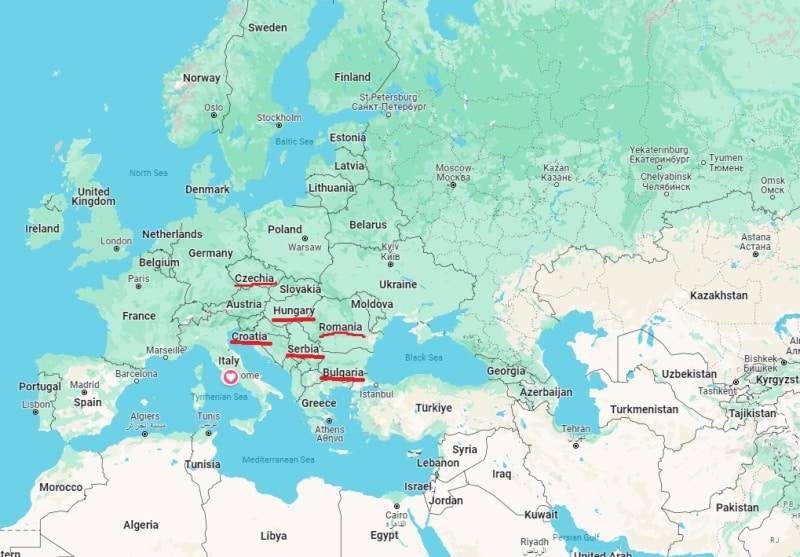
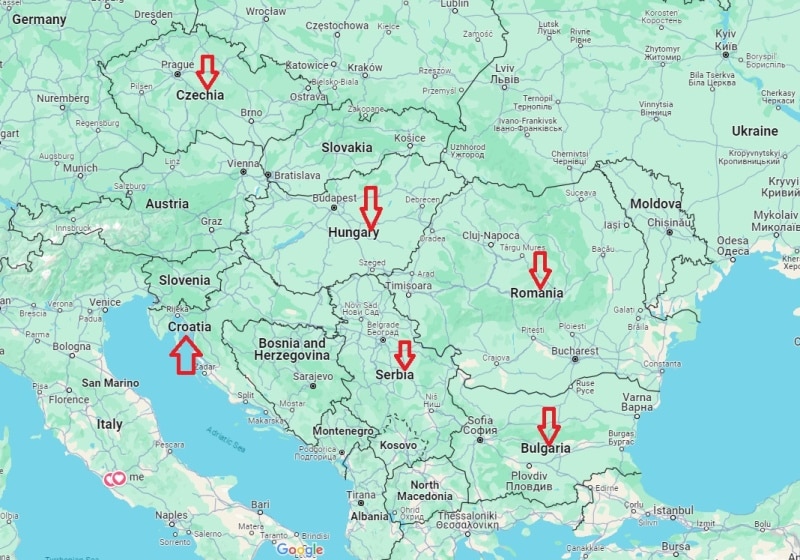
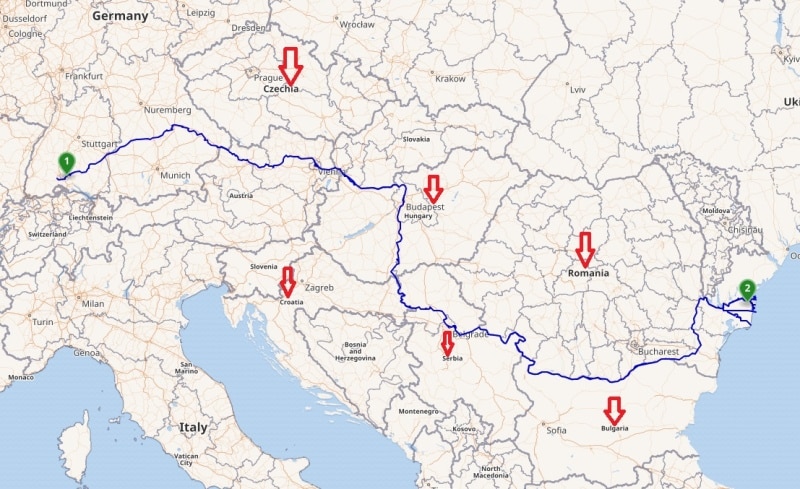
With the war going on between Russia and Ukraine, you may well know that this Eastern European region has a history of instability. With that in mind, I will provide very brief information about the six countries we visited at the end of the detail of what we experienced on each day of our vacation. Additionally, I provide the fascinating history of Viking Cruises.
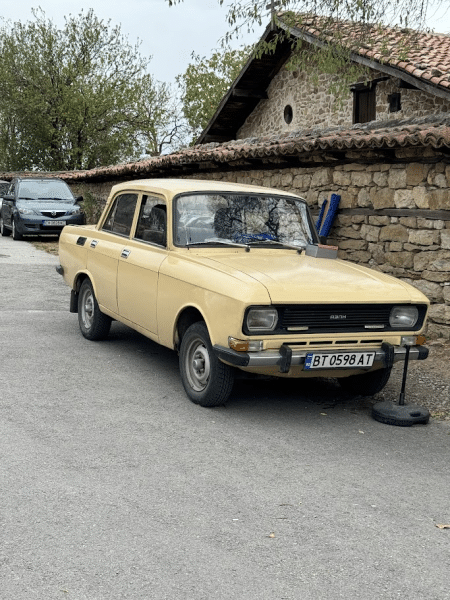
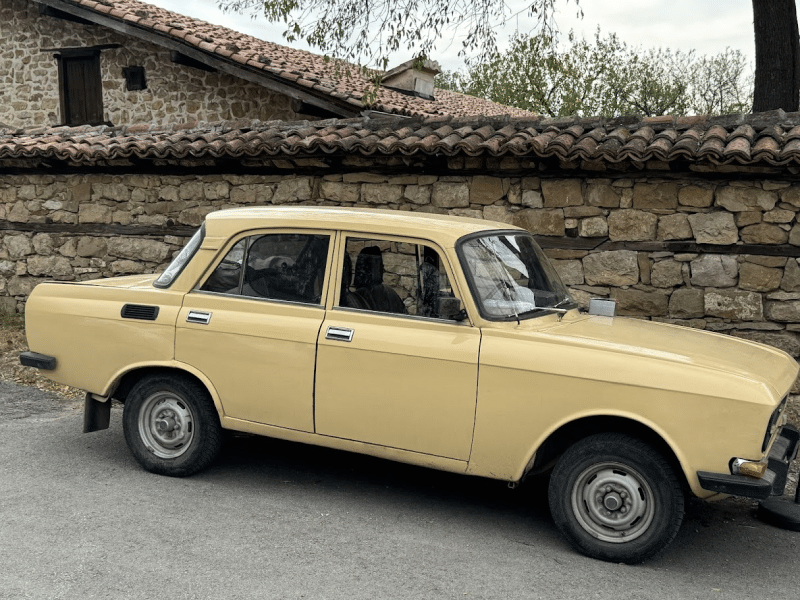
The story about these vehicles explains that when you exit the vehicle and slam your door, another door falls off the car!
Update November 1, 2024. I was amused to see this mentioned in Alexei Navalny’s book Patriot: A Memoir. Ronald Reagan liked telling Soviet jokes. “You know, in the U.S.S.R. to buy an automobile you have to pay in advance and then wait in line for ten years,” one of them began. “This man laid down his money and then the fellow in charge said to him, ‘Okay, come back in ten years and get your car.’ And he said, ‘Morning or afternoon?’ And the fellow behind the counter said, ‘Well, ten years from now, what difference does it make?’ And he said, ‘Well, the plumber’s coming in the morning.’ ” That was not far from the truth. A car was a family’s most prized possession, the most valuable item you were legally allowed to own, and here you were, having to abandon your own with little prospect of buying another. The waiting list to buy an outdated Fiat model manufactured in the U.S.S.R. under the VAZ brand was a staggering ten to fifteen years.
Day 1, Thursday, August 29, 2014, Flying KLM
We start our journey with a heavy heart. My sister Monica’s husband Colin Campbell Shaw (May 1, 1943, – August 25, 2024) passed away in Cape Town, South Africa this past Sunday, and held a memorial service this morning. Monica and Colin had been married for 48 years. Monica’s son Alistair and wife Lynette live in Cape Town, while Barry and Jennifer with sons Liam and Noah live in Auckland, New Zealand. I know only too well the emotional difficulties when my parents died in South Africa while we were living in America.
Our HVAC (Heating, Ventilation, and Air Conditioning) unit failed in our condominium and had to be replaced while we were on vacation. Our exceptional neighbor, Sandy Witt, took charge of helping the technicians remove the old unit and install the new one. What a blessing.
Sean and Erica arrived at our Condo this morning to bid us farewell. Erica drew the short straw and drove us 20 minutes to General Mitchell Airport in Milwaukee. Here we boarded a Coach USA bus traveling to Chicago’s O’Hare International Airport.
The lady bus driver shared with us that after she retired, she took care of her mother until she passed away, and two years ago, she took this part-time job of shuttling passengers to and from different locations around our community.
We were early to board the bus in Milwaukee and elected to sit in the front row seats on the opposite side of the driver. As we commuted to Illinois, we saw that we sat in the handicapped seats, but that was not a problem since no handicapped passengers boarded this bus.
I was impressed by how carefully she drove us, always checking before changing lanes and keeping a safe distance from vehicles in front of her. The bus can seat 56 passengers, and our driver took responsibility for loading and unloading the luggage into the hold on the bus. It was fun sitting so high up. I have driven this route at least a thousand times in the past forty years, and never really appreciated the views of the surrounding landscape. Then too being able to see into the cabs of the 18-wheeler trucks was a rare experience.
One negative during this trip was that the air conditioning was broken. They opened the vents on top of the roof which made the bus ride rather noisy, and a bit warm.
We got through customs at O’Hare in short order and walked to the new international wing of terminal 5, to a secluded spot. We had lunch at Bar Siena, an Italian restaurant that we highly recommend, and enjoyed a piping hot pizza. Kenneth and Jennifer Brink, who came by bus from the Madison area, joined us, and for the next two weeks, we will travel together.
In January 2023, the CDA celebrated the grand opening of the new eastern extension of Terminal 5, part of a $1.3 billion, multi-year investment to expand and modernize the key gateway at O’Hare. The expansion of Terminal 5 represents the largest terminal project at O’Hare since the terminal was originally built in 1993. The project is critical to elevating the customer experience and improving operational efficiencies to ensure the airport’s continued growth and strong competitive position.
With our recent travels, we have seen some great airports. Seattle, Washington comes to mind. Over the years we have flown in and out of O’Hare on several occasions for international flights. However, it has been a few years since we used this airport. The international terminal, Terminal 5, has a new extension with 40 gates. To say that we were impressed is an understatement. With everything being new, we found that it was a spacious wing, and even the toilets were impressive. A nearby coffee shop provided us with tea.
Our actions were very deliberate today. We left the condo early to get to the Milwaukee airport with lots of time to spare, and again early into O’Hare. We did not want to be late for our international flight, so had lots of time to kill. A definite stress reliever. After all the careful planning I had done this week, for some strange reason I forgot to pack my Kindle and to have a couple of books to read for our journey to Prague.
Our KLM trip to Amsterdam is scheduled to be 7 hours 45 minutes, arriving Friday morning early. The flight arrives just after midnight Milwaukee time. We boarded the flight at 4:30 pm. The Boeing 777-300 holds 408 passengers, and we had a full flight. Sitting near the back of the plane in row 37, the seating arrangement across the aircraft was 3, 4, and 3 separated by two isles. This being a relatively new aircraft we were pleased with the seat comfort and legroom.
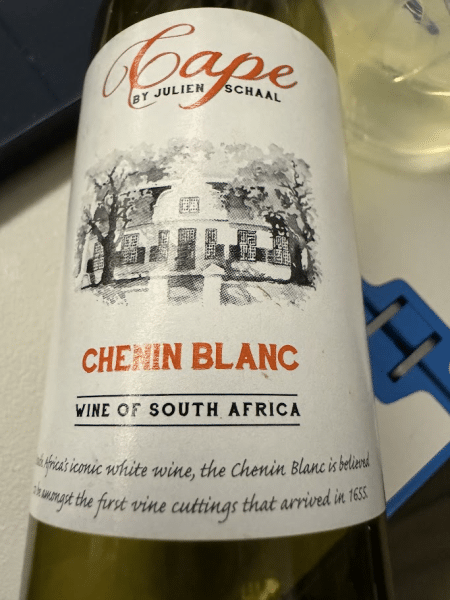
On our previous flight to Vancouver, British Columbia, Canada this past June we encountered significant turbulence, but this flight was smooth. In fact, in total, there was no more than 5 minutes of turbulence, and the pilot did not call for seatbelts to be fastened.
We were warned that no photos or videos can be taken on this flight unless you have the passenger’s permission. Privacy is critical. Frankly, it is the first time I have heard this request or demand.
I have made two mistakes thus far. I forgot to take my medication last night. I forgot to place the tracking devices in our luggage, should it get lost we will know where to find it.
We arrived at Amsterdam’s Schiphol Airport on time, with a 90-minute delay to board our next flight to Prague, Czech Republic. This time we had a smaller plane, a Boeing 737-700 with 142 passengers, but Linda did not have someone sitting next to her, so we had space to move.
Before departure, together with the Brinks, we bought 4 lattes at a coffee kiosk. We ordered a small size, and we were presented with small cups, half filled. The price was 15 Euros, and that worked out at Euro 1 per sip!!! The treat was welcome even at the price.
Viking mailed us tags that had to be attached to our luggage and decals to attach to our shirts to be recognized at the airport. This is all part of their customer service to ensure a happy and memorable trip. We were transported to our hotel, with Viking taking care of our luggage.
On the connecting flight to Prague, also on KLM, we were offered a vegetarian homemade sandwich with two slices of brown bread and a filling with cheese crafted in a climate-neutral dairy and egg from chicken-friendly Rondeel houses. We had researched and followed a healthy living lifestyle; it was very encouraging to read what the Dutch are doing in this regard.
Day 2, Friday, August 30, 2014, Hilton Prague Hotel, Czech Republic
Flying into Prague we saw many small communities and farms, and an Amazon distribution center, located alongside the airport.
The Viking’s representative, Joseph, met us at the airport and arranged for Viking transport to take us to the Hilton Prague Hotel in Pobrezni. We were met by George, his English name because we would never be able to remember or pronounce his Czech name, which means farmer, even if he has never set foot on a farm. The hotel was a 40-minute drive! We were entertained by quite the raconteur. George was full of interesting information and answered our many questions. I was fascinated that he spoke perfect English, one of his three spoken languages.
George explained that during the 1950s and 1960s The Czech Republic was controlled by Russia and its communist ideology. They were forced to have Russian as the only language taught in schools. With the fall of communist control in the country, the Czechs wanted English to be the language of instruction, but the teachers could not speak English, so they reverted to the Czech language. Today many communicate in Czech, English, and Russian. George went on to say that Czech is a complicated language. When the letter “H” is written as the first letter in a word it is pronounced very differently to “h” in the middle of the word. An “e” is pronounced very differently from one with a checkmark “ĕ” on top of it.






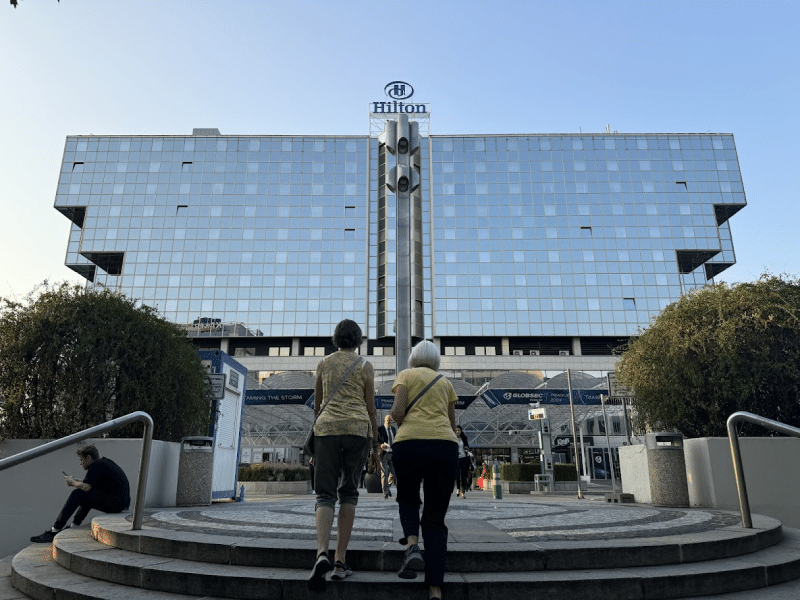

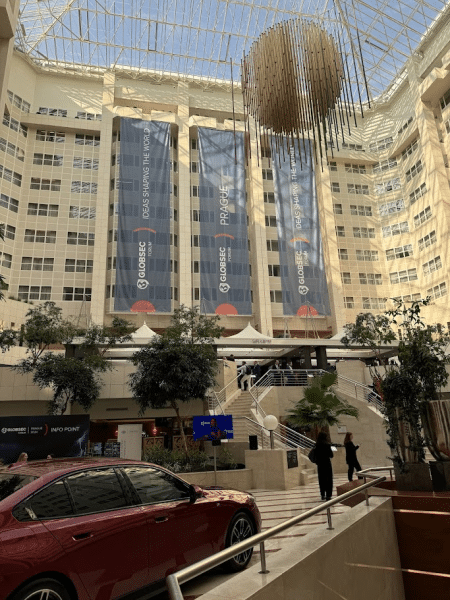

I collected a document to attempt to understand what the international conference was about that would draw dignitaries from around the world, and I saw many television interviews including one by CNN.
GLOBSEC. Ideas Shaping the World. Young minds, Democratic horizons, Paving the way for the EU’s promising future. Attitudes of young people from Austria, Greece, Ireland, and Slovakia. The conference was funded by the European Union (EU). In less than a year EU citizens will vote a new European Parliament into office and the current European Commission (EC) will end its mandate. The 2024 EU elections come at a time when societies are more polarized than ever. Civic space is shrinking and democracy, under attack by malign domestic and foreign influence, is in defensive mode. The continent, moreover, is facing geopolitical fissures heightened by Russia’s war against Ukraine. At the same time, the EU and its Member States are tackling the climate crisis and confronting energy, economic, and migration challenges. The results of the upcoming elections could significantly affect European institutions – the protectors of democracy and stability – and the future of the Union.
The conference caused us a few challenges. After our walks, on returning to the hotel we were ushered into a security check area where we had to empty our pockets, remove our watches, place everything through an X-ray device, and walk through a scanner—much like you will find at an airport security check. Protecting politicians and international dignitaries is important!
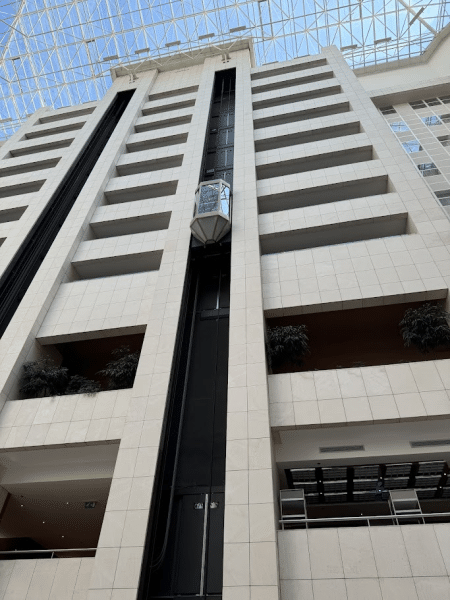
In addition, accessing your floor via an elevator is interesting. When you arrive at the bank of elevators, identified as A through L, you scan your room key at a device, and the device informs you which elevator to use. Amazing. When Ken and Jennifer came to visit us, to go to their fifth floor, they had to scan the device with their room key to inform them which elevator to use to get to their floor. In trying to understand the system, I later realized that this is a security feature that allocates the next available elevator and preschedules you to your floor only, knowing what floor you must exit on. Returning to the ground level does not require the use of your room key.
We learned that Viking occupies 30% of the available rooms in this hotel yearlong with all the tours that pass from or through Prague. That gives Viking considerable influence with this prestigious hotel. Once at the hotel, Viking rolled out the red carpet by providing another Viking representative who handed us documentation detailing touring times and other activities. One unique experience was that we did not have to register at the hotel, Viking took care of all the red tape.
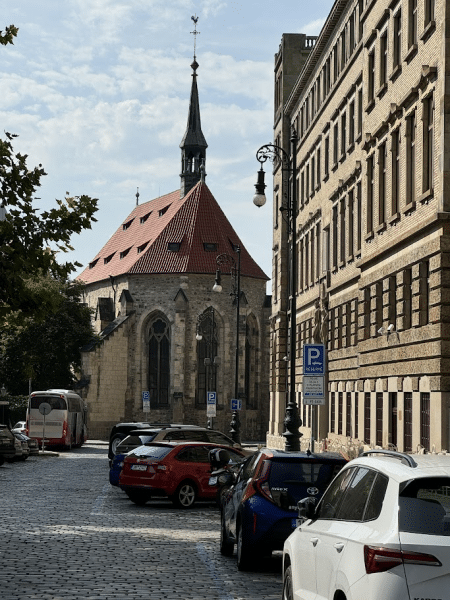


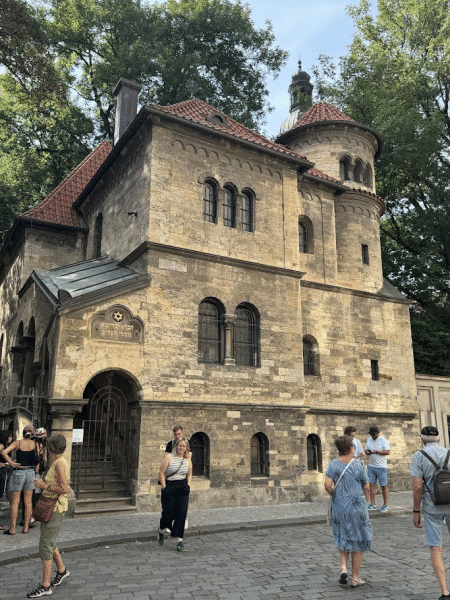
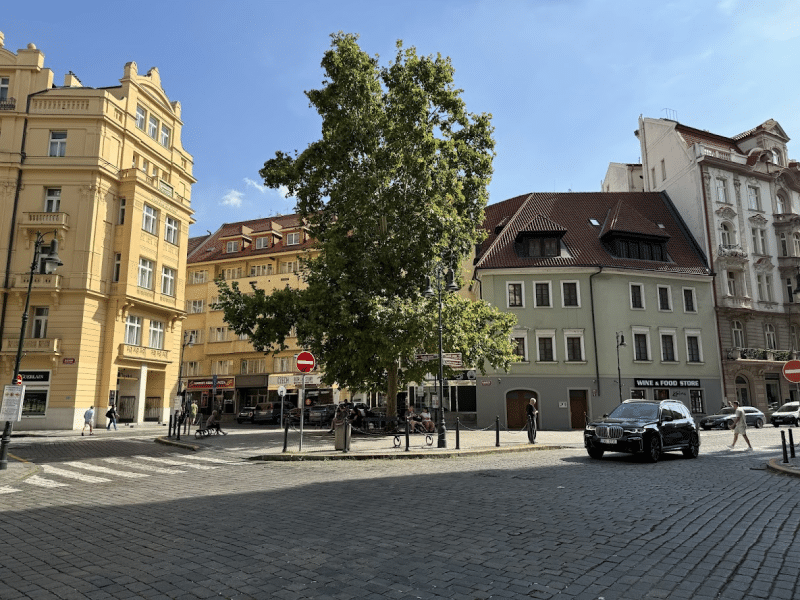

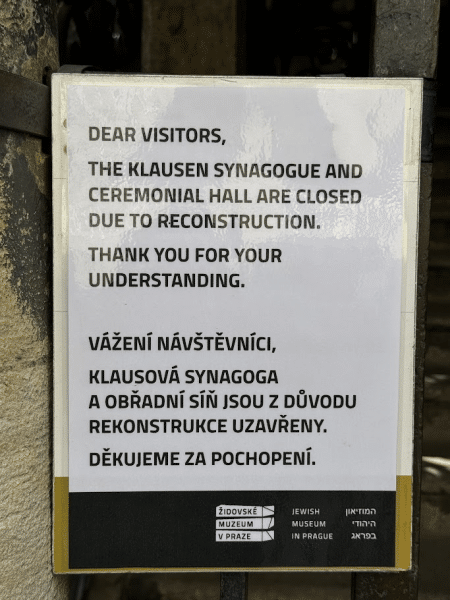
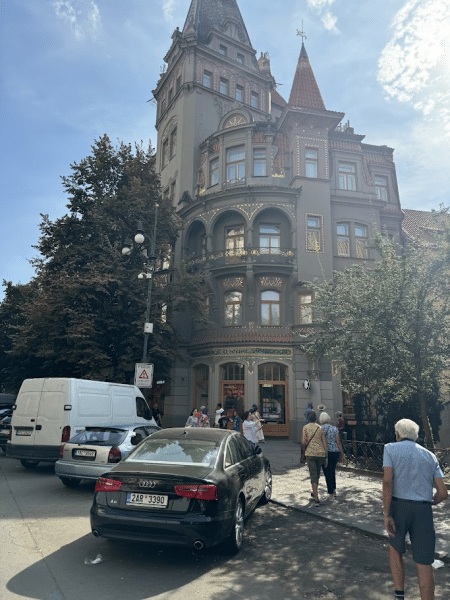


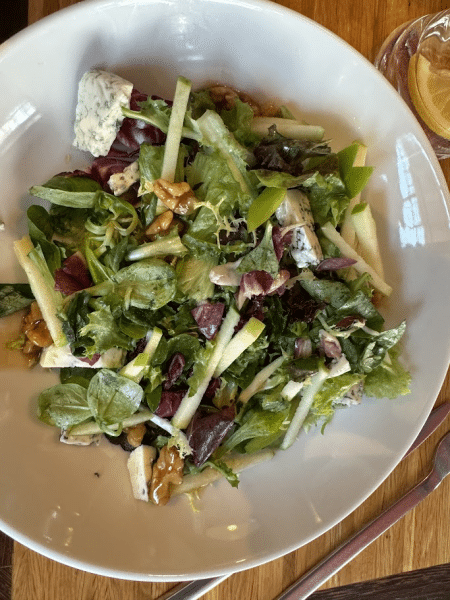
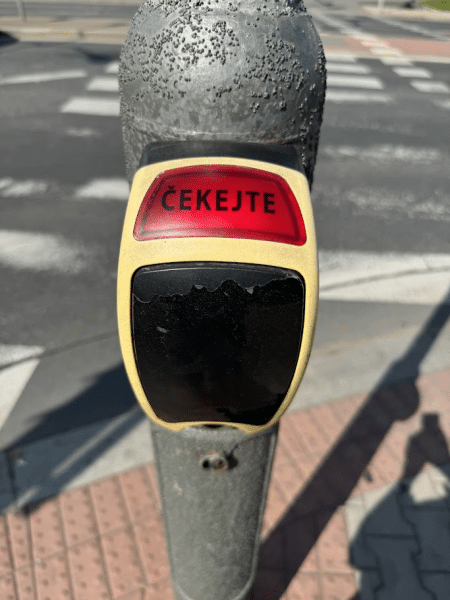
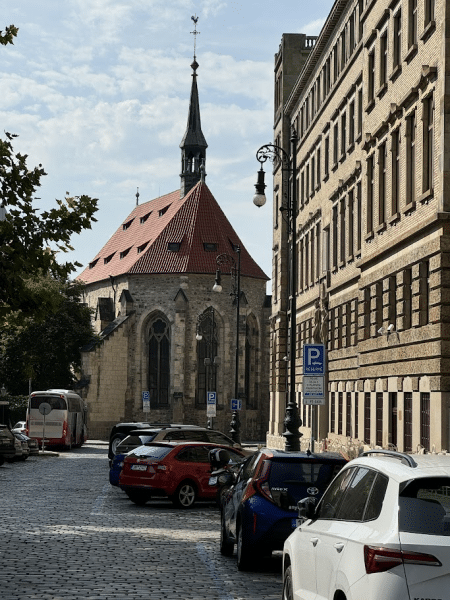
Walking through this ancient city, we see interesting situations. Some intersections where pedestrians cross is supported with traffic light control where motorists must stop for pedestrians. In many places where lights are not supported to allow pedestrian crossing, it tends to be a free-for-all. Some motorists will stop and allow people to cross, but at other places, they may not be obliging, and you take your life into your own hands. While on the subject of traffic lights, Prague operates differently from how we are accustomed. When a light is about to turn green, it shows both red and yellow, with the idea motorists better get ready to drive.
As we headed for bed on our first day here, I calculated that we had now been awake for 30 hours without a shower, and the longest I continuously wore my hearing aids. Can you imagine why we feel so tired? However, if we fall asleep by 8:00 pm, what time will we wake in the morning? Decisions to make!
Day 3, Saturday, August 31, 2024, Hilton Prague Hotel, Czech Republic
Picture a hotel with 780 rooms. Breakfast is included in the room rate. You visit the restaurant and enjoy a buffet. What a spread with an unbelievable selection. I started with a fruit bowl beautifully cut up, took a banana, and an apple, chose Americana coffee from a machine, and orange juice from a dispenser, followed by scrambled egg, bacon, fried tomato, and mushrooms. A fantastic meal all things considered. Then too the service is outstanding, as you finish using a plate or bowl it gets whisked away with a smile. When we checked into the restaurant they noted our attendance on a register of guests in the hotel. Everything is so professional. Hilton, I am impressed.
Prague Castle (26 seconds)


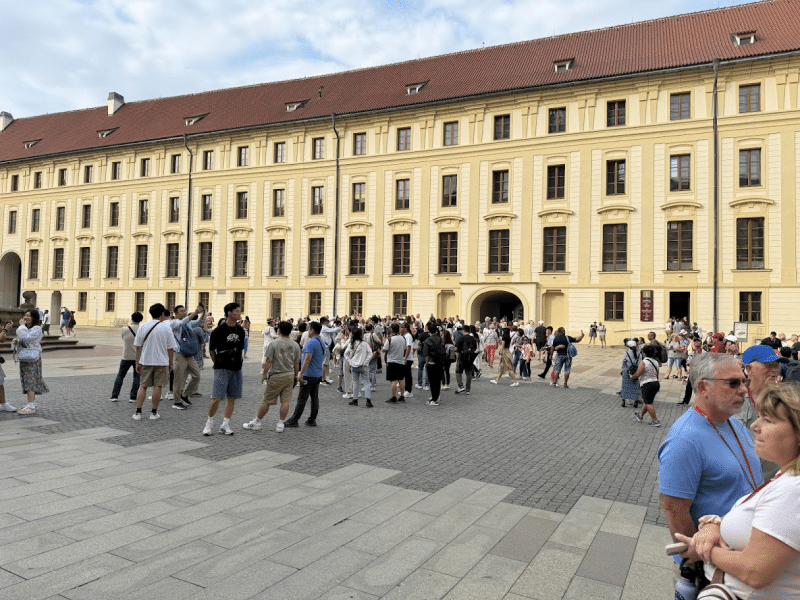

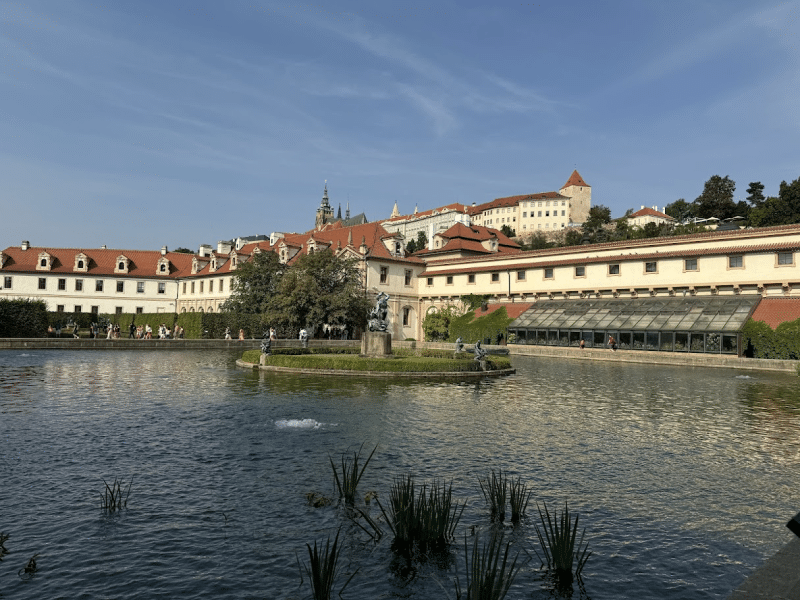


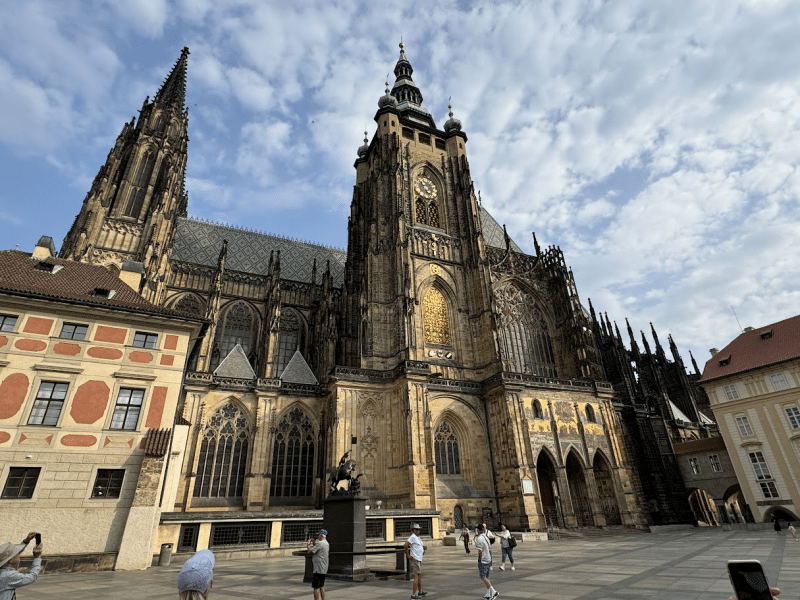

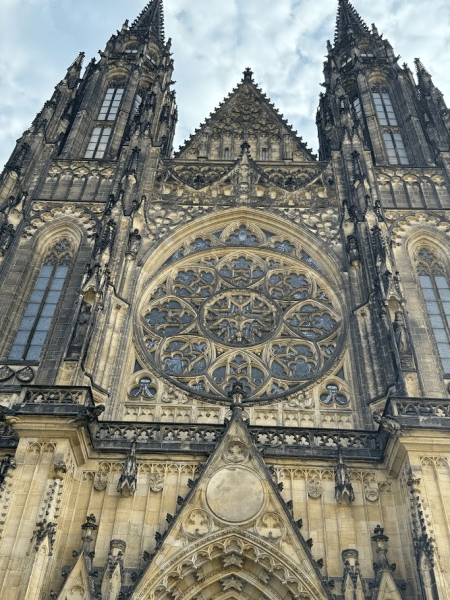
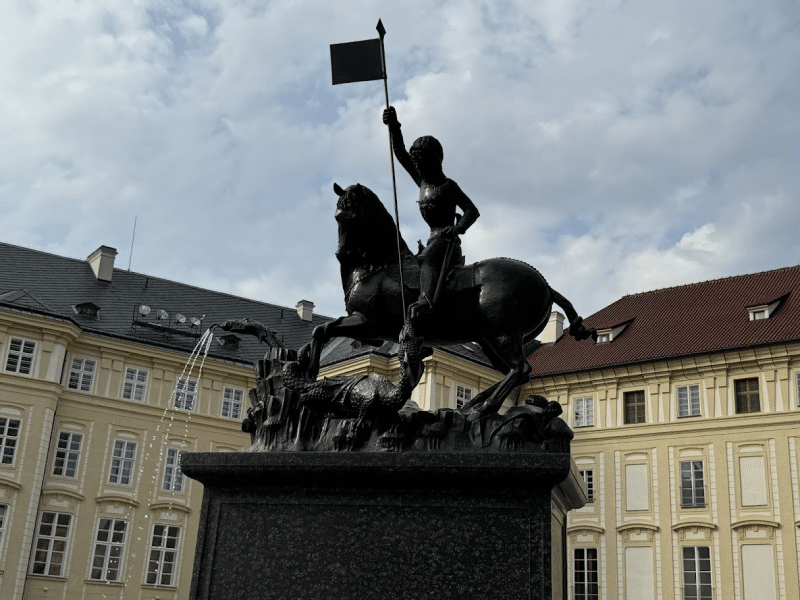

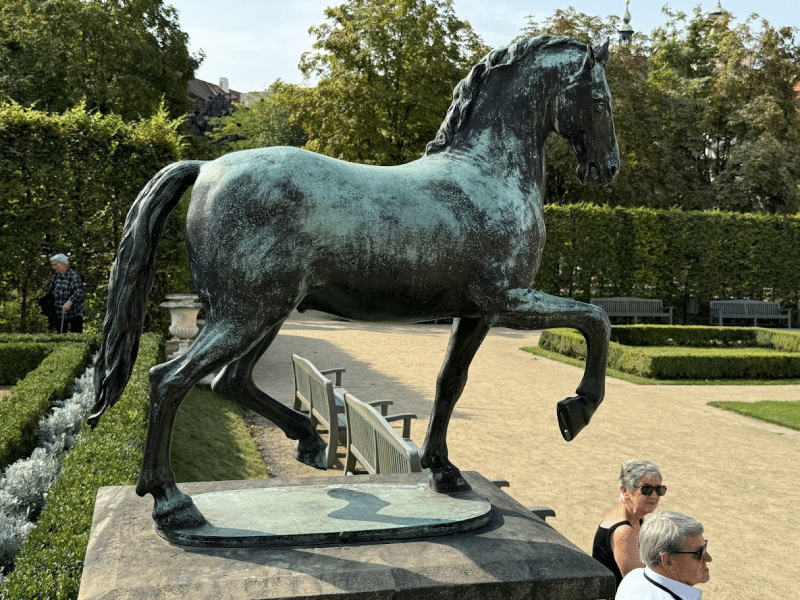
Having been on a recent tour to Alaska, I suspected that I would be overwhelmed with positive information. I purchased a recorder so that later I could filter all the fresh information worth recording. Unfortunately for me, the guide handed us a gadget with an earpiece to plug into our ears, and she delivered all her educational information using a device that we could hear her clearly, but not one I could use to record her information.
Prague Astronomical Clock (47 seconds)
Prague is the “City of a Thousand Spires.” We visited the Old New Synagogue, saw the Astronomical Clock on the Old Town City Hall turn noon, walked the Charles Bridge, and so much more.
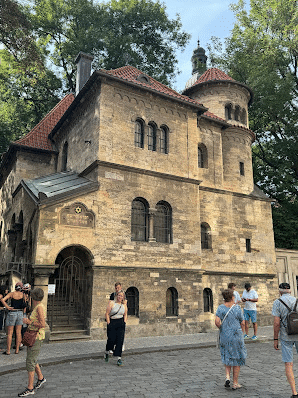
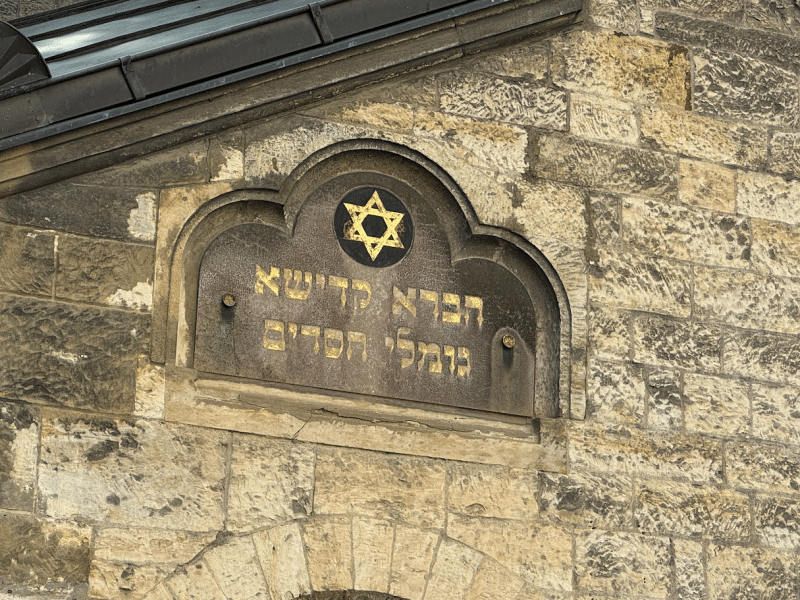


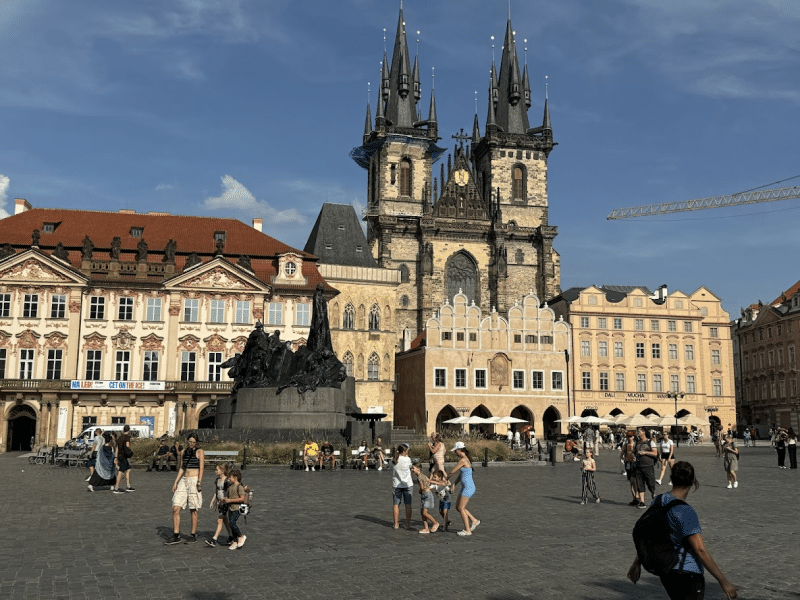
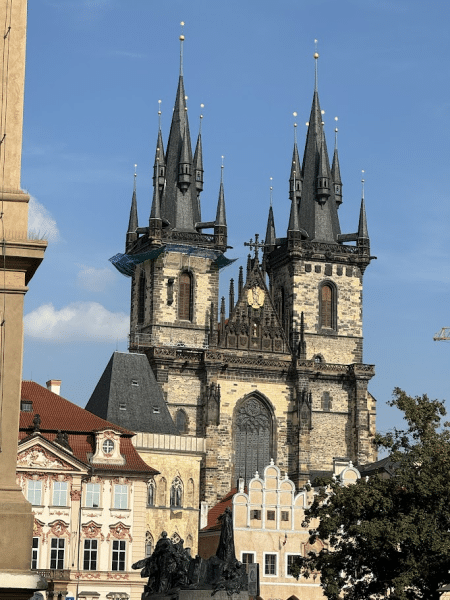

Prague boasts a fairytale medieval Old Town, the historic Church of Our Lady before Tyn. The church serves as a gallery of Gothic, Renaissance, and Early Baroque works, like paintings by Karel Škréta and the tomb of Tycho Brahe. Also find the Klausen and Staronova Synagogues (two of many), and perhaps Europe’s largest castle. A good way to introduce yourself to the city, its layered past, and its resilient people is with a walk across town, starting on lively, urban Wenceslas Square, weaving through the atmospheric Old Town, and ending at the picturesque Charles Bridge.
The Church of the Infant Jesus, also The Church of the Lady Victorious. This Early Baroque building, dating back to 1611, was rebuilt from 1634 to 1669 by the Carmelite order. The church is famous for its statuette of the Infant Jesus of Prague, originally from Spain and donated to the Carmelites by Polyxena of Lobkowicz in 1628. The Infant Jesus has two crowns and about forty-six robes. His vestments are traditionally changed about ten times a year according to the liturgical season. A small museum was built for the clothing and other religious objects.
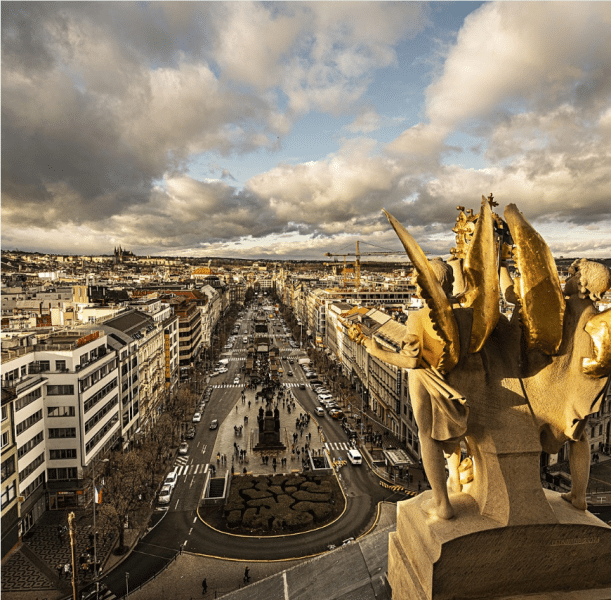
Huge Wenceslas Square, lined with great buildings and plenty of history, is the focal point of Prague’s modern, New Town Quarter. It’s named for King Wenceslas, the “good king” of Christmas carol fame, sitting astride the big equestrian statue at the top of the boulevard. The statue is a popular meeting point among locals, who say, “I’ll meet you under the horse’s tail.”
Wenceslas Square has been center-stage for much of modern Czech history: The creation of the Czechoslovak state was celebrated here in 1918. An inspiring memorial here commemorates Jan Palach and Jan Zajíc, two college students who set themselves on fire in 1969 to protest the Soviet Union’s invasion of the Czech Republic the year before. Twenty years later, giant crowds converged on the square, jingling their key chains and chanting, “It’s time to go now!” in the lead-up to the peaceful overthrow of the communist government.
This square is the commercial and administrative center of the city as well as the site of important social and historical events. Here you’ll find cinemas, theatres, banks, hotels, restaurants, dozens of small and large shops, and administrative centers. The square was created during the founding of the New Town by Charles IV in 1348. Today it is dominated by the National Museum (1885—1891) and Josef Václav Myslbek’s statue of the national patron St Wenceslas from 1912.
The Czech people have a rousing enthusiasm for blowing raspberries in the face of authority — even voting to name a fictional comedic character, Jara Cimrman, as their “Greatest Czech of All Time.” From the 14th-century rebel Jan Hus (who challenged Church corruption roughly a century before Martin Luther) to the flashes of revolt that sparked the 1989 Velvet Revolution against communism — the Czechs have maintained a healthy disrespect for those who would tell them how to live their lives. (Remembering the mediocre jobs the communists assigned them, Czechs quipped, “They pretended to pay us, we pretended to work.”)
Whether in a crowded market, restaurant, or taxicab, be aware of your surroundings — Prague is awash in pickpockets and con artists.
A couple of blocks from the market is the Old Town Square, surrounded by gloriously colorful buildings in a diversity of architectural styles: Gothic, Renaissance, Baroque, Rococo, and Art Nouveau. Chief among them is the towering Gothic Týn Church, topped by fanciful spires. The square’s centerpiece is a memorial to Jan Hus.
A short detour up the uniquely tree-lined Parizska (“Paris”) street leads to the poignant Jewish Quarter, with museums, synagogues, and cemeteries. This is one of the most powerful collections of Jewish sights in Europe.
Parizka ends at a bluff that once sported a 100-foot-tall stone statue of Stalin. Torn down in 1962, it was replaced in 1991 by a giant ticking metronome, its concrete base now favored by skateboarders who love to film themselves “skating at the Stalin.” From oppression to counterculture, Prague has come a long way.
Back at the Old Town Square, Karlova Street (and a gaggle of tourists) zigzags down to the river to one of the favorite places for a stroll — the Charles Bridge. Under the communists, this pedestrian-only bridge crossing the Vltava River was empty, its big Gothic towers and statues of saints coated in black soot. Today it’s a celebration of life, with a festival of artists and musicians all along its length.
If you were to continue across the bridge, you’d reach the charming Little Quarter, and beyond that, the Castle Quarter, topped by the massive, must-see Prague Castle. A visit to the castle complex, with its quarter mile stretch of churches, courtyards, and palaces spanning a thousand years of Czech history, can fill the better part of a day.
The mythical founder of Prague — the beautiful princess Libuse — named her city “Praha” (“threshold”). The Czechs have always been at a crossroads of Europe — between the Slavic and Germanic worlds, between Catholicism and Protestantism, and between Cold War East and West. Despite these strong external influences, the Czechs have retained their distinct culture…and their enviable ability to find humor in life’s challenges.
In 2002 Prague had a 500-year flood. The year of the most destructive floods in modern Czech history. Prague was the most badly affected of all the Czech cities hit by the large-scale natural disaster. Several neighborhoods were flooded and metro stations, monuments, and a part of the zoo all ended up underwater. We were shown various places where you can still see where the level the water rose to.
After an afternoon nap, we headed out for a short walk and found the Restaurant Sklep, which was highly recommended by our tour guide, Renata. The four of us started with a Pilsner Urquel beer which is not the same as the American beer of the same name. It is a long story, but briefly, some workers from the Czech factory moved to America and decided to start a brewery with the same name. Court cases were ensured, and the distribution of the respective beers was restricted to specific countries to avoid conflict. For dinner, Ken Brink had Pilsner beef goulash, I had baked smoke ribs, and Linda and Jenny had roasted beetroot carpaccio salad. The food was delicious, and again the service was excellent.
Day 4, Sunday, September 1, 2024, Hilton Prague Hotel, Czech Republic
Today I had a rude awakening twice. The first was at 3:00 am when a friend called me, the second was at 5:00 am when Robyn sent us a photograph of the twins and I got an alarm. The reason is that I bought a new iPhone this past Tuesday, and in setting it up I forgot to set the Do Not Disturb feature. We all learn from our mistakes. At least I showered very early and was ready for an all-day tour.

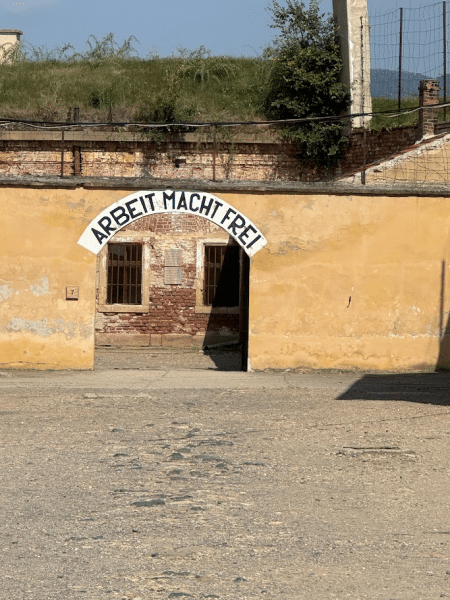

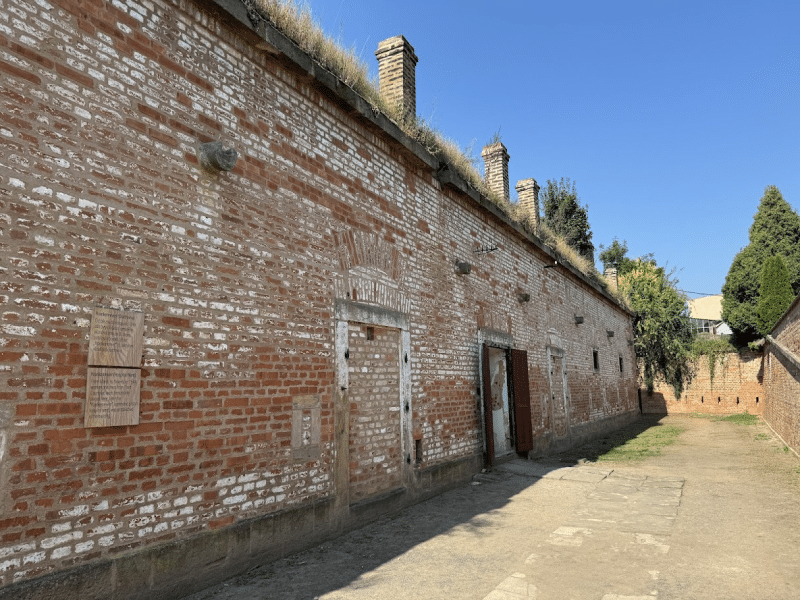


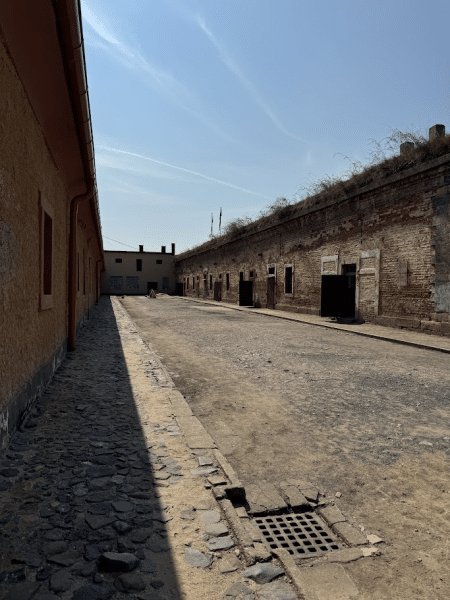

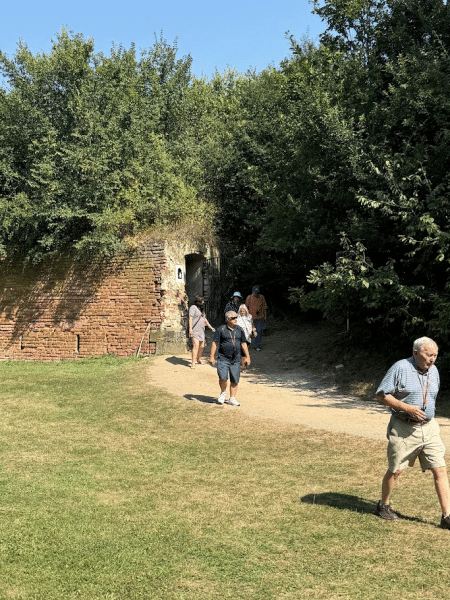


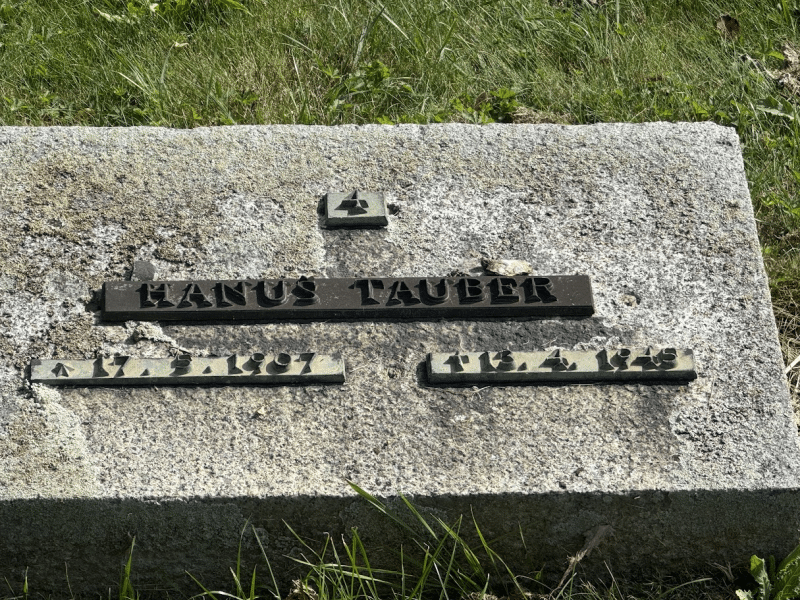


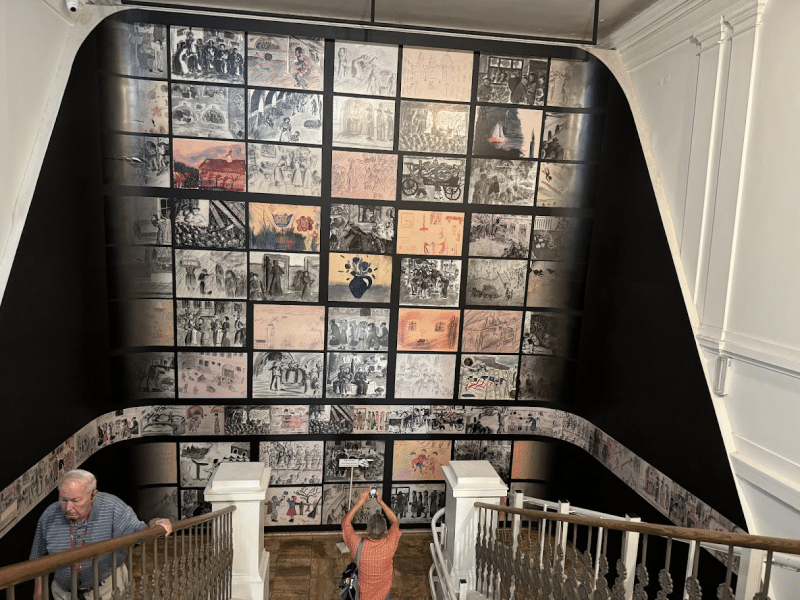
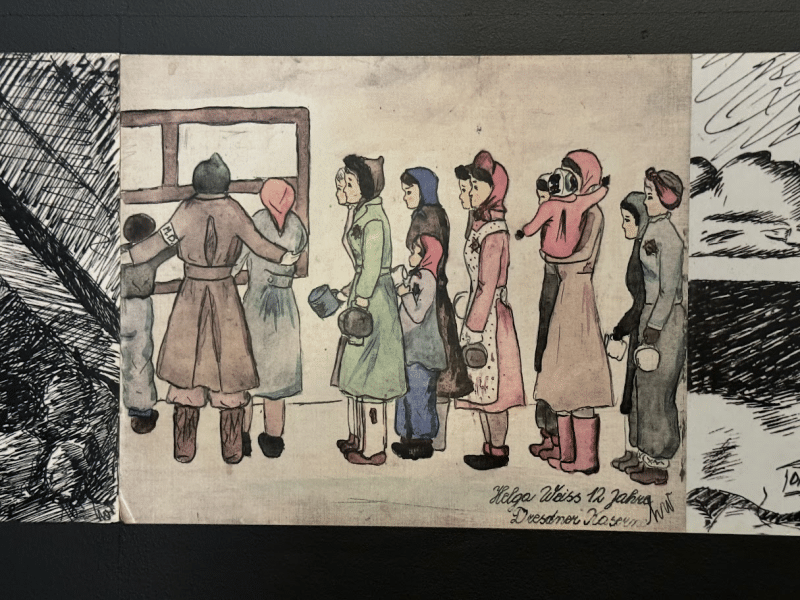
The visit to Terezin was a sobering experience. We learned that it was not a concentration camp, per se, but a place where Jews were assembled, men, women, and children. Many were murdered in the camp or shipped to several of the nearby notorious concentration camps in Germany, where Jews and Jewish sympathizers were murdered. Statistically 1 or 2 out of every 1,000 managed to survive. What kept going through my mind was why were so many Germans, and German sympathizers willing to go along with Hitler and his ruthless madness.
Terezin, a Jewish Ghetto and holding camp where Jews were rounded up and made to labor after having all their belongings confiscated. They usually lasted there six months by which time they were so emaciated that they were then shipped off in transports to death camps like Auschwitz which is seven hours away. So, a very sobering day to walk the fortress and cell blocks and learn more of the history.
What is not apparent from the photographs is the wall around the encampment had an underground tunnel, and some photographs reflect that fact. There are 52 miles (84 kilometers) of tunnels under the walls.
Taken from a plaque in the camp. “Occupied areas of Poland and the then Soviet Union became the stage for the closing phase of the ‘Final Solution of the Jewish Question’—the mass slaughter of Jews. Some 87,000 prisoners were deported to the East from Terezin. Most of them were murdered or tormented to death. Only around 3,600 of those who had been selected for labor assignment and who had survived the horrific hardships of life in concentration and labor camps lived long enough to be liberated.”
From another plague. “In the years 1940 – 1945, more than 1,500 Jews were imprisoned in the Small Fortress. Their destiny was the worst of all the groups of prisoners. About 500 of them were tortured to death here, and most of the others perished after their deportation to the concentration camps.
“Dedicated to the memory of the victims by the Embassy of the State of Israel.”
One more Plaque. “Krankenrevier (Hospital Ward). From March to November 1944, women prisoners from Third Courtyard were temporarily placed there. Later the Krankenrevier, a primitive prison hospital ward was established in the building.”
The youngest person murdered in Terezin was a 14-year-old girl!
While passing through one of the cell blocks, a Texan commented that this is where Kamala Harris should be locked away. My blood hit boiling point instantly and the first thing out my mouth was “Are you ready to go and rape women” just one of the many Trump characteristics. He instantly said that he would not vote for Trump, which was bullshit. I was ready to keep going but he instantly backed off. My question here is why do half the Americans support a racist, convicted felon, who assembled a documented list of over 30,000 lies while in office, who is fully supported by Evangelical Christians who see Trump as the second coming of Christ, and his long list of shocking behavior like manipulating his father’s inheritance to cheat his family out of their rightful inheritance, bankrupting his companies so as not to pay his contractors, and the list goes on. To repeat, Hitler too was no saint, but having a negative character has no detraction for the ardent Trump cult supporters.
One Life movie was filmed in Prague in 2023.
We gathered so much information, and here are brief examples. The cost of living is lower than in the US. Beer is cheaper than Coca-Cola. Czechs drink more beer than almost any nation globally. 78% of residents in the Czech Republic are agnostic, caused by all the religious wars over the centuries. The Romans tried to conquer the country, the Ottoman Empire of Sunni Islam Muslims tried the same, and the Eastern Orthodox Church made its assault on the country. Unemployment stands at only 2%.

In Prague, they use specially equipped vehicles to identify illegal parking, and you receive your fine in the mail. Residential areas have parking places demarcated with blue lines painted on the road, and if you are not an authorized resident, expect a fine. The Czechs prefer manual or stick-shift vehicles since they are cheaper to purchase.
In the old town, homes and apartments are not airconditioned due to the age of the buildings, and heat can be extreme. Vehicles do not always stop at pedestrian zebra crossings. The city was built 500 years ago, but not in a grid pattern, with narrow roads, causing a nightmare for traffic and driving, a special challenge for busses, with trams that have the right of way. Finally, the traffic lights work differently from what we are used to. The red light goes red and yellow to prepare you to start driving, then goes green. The green light shows green and yellow, before going yellow, and finally red.
Day 5, Monday, September 2, 2024, Corinthia Hotel Budapest, Hungary
Today was another early start in Prague. Our luggage had to be outside our hotel room by 7:00 am, but we went down for breakfast at 6:30. We had to report outside our bus to identify the luggage that Viking personnel had carried to the bus. Naturally, there had to be some chaos. There were four buses outside, one going to the airport, ours to the hotel in Budapest, and one directly to the boat in Budapest, and no idea where the other bus was headed. All I can say, and keep repeating, Viking does an excellent job of customer service. Before the bus departed they did a roll call to verify that we were on the bus and so was our luggage. The guide asked if we remembered to take our money from the safe and our coats from the cupboard because the bus would not return to collect the forgotten items. We did not have a safe. The Brinks told us that they had a bedside clock, and we did not, so I guess we had a cheap room charged at the standard rate.
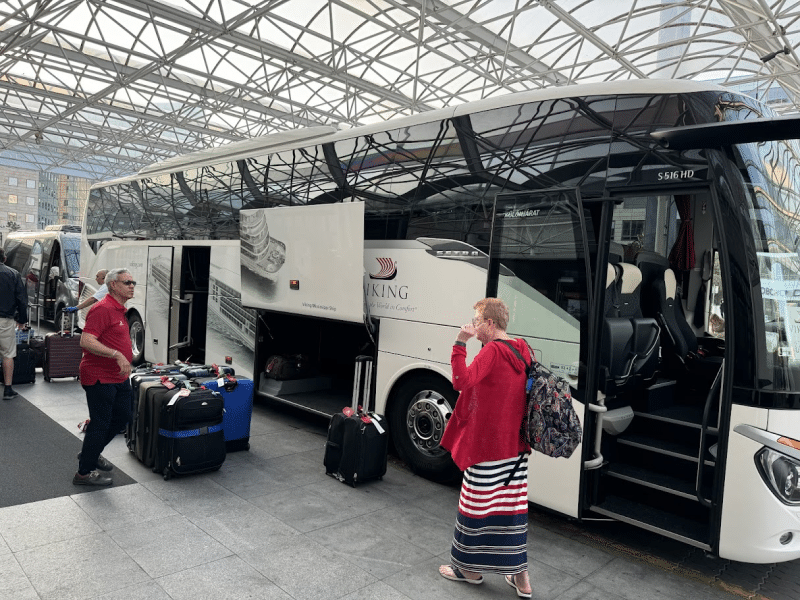

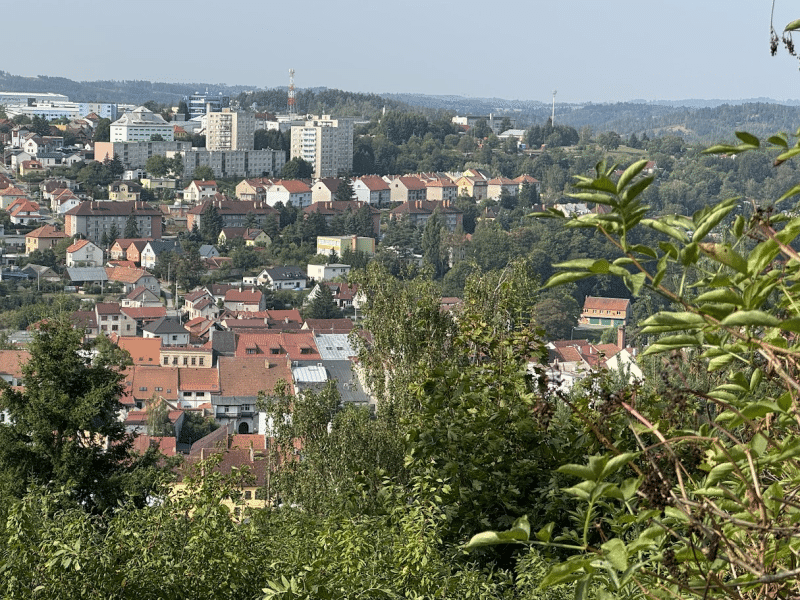


On the bus ride, the guide gave us several running commentaries that made the ride highly informative. Repeating experiences we had in Italy on the autostrada, trucks must only drive in the slow lane. As we drove to Brno, we left the D1 motorway to join the D5 motorway to drive south to Slovakia. Passing Brno, the guide pointed out numerous large apartment complexes built to accommodate families in small one-bedroom homes, where parents converted the lounge at night into sleeping quarters, and the tiny rooms used to sleep children. These buildings went up after World War II after many communities got bombed. We saw other such communizes around Prague. What was so fascinating was to learn about the radicle changes that took place just before and after the war to satisfy the political demands of the various countries as they changed boundaries and renamed places like Czechoslovakia to the Czech Republic, and Slovakia.
With our drive, the driver is restricted to how long he is allowed to drive, and how long to take a break, and everything is recorded with electronic devices, and police can demand to review the information on demand. Violating these rules can result in a fine, or at an extreme the driver can lose his driver’s license. The bus was not restricted to the rules of trucks and can and do use lanes for motor vehicles. I was fascinated by the narrow steel structures across the motorway, and it turned out to be a method to carry cables across the road. Additional structures are used to track motor vehicles, especially trucks. Naturally, there were motorcar bridges across the motorways, and smaller bridges to allow animals to cross.
As we crossed the border into Slovakia, the driver had to stop to enter data into the electronic device to acknowledge entry into the country. Crossing the border was a non-event. We have a longer stop for lunch, at our own expense. The guide was at pains to ensure those of us who might need to use the toilet had a one Euro coin per person. We traded a 5 Euro note for one 2, and three 1s. Viking again being so thoughtful.
We passed the Volkswagen factory that employs 40,000 people, half manufacturing engines, and the other half producing automobiles.


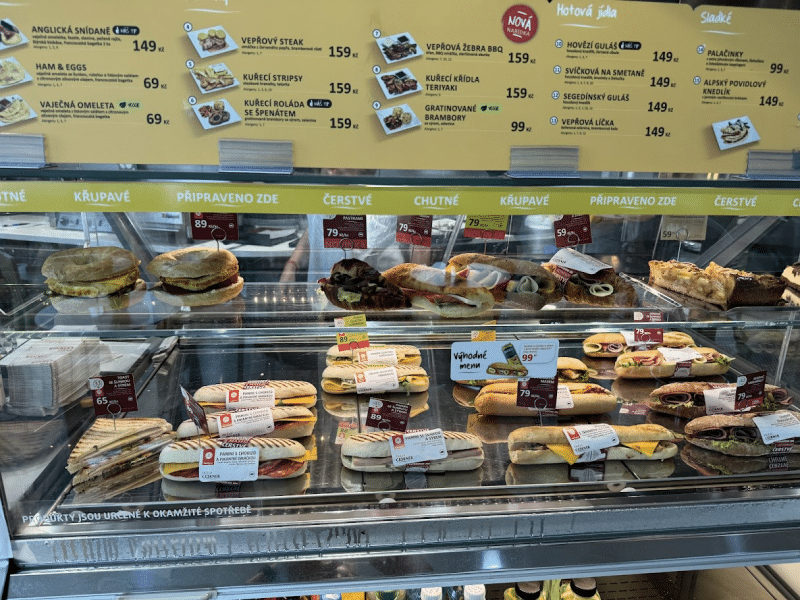
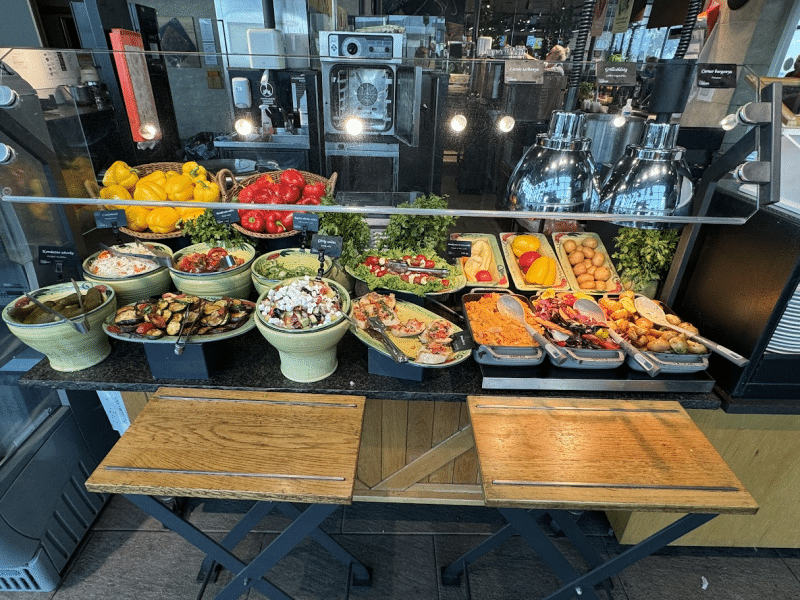

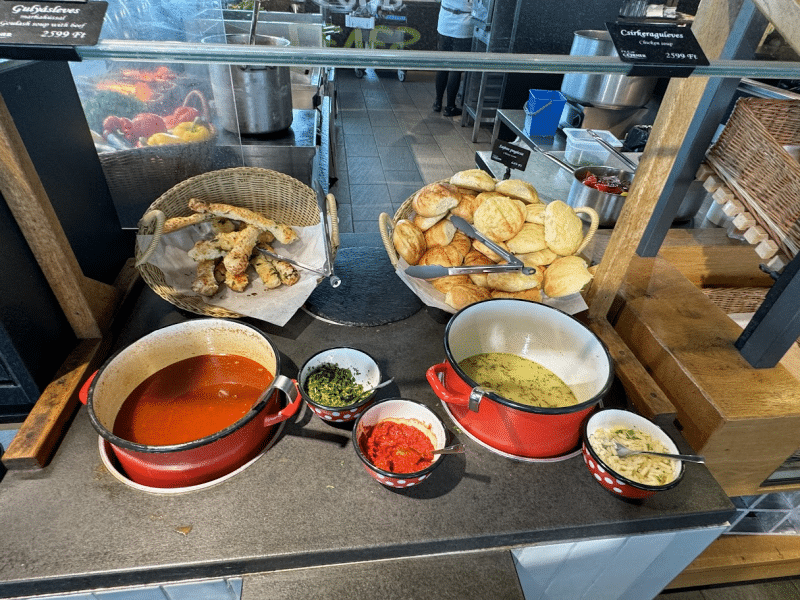

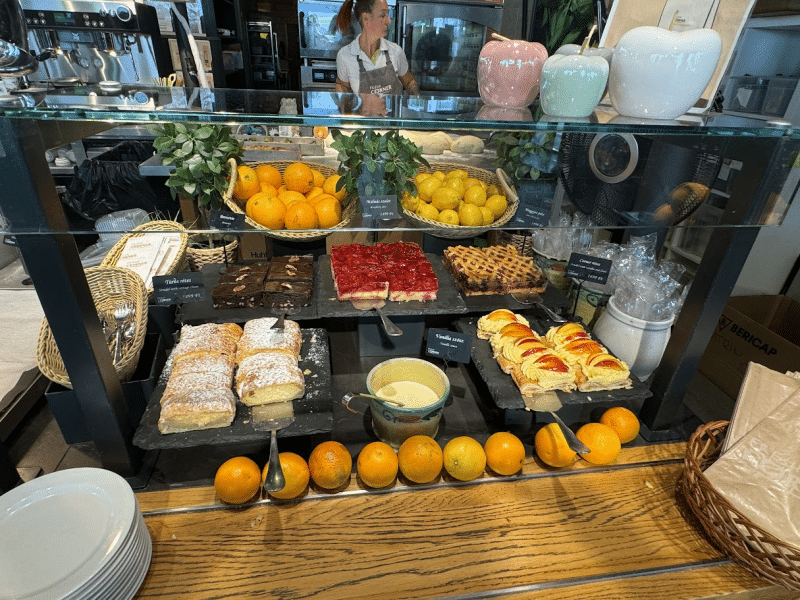
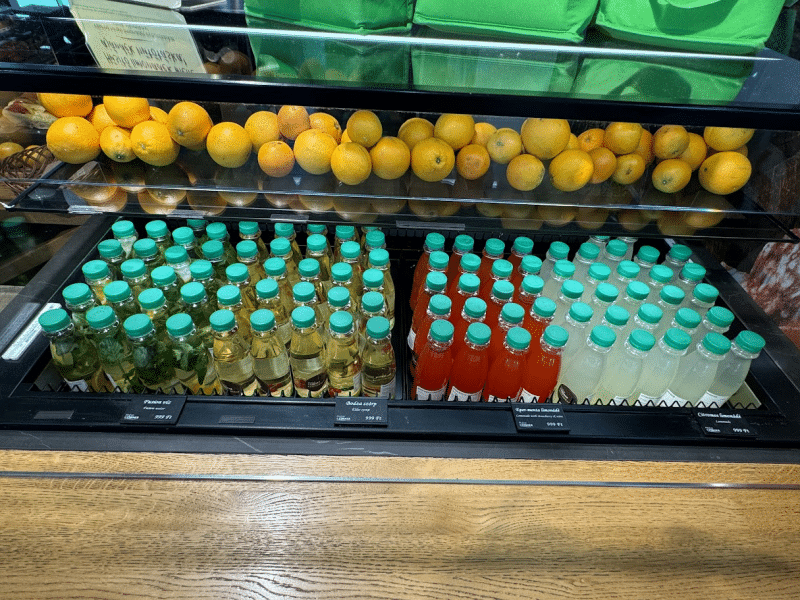
Our lunch break was at a gas (petrol) station with a shop and restaurant. At the recommendation of the guide, we enjoyed a bowl of Hungarian Goulash, and after lunch bought an ice cream. We were informed several times that goulash is a soup and not a stew! Our food cost 6,500 Florint for Linda and me, but that was only $18 or $9 each, far cheaper than we would ever pay at FirstWatch back home, where the minimum cost would be around $16 each.
As our guide keeps telling of life in Hungary, I keep thinking of the challenges the community had to live through before, during, and after World War II. It had to be a struggle for the population. Victor Orban, is the current strong man of Hungary, and Donald Trump’s hero.
I found it impressive to see the wind turbines and solar panels showing that Hungary is serious about global warming and its investment in green energy.
Today is the first day of school for the new school year in this country and explained some of the challenges on the road in the cities. As I understand it, the 18-wheeler trucks are kept off the road over the weekend to allow families to travel. With today being a Monday, the trucks were in full force and accounted for the large traffic volume on the thoroughfares. To add to the challenge, something spilled on the road for the northbound traffic, and they were stopped causing a 10-mile (16-kilometer) block and backup on the other side of our road. While looking at this mess, we saw a very large statue on a hill of a bird with swords in its talons.
Viking has no plans for their guests to slum it on these trips. We booked into the Corinthia Hotel with 425 rooms and landed a room on the 5th floor. It is magnificent. In many hotels, this would be considered a suite with a bed, lounge area, bathroom, and loads of cupboard space. The room provides a robe, slippers, and a coffee machine. Only two power outlets were available to us, and our adaptors were critical. We have more than sufficient outlets for all our electronic gear. Our first order of business after unpacking is to go on a local tour of the surroundings to get orientated.
While having dinner sitting on the street side, a motorcyclist came roaring past in what I guess was at least 60 mph (100km/hour), hotly pursued by three traffic police cars with their sirens blaring. So, we had our entertainment for the evening.
Tonight is a relaxing evening, and we will be up again tomorrow morning for a four-hour tour of Budapest. By the way, our hotel is located on the Pest side of Budapest. They were two cities, Buda and Pest, combined as one city years ago, separated by the Danube River.
Our afternoon tour today consisted of an hour-long walk around the block with a device stuck in our ear to hear the tour guide. I was irritated that I could not hear too well, but the presentation was high on history and pointing out spots where we could eat. Along a short stretch of road, there were twelve restaurants alongside each other, half on the one side of the road, and the rest on the other. I was so fascinated that I went back and counted. We went to one recommended by our tour guide around the corner. Prices are ridiculously cheap, the total cost of 11,661 Florit, or $34, or $17 each!
The yellow taxis in Budapest charge 440 Florit/kilometer, translated to $1.24/km., or $2.00/mile. On the topic of vehicles, our tour guide said that the price of a new car was about 24 million Florent or about $70,000. Can this possibly be correct?
We got a call from the agent we booked our trip through, to inform us that our flight home had been canceled. The original one was due to depart at 6:20 am, and the new flight was at 5:15 am, so that sounds like we need to be up at 3:00 am to get a ride to the airport and check in on time.
Day 6, Tuesday, September 3, 2024, Corinthia Hotel Budapest, Hungary
My best news of the day is that I woke early, showered early, and in this fancy hotel, they have a bathroom scale that informed me I had not put on one once in weight. It was not from the lack of eating but maybe from all the walking. I logged as many as 17,000 steps in a day on occasion.
I am not impressed with the Wi-Fi in the hotel. The signal is so weak I cannot check the balances on my credit cards, but I see that we were charged $56 by the hotel. I assume this is a provisional charge just in case we bill anything to our room, and this will be reversed when we check out of the hotel. When we check out tomorrow, Linda plans to complain because the air conditioning in our room appears not to be working. You can adjust all you want, and nothing happens.
One of the pleasures of staying in these fancy hotels is the way your every taste is satisfied. The buffet breakfast today had everything that you could ever imagine, including Champaign. We had the choice of fruit, cereal, cold meats and a variety of fish, any style of egg, bacon, sweet bread, and the lists go on, there is a variety of coffee, fruit juices, and more than I could ever eat in such a short time. We elected to eat in the atrium, but naturally, you could eat inside the restaurant as well. The hotel has six floors in two sections with an interleaving walkway. Just had a local drink, Melange, a latte with honey requesting a cold option.
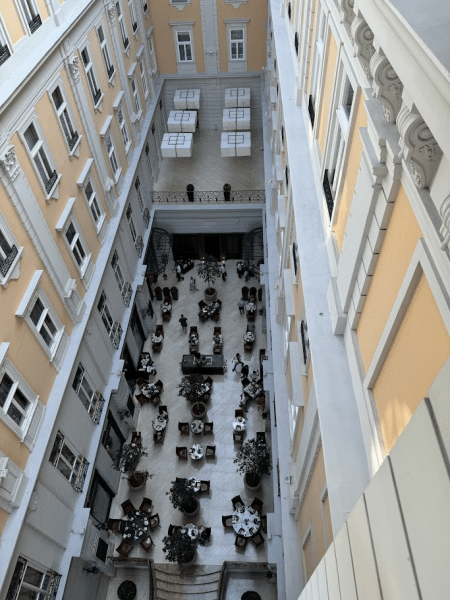

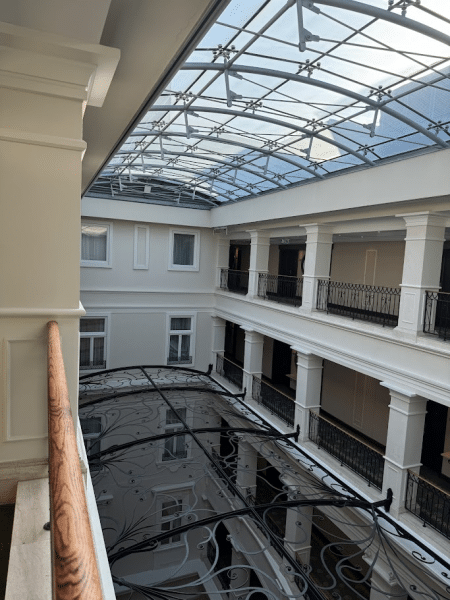
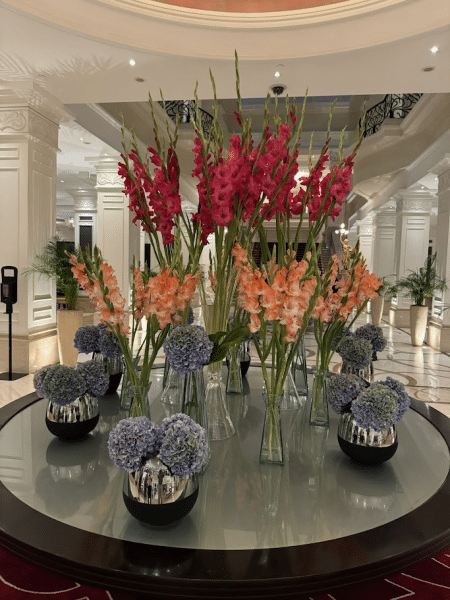
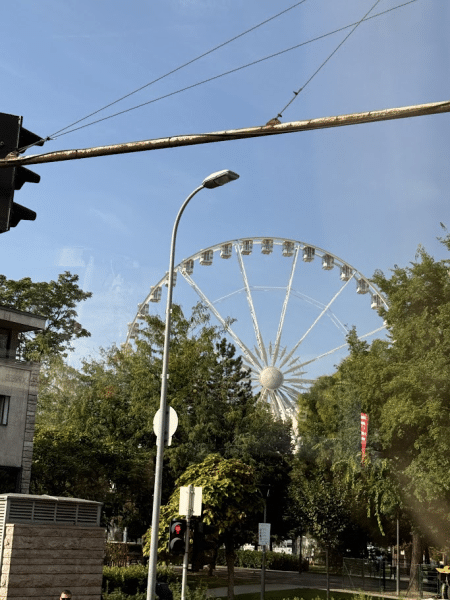

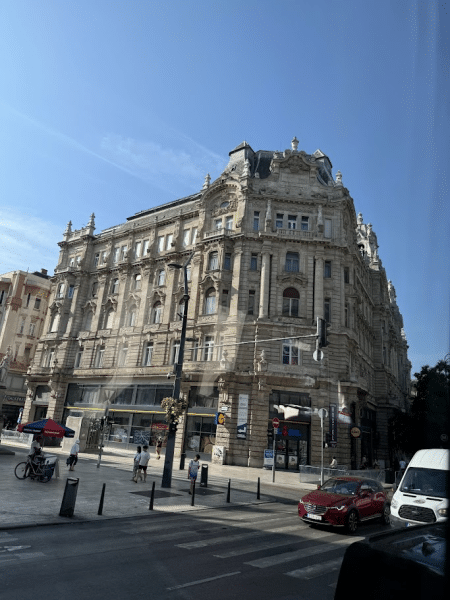
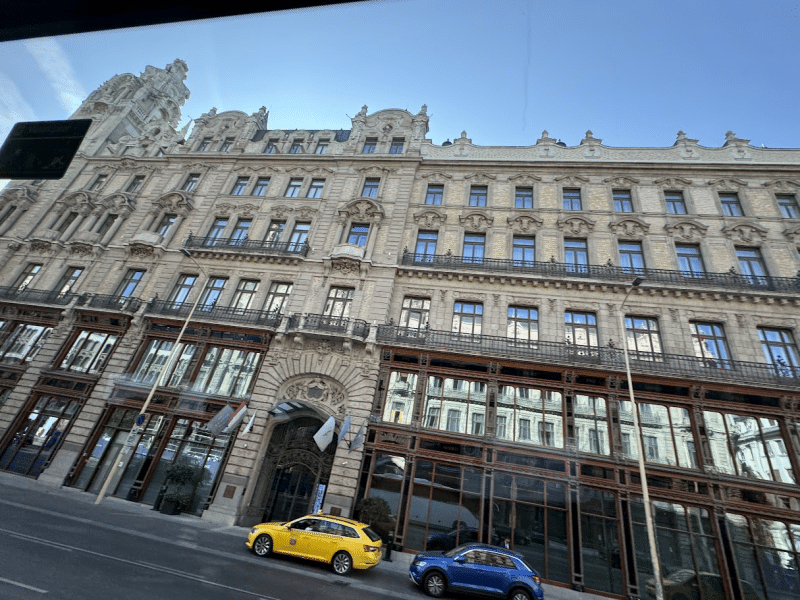
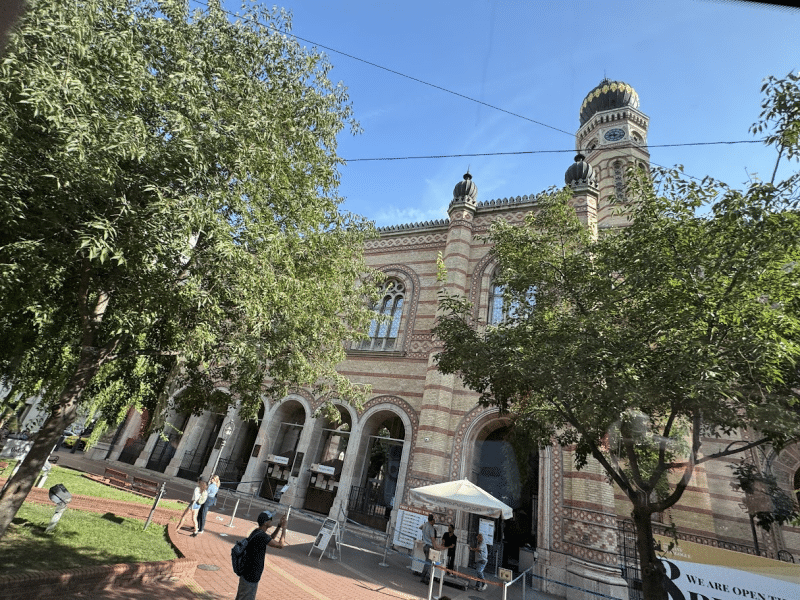
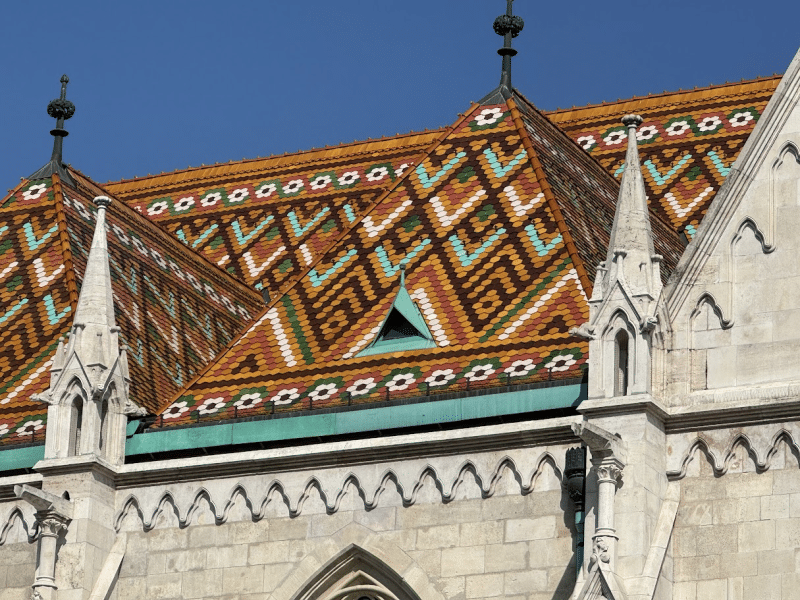
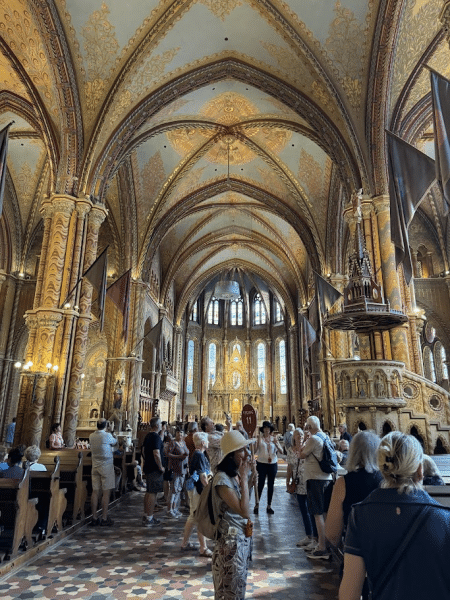
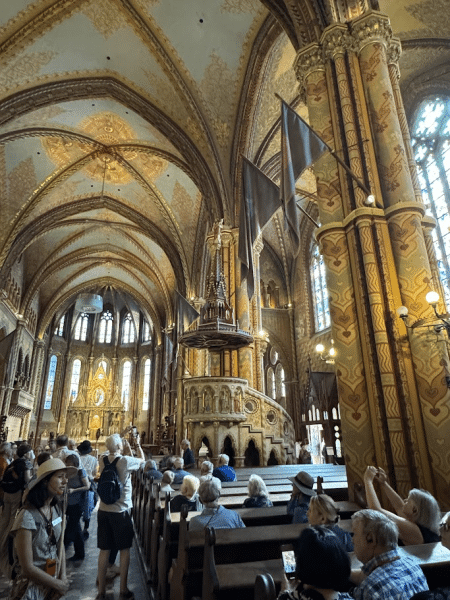
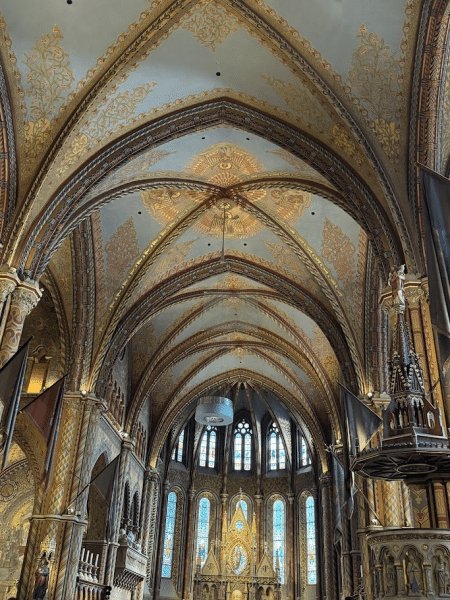

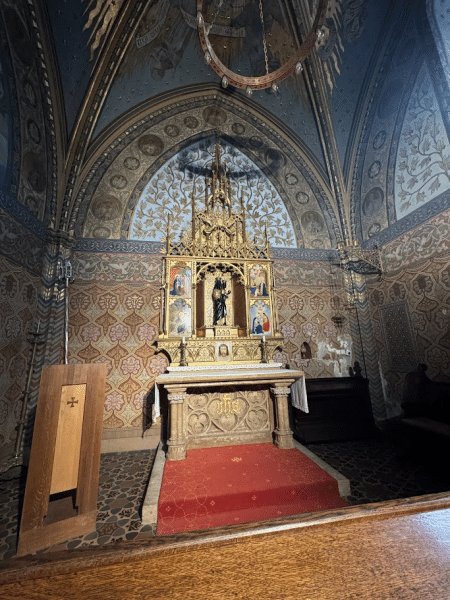
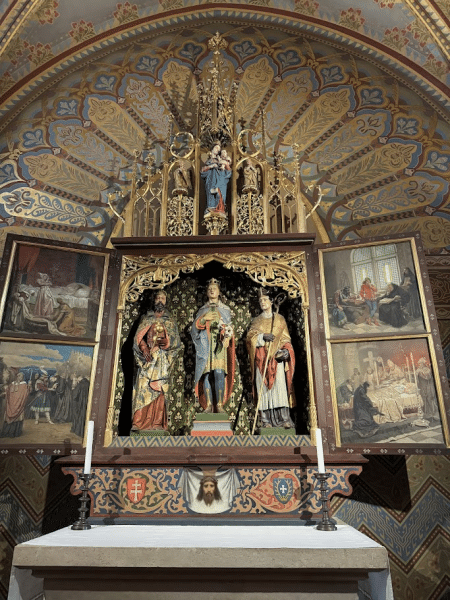


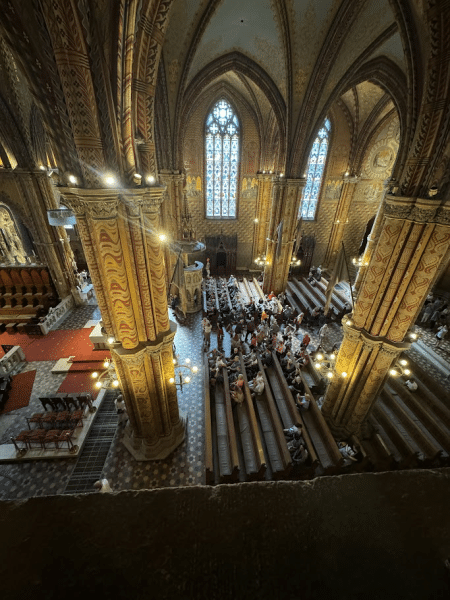
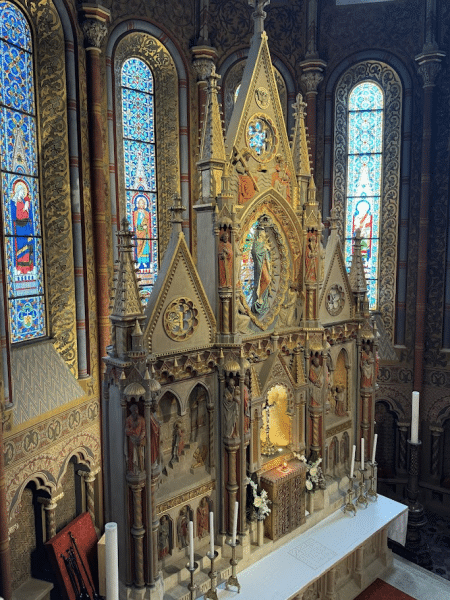
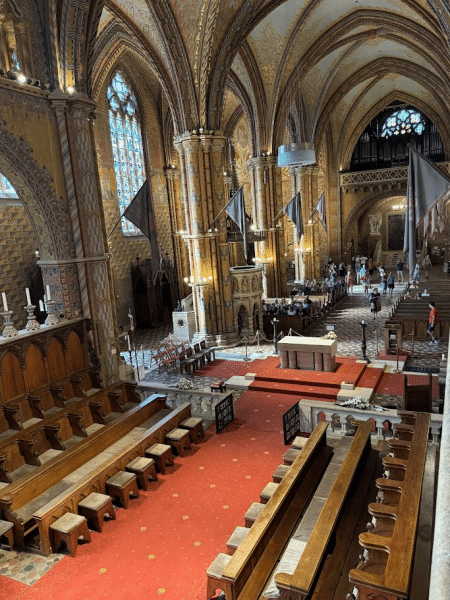
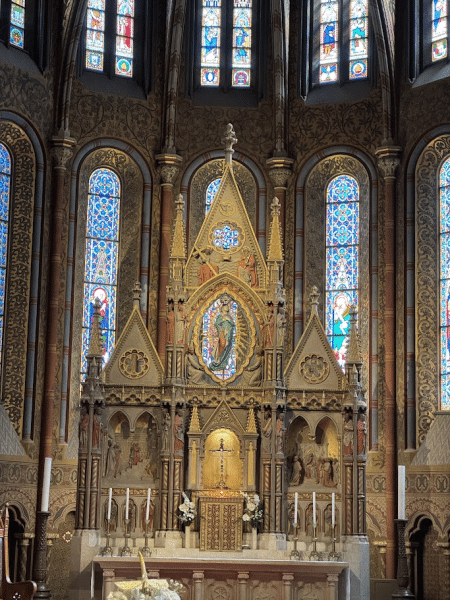

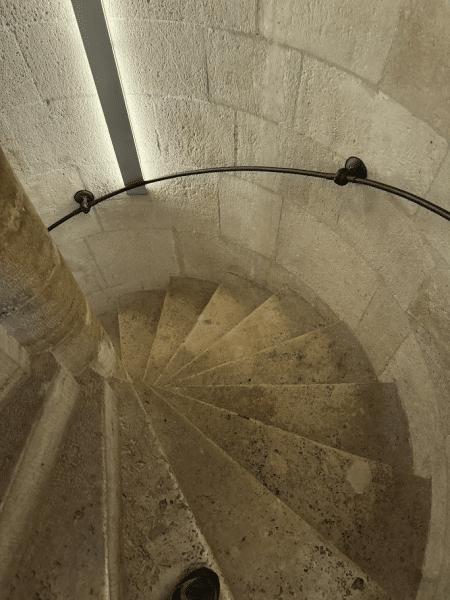
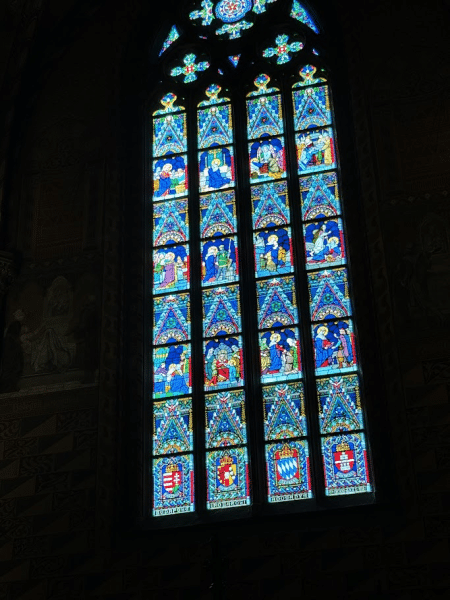
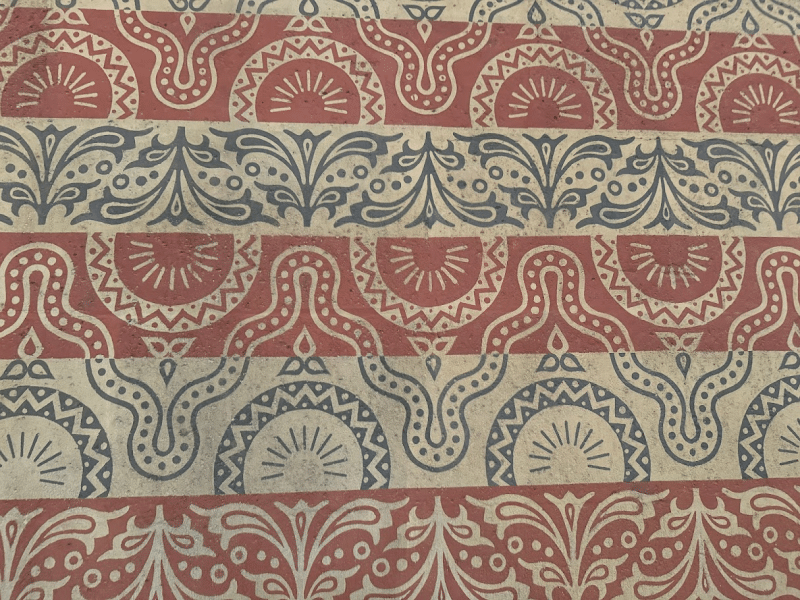

Our morning started with a tour of Buda and Pest. This included visiting the Saint Emeric Chapel, and the Matthias Church. Later, on our own with the Brink’s we visited the Dohany Street Synagogue, the largest in Europe and the second biggest after the Synagogue in New York City. We were told that of the 129,000 original Jews in Budapest, 80,000 were murdered, with only 15,000 living in the area today. Most are known as 2-day Jews, who only attend Shabat on the two holy days of the year.
We had a delightful dinner at Mensa Etterem Es Kavezo which also came highly recommended. The waiter was a delight. He has worked at this restaurant for four years and was more than jovial. He told us that he invested US$50 every month into the futures market to build his nest egg. He has a 90/10 split with the company he invests through. He pays them 10% of his winnings but could also lose it all if and when the market tanks. All investments are on the New York Stock Exchange. Frankly, despite the risk, it was great to meet a young man thinking about his future. All we know is that his name was R Tamas.
Tonight, we have to pack for an early start in the morning. Our luggage must be outside our door by 8:00 am.
Day 7, Wednesday, September 4, 2024, Viking Ullur, Day 1, Budapest, Hungary
I was very impressed with Osama Munzier, one of the Viking staff, from northern Sudan who joined the company 6 years ago. Has 2 degrees and two diplomas, in architecture and finance. He worked in the architectural field before joining Viking. He plans to move to the Middle East before year-end. The situation in Sudan is a disaster and he could never go back. Speaks 3 languages. He says that there is no way to get permanent residence or citizenship in Hungary.
I was up at 6:00 am to shower, went to breakfast early, and checked out the room by 10 am. After breakfast we walked around the city, returning at 10 am to board a bus that took us downtown to be within walking distance of the ship. We had Coca-Cola’s at a cafe then boarded the boat at noon.

On our walk to the town square, we saw a van that lost a front left wheel forcing the driver to pull over to the side of the road. A few minutes later there was a loud explosion as the tire burst. Within minutes two police vehicles arrived on the scan to inspect what took place, so we had our morning’s entertainment.
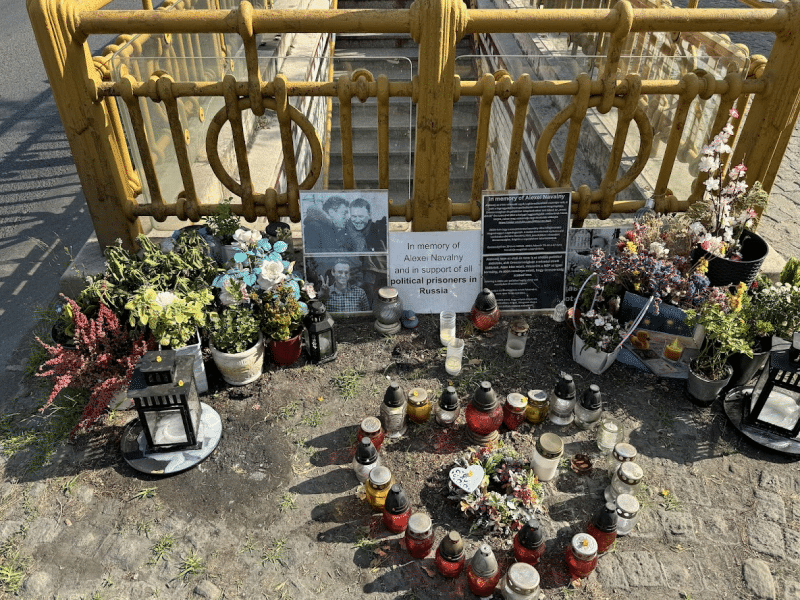
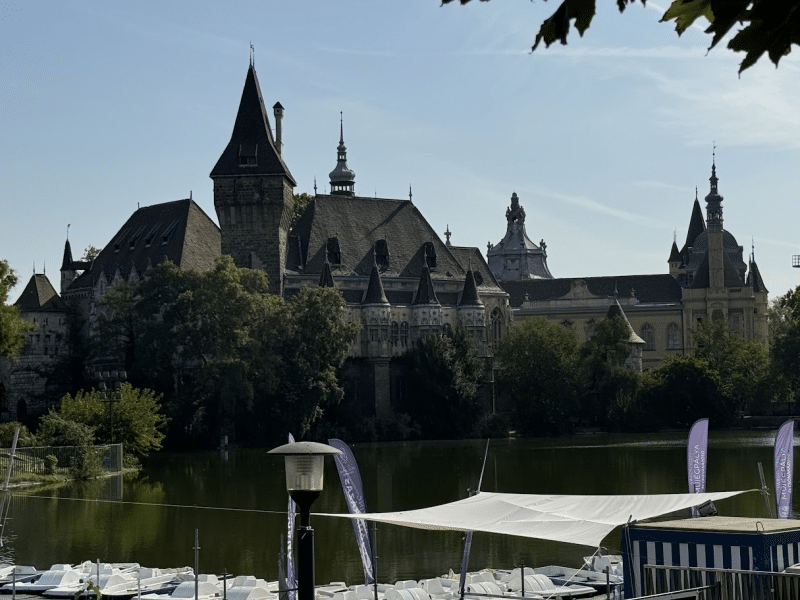


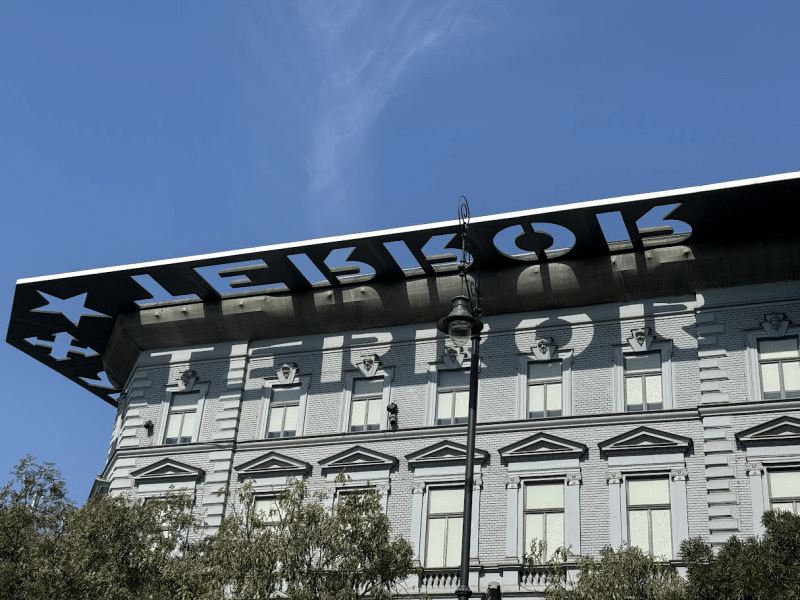


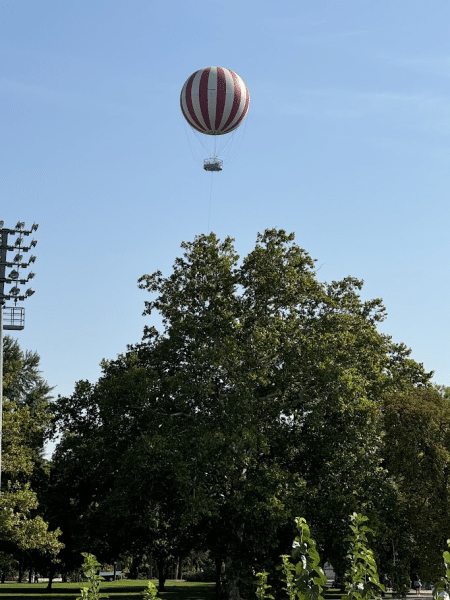
Some of the other sights from our early morning walk. Please note the first photograph, a memorial to Alexei Navalny, and all Russian prisoners.
Updated December 29, 2024, with photographs from Facebook.



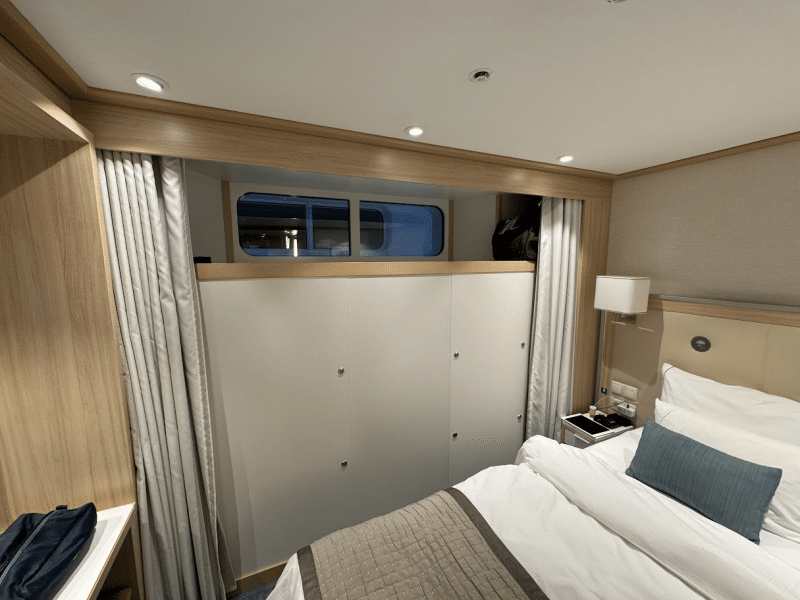


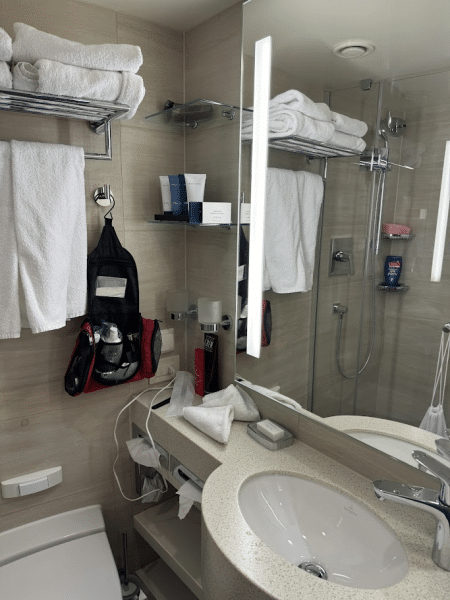

We got to our staterooms to find our luggage waiting for us, unpacked everything finding a place for our clothing and toiletries since this is our home for the next week. Please respect the fact that we elected not to travel first class, so we had a basic stateroom that more than met our needs. We watched several television programs in our room to learn about safety measures and understand all the information that guides us daily. We had lunch, then attended a presentation including a rehearsal for a safety exercise where we had to return to our stateroom, collect our life jackets, and report back to the lounge to check in, allowing the ship’s crew to verify that we were all accounted for.
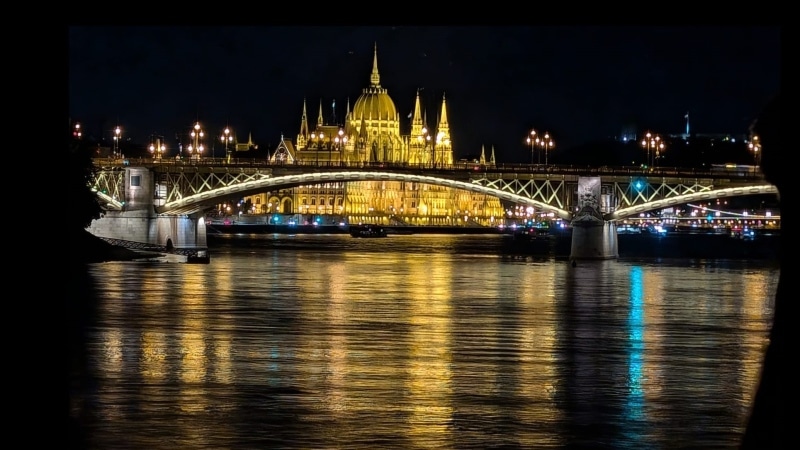
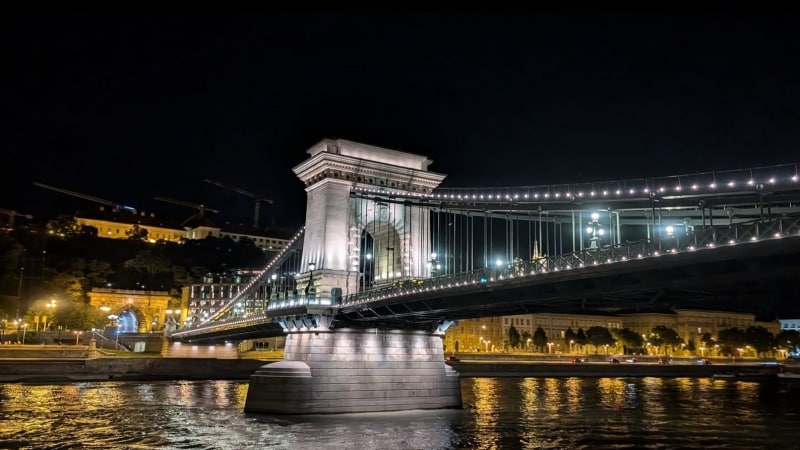
We took our time to wander the different decks to get a feel for our new home. At lunch, we met a couple Karen and Ken, who joined us again for dinner. We had dinner with them and the Brink’s for most of our meals for the duration of our cruise. The boat departed at 7:00 pm, traveling up the Danube away from the city to turn around so that we would pass Budapest at nighttime. During this time we were on the top deck on a beautiful night in perfect weather. We were getting a running commentary about the places we passed. We were given a very informative talk about the city and its many landmarks, with historical perspectives included. We returned to our room at 10:00 pm to prepare to get sleep for an early start in the morning.
We logged on to the ship’s Wi-Fi, but this has not been particularly successful as the signal keeps dropping. We debated if we would recommend to our children to take a cruise like this. Frankly, they should not think about it until they were in their 60s at the youngest. Vikings rules forbid anyone going on a cruise unless you are 18 years of age, but with most people on the cruise at retirement age, or older, it would not be enjoyable for a younger set.
Day 8, Thursday, September 5, 2024, Viking Ullur, Day 2 Kalocsa, Hungary
We were up at 6:00 am to shower, have breakfast, and be ready for our excursion departing at 8:30 am.
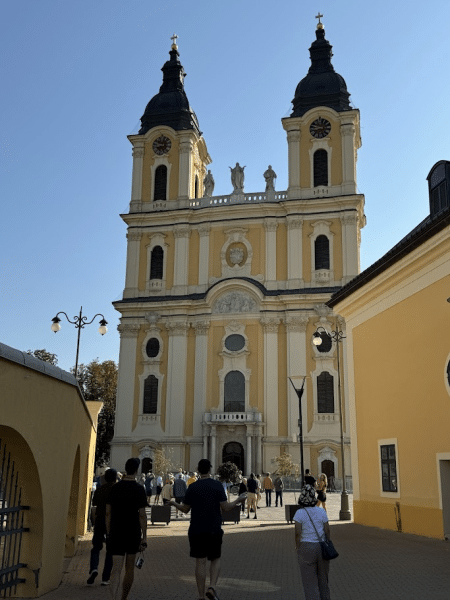
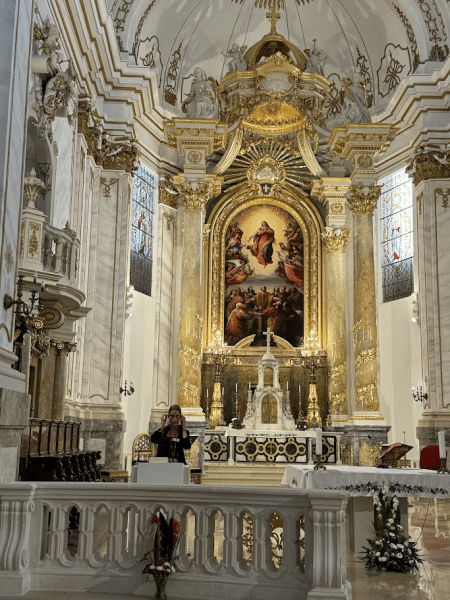
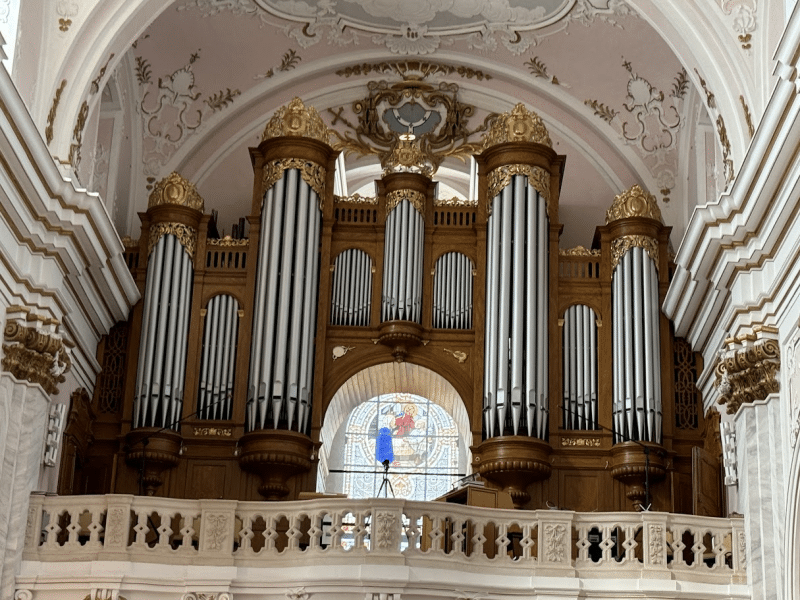
Organ recital, 1 minute 10 seconds.
What a great tour we had today. We started off visiting a magnificent church, and to me, interestingly, it was in such a small town. Without a doubt, the highlight of the day was an organ recital in the church, it lasted about 25 minutes, with the organ boasting 4,960 pipes providing a magnificent sound. Next, we went to a farm, where we had a demonstration by Hungarian cowboys on these amazingly trained horses. They were like Spanish bullfighters combined with our real cowboys. The history of what and why the horses are trained the way they are is another story going back in time.
Cracking the whip, 2 minutes 51 seconds
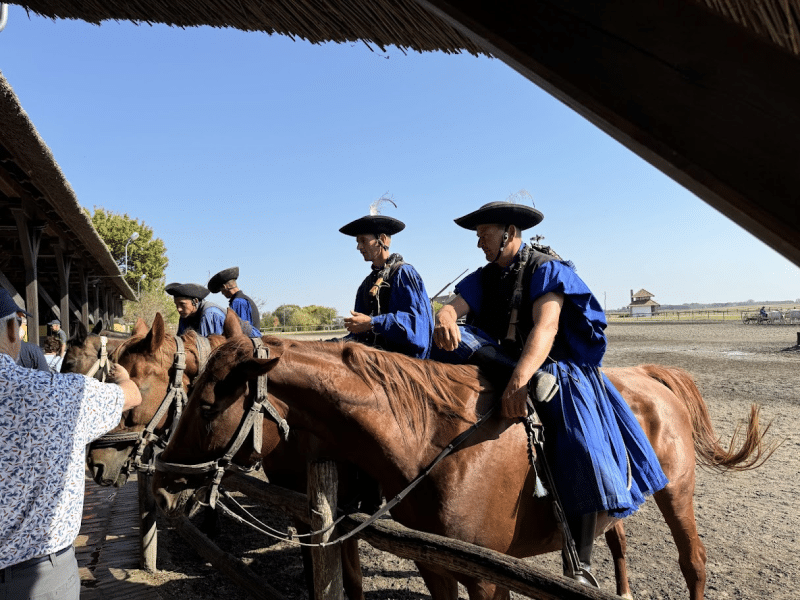

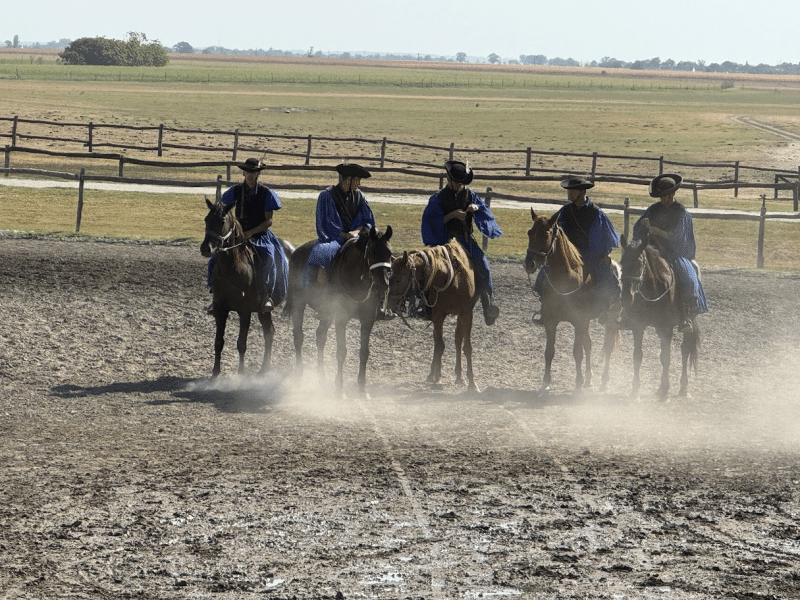
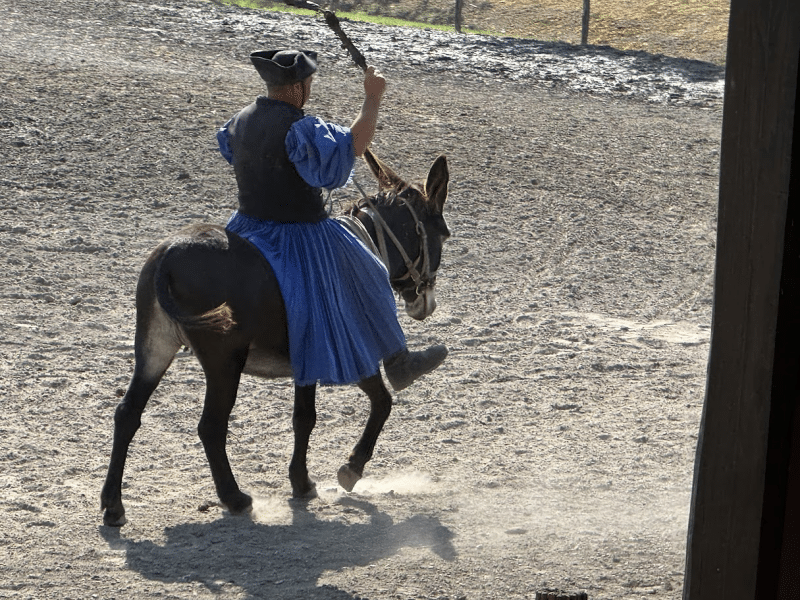

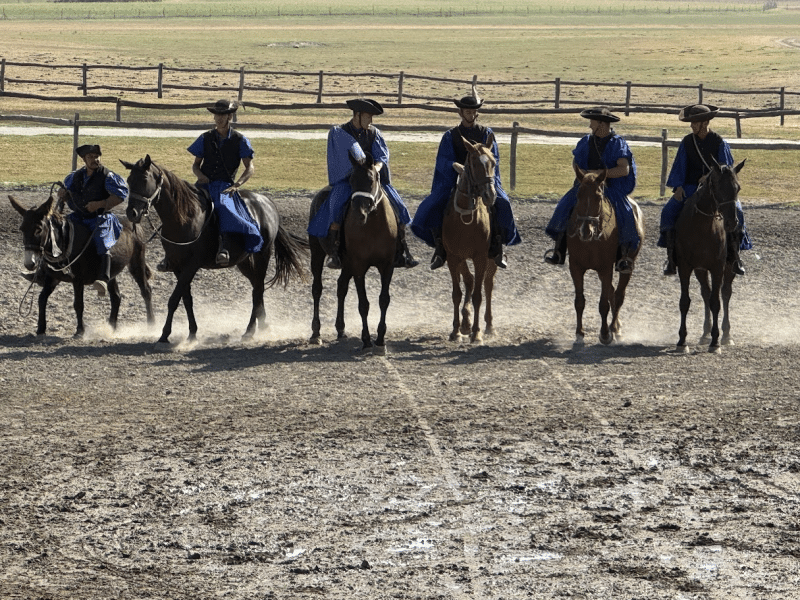
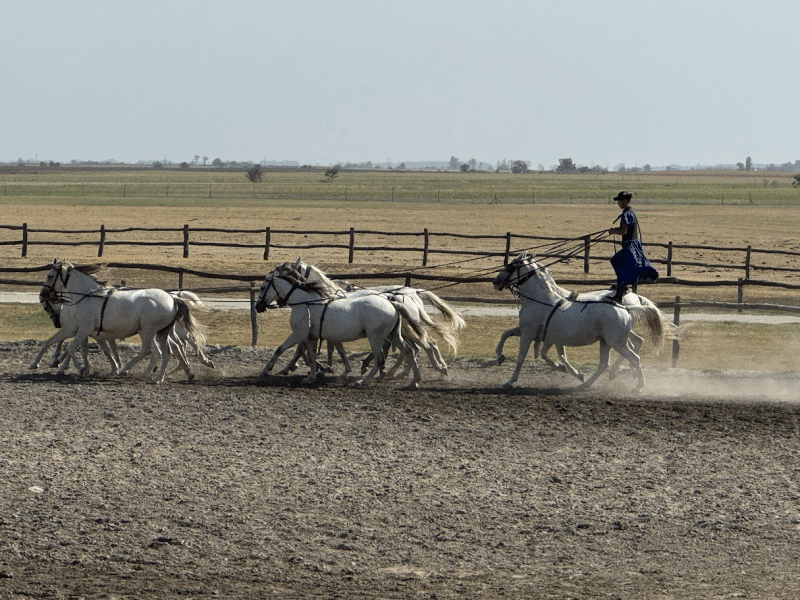


The horse show was varied, starting with the riders showing how they cracked their whips and did not impact the horses.
Horse and buggy ride 17 seconds.


The afternoon was unusual in that we sat on the top deck of the ship to relax and watch the ships as we sailed to the next stop. Along the Danube, we saw numerous small communities with what appeared to be very few homes. The entire section we sailed today had trees, possibly a forest lining both sides of the river.
We elected to have a light lunch at the very top of the ship. By light, instead of eating all four courses, we had a salad and dessert, together with a Coca-Cola and water. Frankly with the amount of available food, we could easily eat ourselves to death before the week is over.
The waiter at our regular lounge table was telling us he only gets two days of vacation a year, he comes from Bali and works 10 months a year.
The young guide who accompanied our bus this morning was sharing quite a bit of her personal life experiences. She went to the local Catholic School in Karlosca, and wrote a national exam required by all students in Hungary, during her final year of high school. This appears to be much like the national matric exams we wrote in South Africa. She earned excellent academic results that ensured she could attend university in Budapest. The 4-year education is free provided she works for four years in Hungary over the next twenty years, or she must repay her tuition. One cute aside, when we exited the church, she pointed to her mother waving at us from a nearby apartment building.
She shared with us some local traditions. At Easter boys spray girls with perfume, and this includes her father, brother, and cousins to fulfill their dutiful role. I asked her about her boyfriend, but she said, alas, she did not have one at this time. On the first day of May, boys decorate the trees outside their girlfriend’s home, and the one with the best decorations gets the biggest praise.
On the drive home, we saw a tall statue the Chronic 8, with many hanging mirrors. With the passing traffic, the statue plays a melody but sitting in an air-conditioned bus we could not hear or enjoy the melody.
A message that was repeated by several guides is that Hungary is a place where people find many reasons to drink alcohol and usually prefer a high percent alcoholic drink and another consistent message is that goulash is a soup, and not a stew as we refer to it in Western countries.
Linda was so impressed with this young lady, at only 26 years of age, that she rewarded her with the biggest tip we have given thus far.
We did learn that paprika, aside from its flavors, is extremely high in vitamin C and has been used for medicinal purposes since the 1700s. The area we visited today is known as the center for growing and proving paprika. Linda and Jenny supported the local industry by purchasing all three flavors: hot, medium, and mild, to take home for their use and possible gifts. Later in the day, they attended a paprika cooking lesson.
While sailing south on the Danube, we had to keep moving positions to avoid getting sunburned as the river took turns necessitating us to find more shady spots under the awnings on the ship.
As we sailed south, we left the waters of Hungary and sailed with Croatia on one side of the Danube, and Serbia, on the other. Our mobile carrier, T-Mobile got so confused that they welcomed us to those two countries simultaneously.
One of the treats sailing with Viking is that they make the dinner special by, among other choices offering each night local specialties as well. For tonight’s dinner, the entrée was Hortogbagyi Palacsinta (chicken crepe, creamy paprika sauce), for the main course Balkan Style Moussaka (layers of potato, egg & minced pork), and for dessert Somloi Galuska (traditional Hungarian trifle). Needless to say, the food was delicious, and what made it special, the serving sizes were small. Naturally, wine, beer, or spirits are available, as well as tea or coffee.
Day 9, Friday, September 6, 2024, Viking Ullur, Day 3, Osijek & Vukovar, Croatia
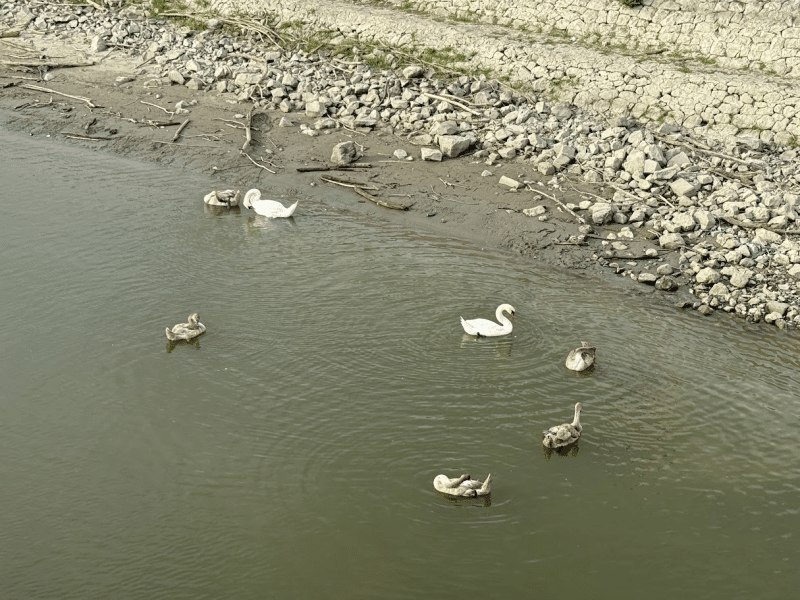
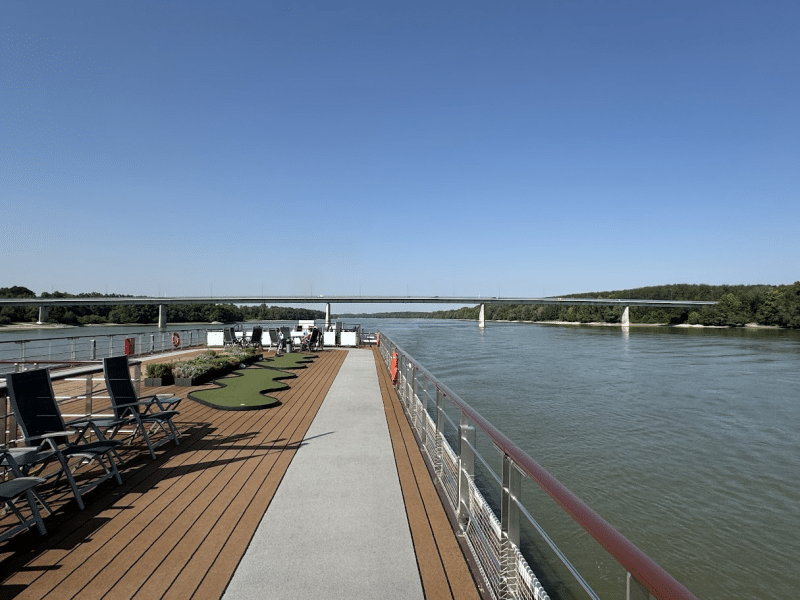
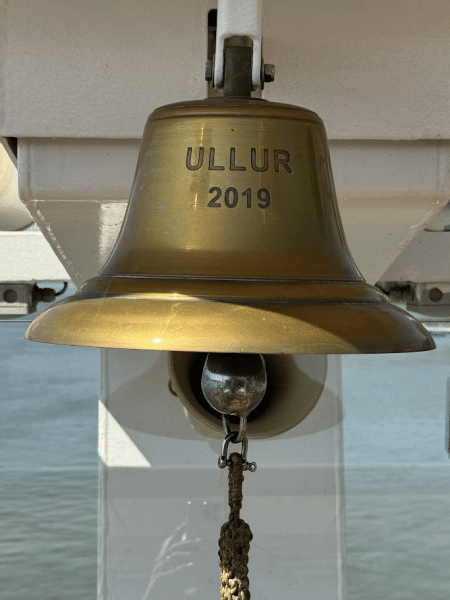
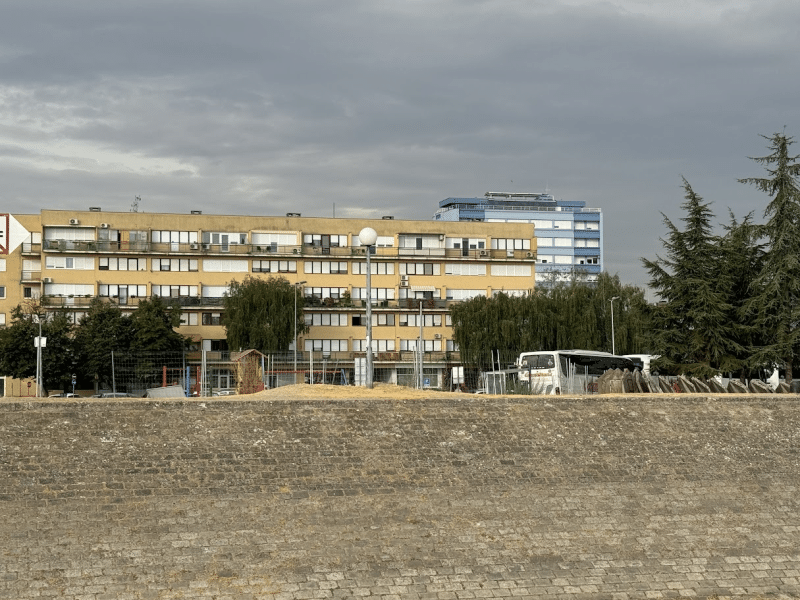
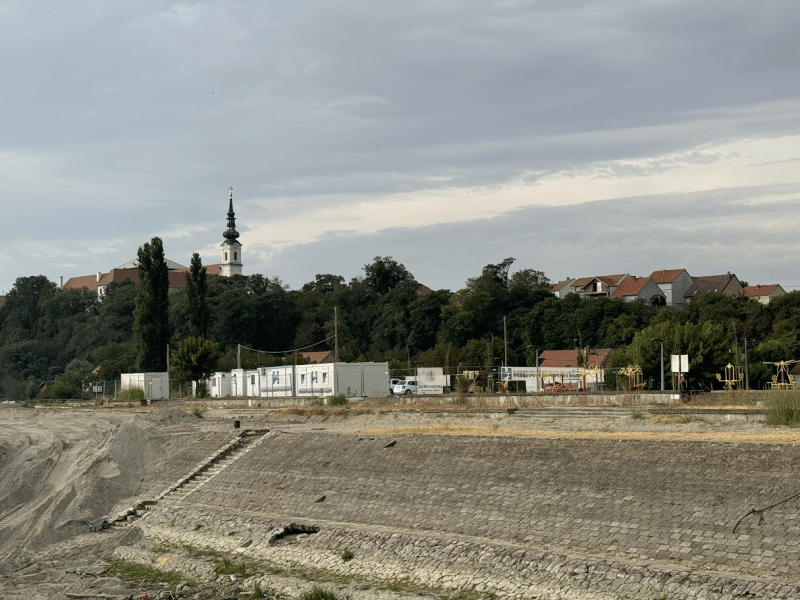

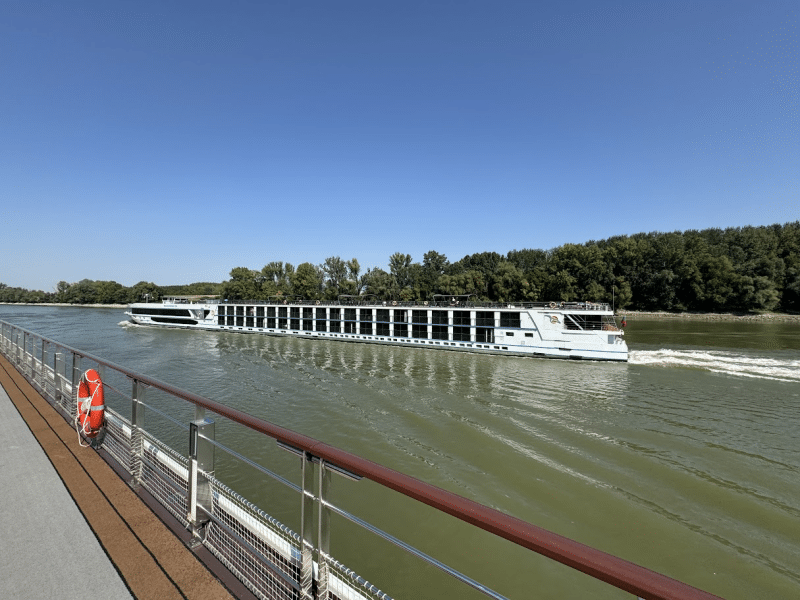

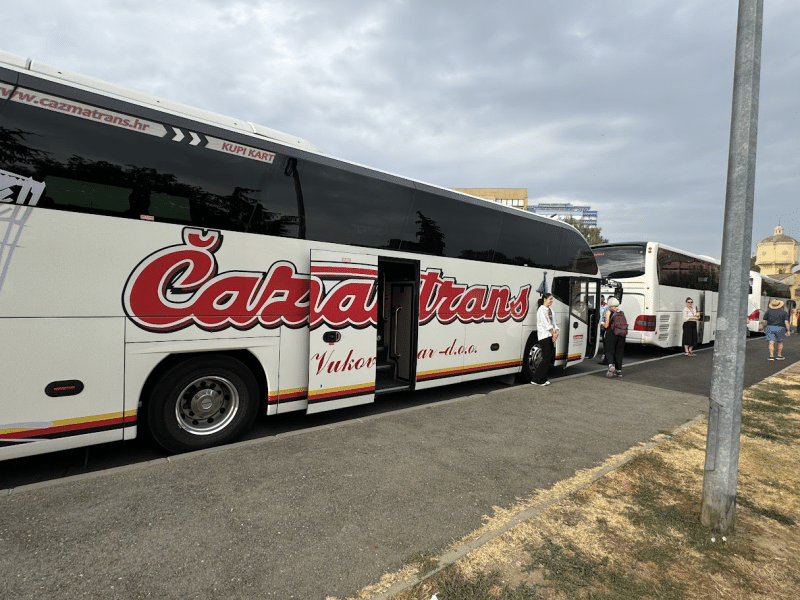
I woke up today to find there was no hot water in our shower on the ship. I discovered warm water in the hand basin. We later learned that there was a mechanical fault impacting the hot water to a few staterooms, but a technician was on hand to repair the problem. The boat had docked during the night, so we were ready to take on the day. While walking around the ship early this morning we saw a family of seven swans swimming alongside the ship and delightful scenes on the shore of the Danube.
We enjoyed our breakfast and again we appreciated the friendliness of the waiters. We were advised that after our morning tour, we would be able to walk to the nearby town to see what a Croatian city has available.
I saw a card in our stateroom stating that it was cleaned by Rosalia, a young Romanian woman we met on our first day aboard the ship.

Today’s outings covered the cities from where we docked in Vukovar to Osijek, and Bilje in Croatia.
We docked in Vukovar on the Danube in Croatia. We had a delightful young girl as our guide. Her English name was Karla. Karla grew up in nearby Osijek, with a degree from Budapest in tourism, economics, and business. She was delightful and had such a sweet comical sense of humor. Ninety percent of the Croatian towns were destroyed in a war with the Serbs from 1991 to 1997. It is unbelievable to be in cities once behind the Iron Curtain. We are feeling blessed to have enjoyed the trouble-free life we have experienced. Yet she was so proud of her country and her city. It was quite an emotional experience.
When you read history books, novels, or nonfiction novels about war, I can attest that it is often an interesting and informative read. However, when you meet a 76-year-old man and his 75-year-old wife who have been married for over 50 years, now with children and grandchildren and have lived through the war, you experience a very emotional personal story.
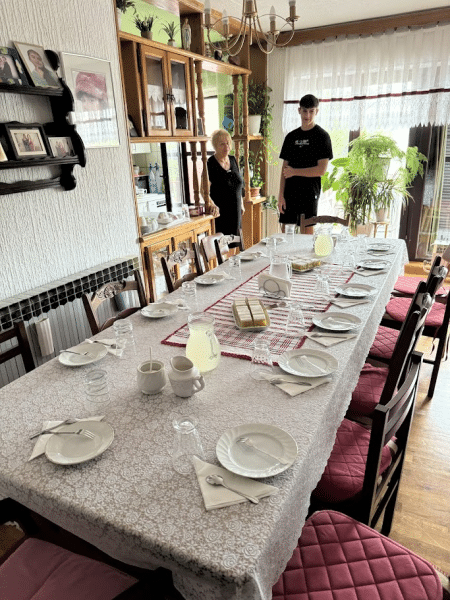

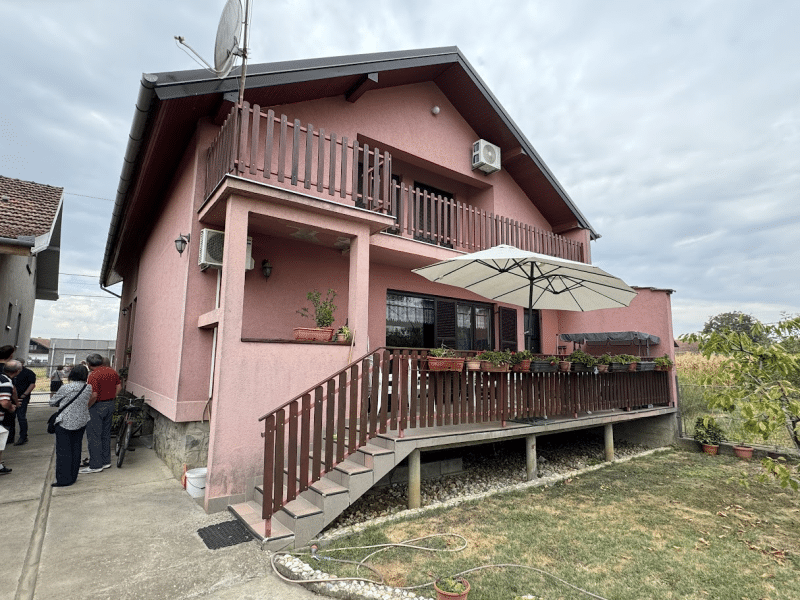
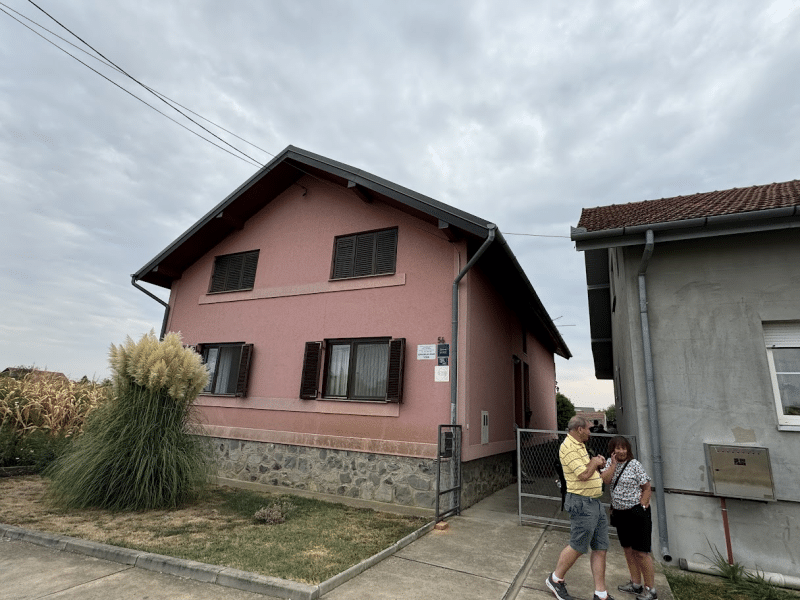

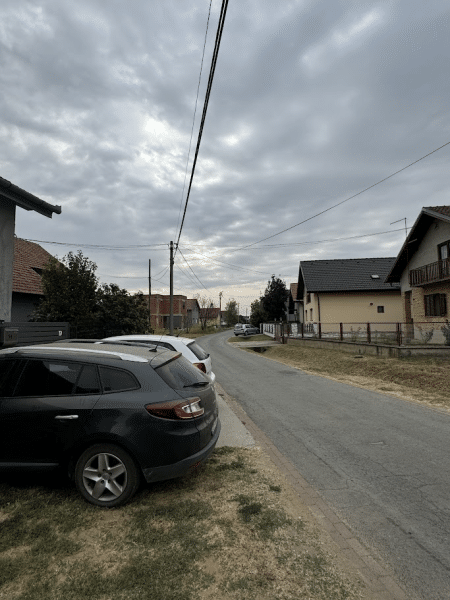
We traveled by bus to Bilje, about a 20-minute drive from Vukovar, and a dozen of us were invited into a family’s home. The couple did not speak English, so we had a 16-year-old high school student, Loca, provide translations. Loca learned English at school and from video games and social media. He translated as our hosts spoke to us and answered our many questions.
It was a lively and informative visit, and the spread they served was delicious. The couple provided tea, Turkish coffee, Elderflower juice, and lemon cake.
During the war, this elderly couple got kicked out of the house they had lived in for decades. For several years they lived temporarily in Austria as refugees while during the war their home was occupied by the enemy. The enemy removed doors and floorboards that they burned to keep warm in winter. Significantly more damage was done to their home.
Our day turned out to be much nicer than we could have hoped for. Four buses to the same places with four separate guides. A small town of 16,500 called Kalosca in Hungary. Started with a visit to an amazing cathedral with an incredible organ where we had a 20-minute concert by an amazing organist.
Piano recital and singing 1 minute 45 seconds
Then a cherry on top was this lovely young woman who sang us a few songs in the local church. Awesome voice. Ave Maria and a couple of other melodies. All in all, it was an emotional day.
Singing a cappella 47 seconds
We were able to shop for paprika which of course is very big here. We had a super young woman as our guide.
Quiet afternoon after lunch on the boat. We relaxed and watched the Danube go by. You can’t imagine the silence and lack of development along such a great big river due to these countries having been behind the Iron Curtain until 30 years ago. In an hour or so we should dock in Serbia and when we wake have another early morning excursion. Just as well as it continues to be very hot. This was a very sad war-torn part of the world, and not all that long ago.
Day 10, Saturday, September 7, 2024, Viking Ullur, Day 4, Belgrade, Serbia
We woke and docked in Belgrade with several warnings about their economy. We turned our mobile phones into airplane mode so that we would not be charged a fortune for roaming. We were also warned that if we draw local currency at an ATM, the currency cannot be used anywhere in the world except Serbia. The country does not like Euros or Dollars, but some businesses will accept credit cards.
It is a beautiful country, as we saw for ourselves, on the bus tour.
Each day we are provided with a “Viking Daily” a 4-page newsletter with the schedule of the day, and all sorts of facts and figures highlighting what we will see on our tour. It appears that Belgrade has had many different names over the centuries. The television in our stateroom is a mine of information about our daily activities, including a map of where we are, and where we are going. Aside from Viking information, they have popular TV channels such as CNN.
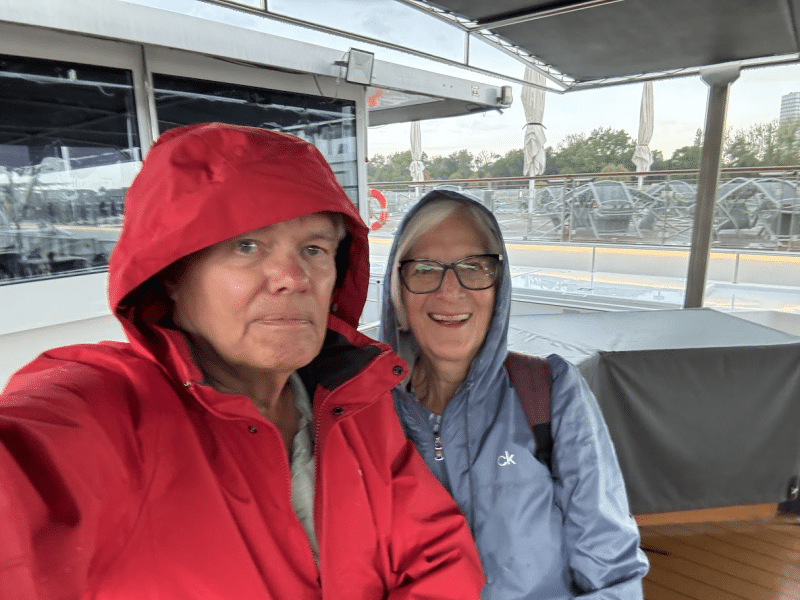
Today for the first time on our trip we were met with rain. Consequently, I purchased a very red Viking raincoat costing 119 Euros ($130.90). The rain did not last for more than two hours and did not impact our morning tour. Now I have a helpful garment to use at home on rainy days.
We woke to the sad news that Paul Casper passed away today. Paul had been in hospital for a while but was sad to hear of his passing. Paul was the husband of Linda’s cousin Dawn Casper. Many years ago, during the time we lived in the Johannesburg area, Paul and I drove to work together. Paul worked for a hardware store, and I worked for a training company. On the way to work one day, we were rear-ended while stopped at a traffic light. Paul got whiplashed and had to wear a neck brace for several days. The lady who rear-ended me was a teacher driving her husband’s automatic vehicle and was unsure how to stop the car. She thanked me for not getting out of my car and screaming at her.

Eastern Orthodox Church in Belgrade. 1 minute 4 seconds.
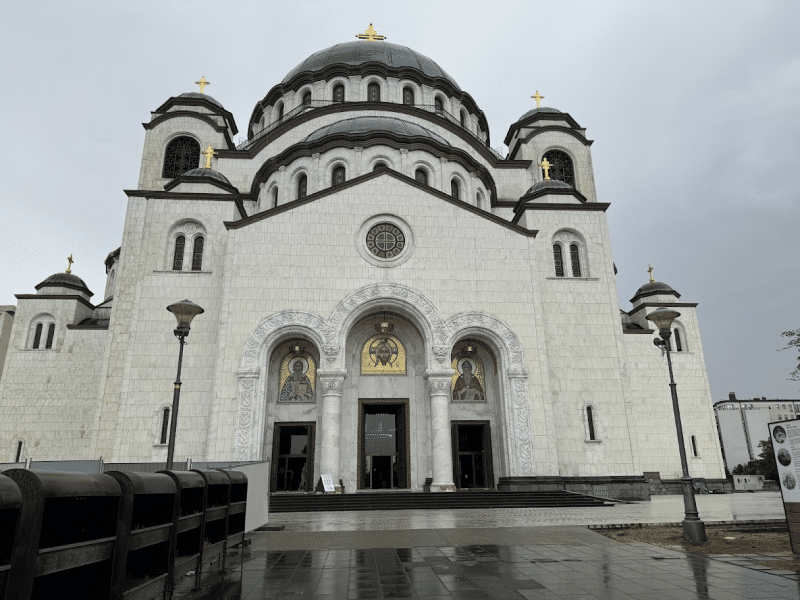


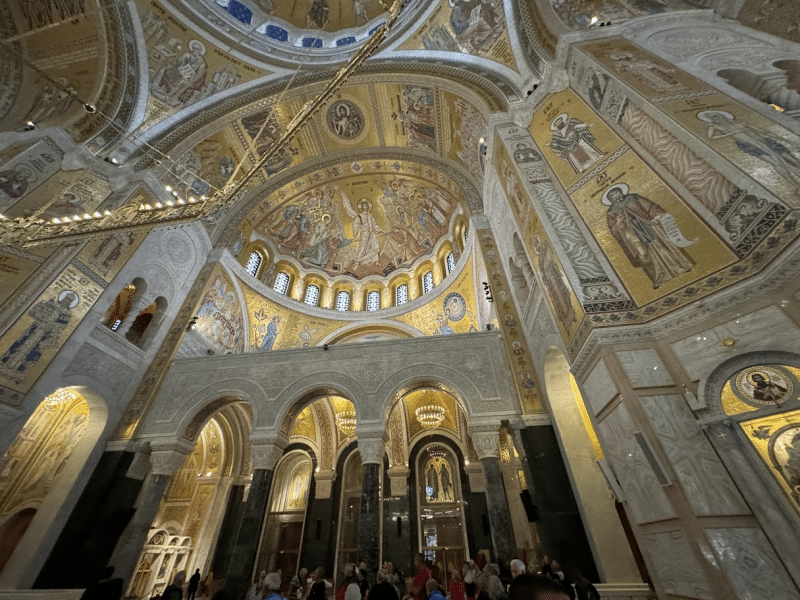

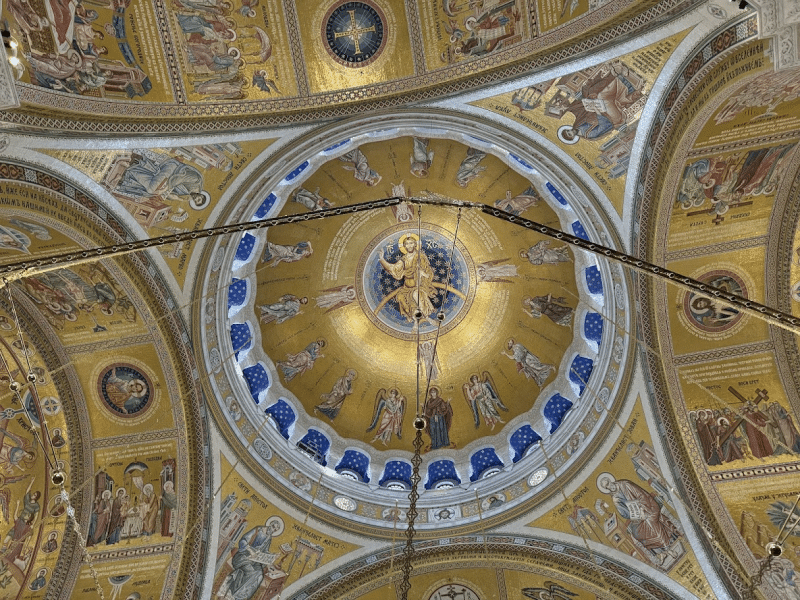
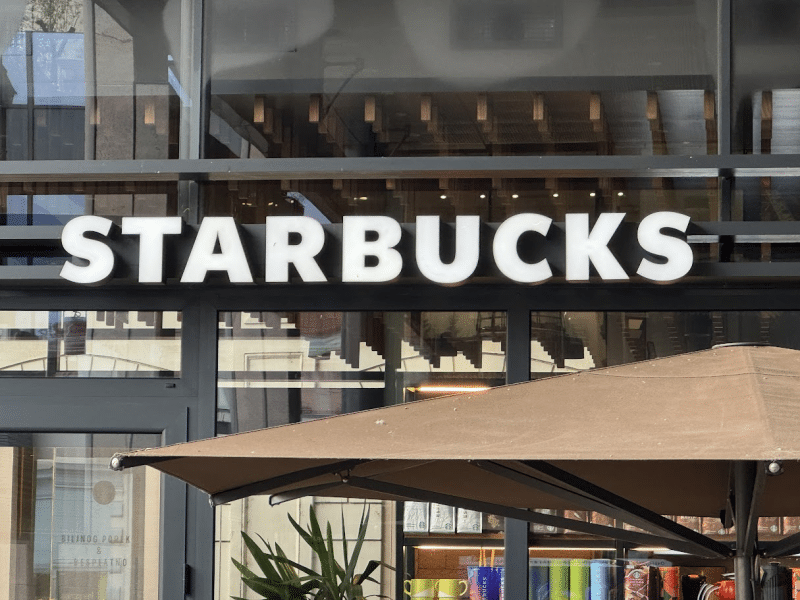
For our trip today, we were driven around Belgrade seeing the highlights of this city. We stopped at a shopping center and the first store was Starbucks or “CTAPBAKC” in Serbian. We visited the “Inner Fortification” going back to 1151. The Cathedral Church is extremely ornate, with standing room for 1,000 people for the hour-long service. It is an Eastern Orthodox Church with different rituals than a typical Roman Catholic Church. One rule was that men and women were separated each standing on different sides of the church.
One more time I need to recognize our luxury coach bus driver, Shasha, able to navigate these narrow roads during a never-ending traffic jam. Our guide was more than a walking encyclopedia with never-ending facts and figures about the community where he was born.
Lunch today consisted of cauliflower Parmesan cream soup, a Montecarlo Cristo sandwich, and a strawberry combo creme dessert. Each of the four of us selected whatever our pallets desired.
Melo and Eka 14 seconds
Lunch with Melo who hails from Portugal, and Eka hailing from Bali, provided their usual humor and great service.
It is not only a beautiful city but also a tumultuous history. A much bigger city so it didn’t feel as personal as the last two days. But some interesting sights. We just relaxed on deck this afternoon. Awesome Orthodox Church just finished in 2010. Building started in 1935 but with all the wars and conflicts and communism, it took all this time to finish.
We sat on the top deck after dinner in fabulous weather. It was fun to see the city lit up, especially the bridge over the Danube with its red white and blue lights. The ship was due to set sail at 10:30 pm and within 15 minutes we would pass the fortress we visited earlier in the day, and this time all lit up. There was even the possibility that they may have a fireworks display that did not materialize.
We had an interesting technical challenge. The crew warned us that we would be bouncing between Serbia and Romania each country in a different time zone. To keep our phones on the correct Serbian time, we had to set our phones to only take the time from Serbia, and take the setting off “automatic” to pick up location. It would be tough if we missed breakfast or the day’s outing.
Day 11, Sunday, September 8, 2024, Viking Ullur, Day 5, The Iron Gates
We went through a storm during the night, and after we docked, I could see the Danube had waves along the river. After my shower, I wanted to recheck the conditions and saw a boat tied up alongside our vessel. That was a reason to keep our curtains closed.

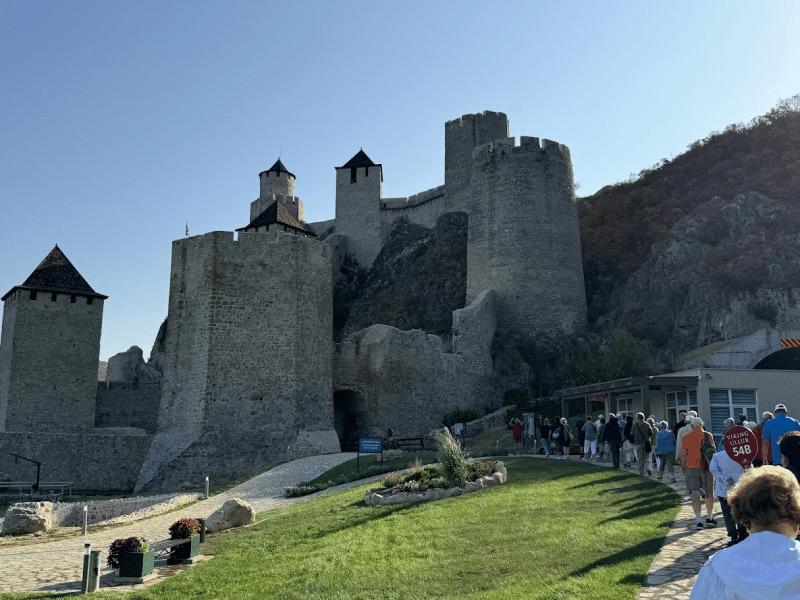
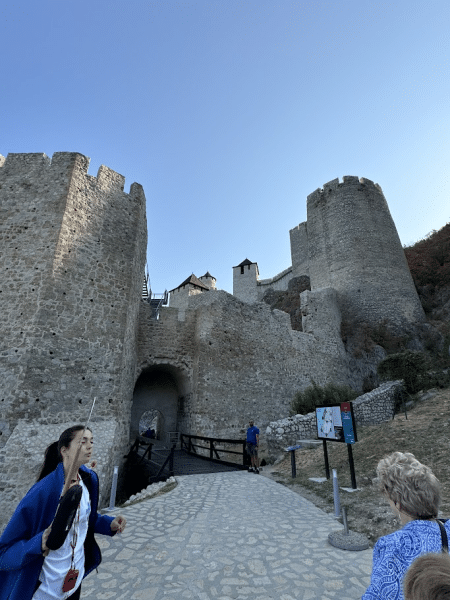
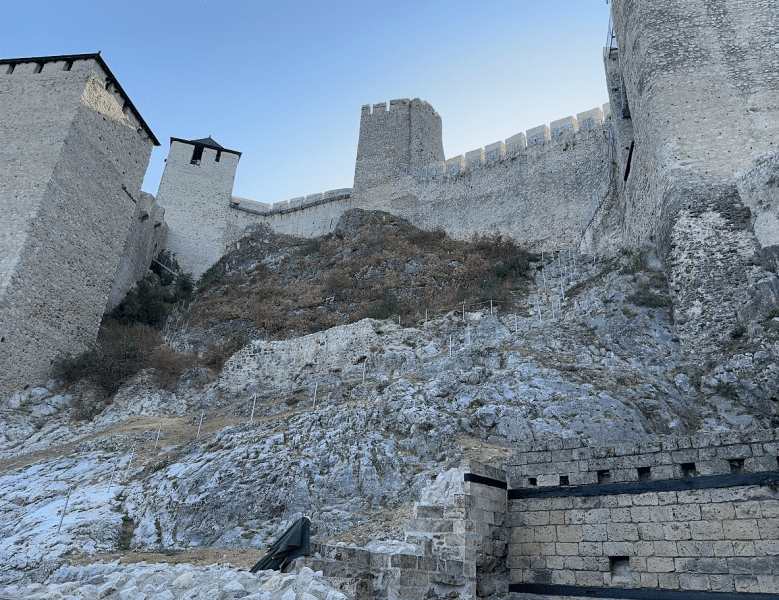


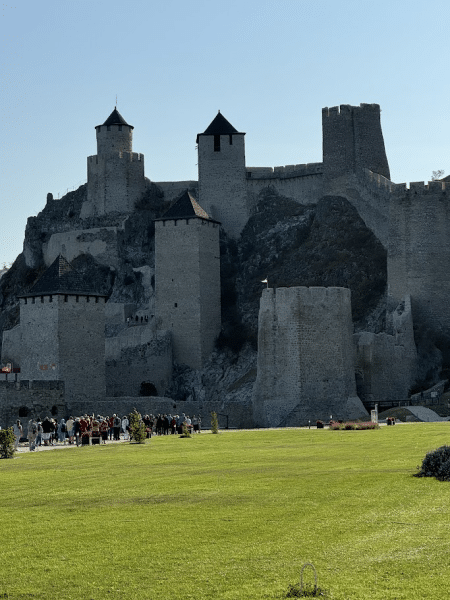
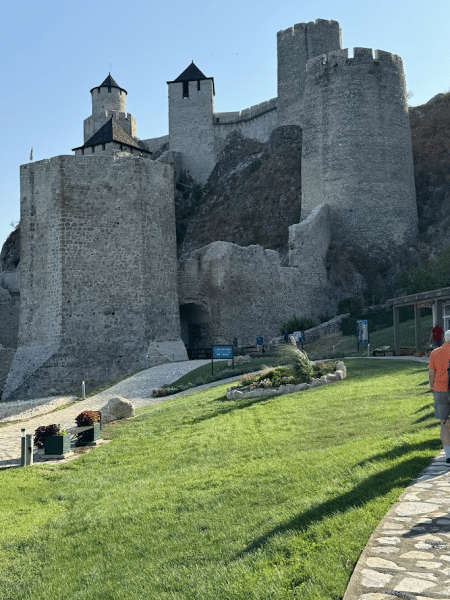


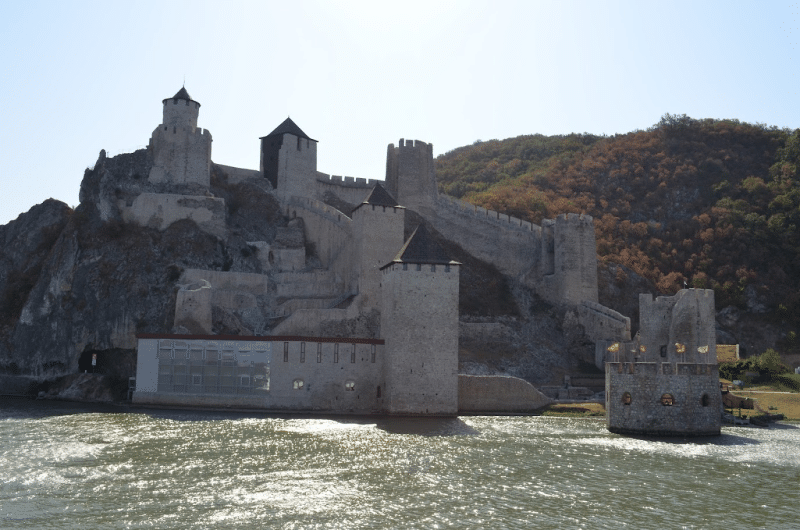
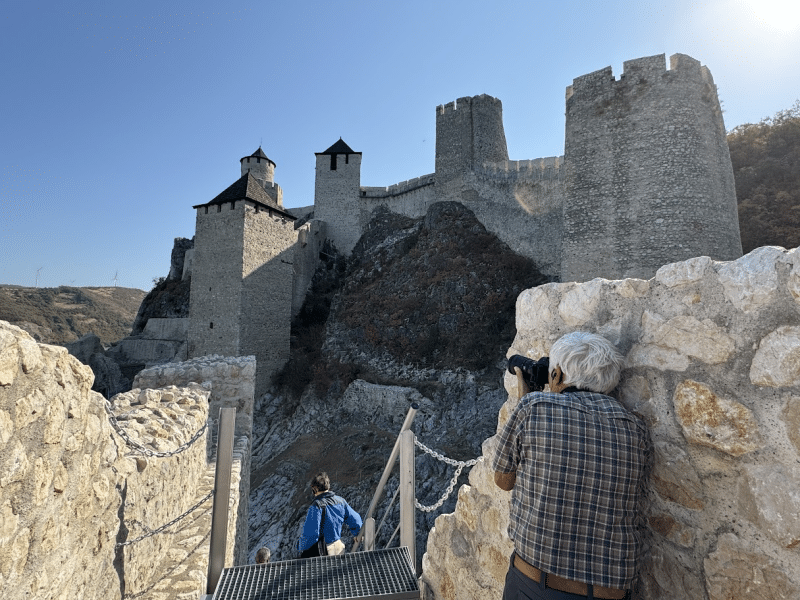
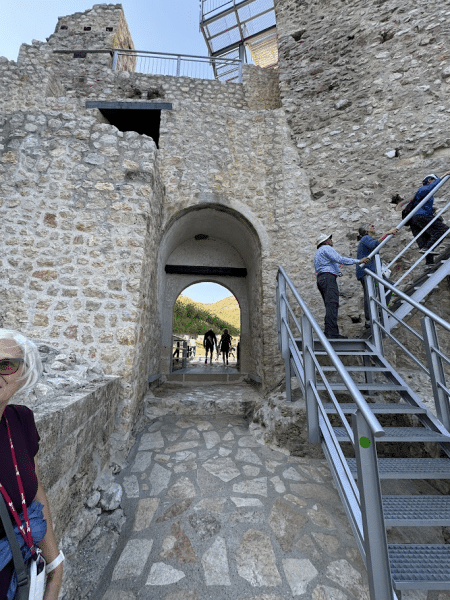
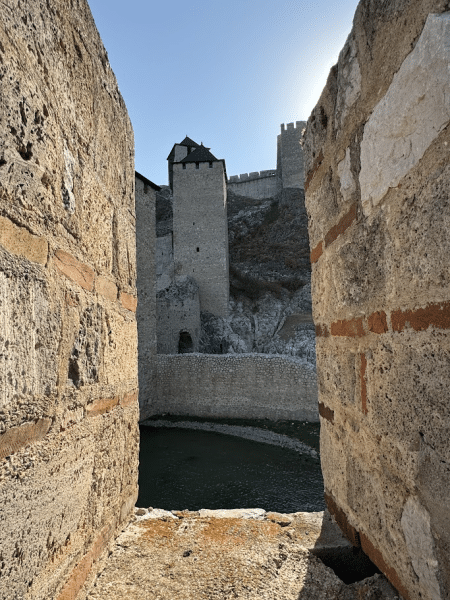
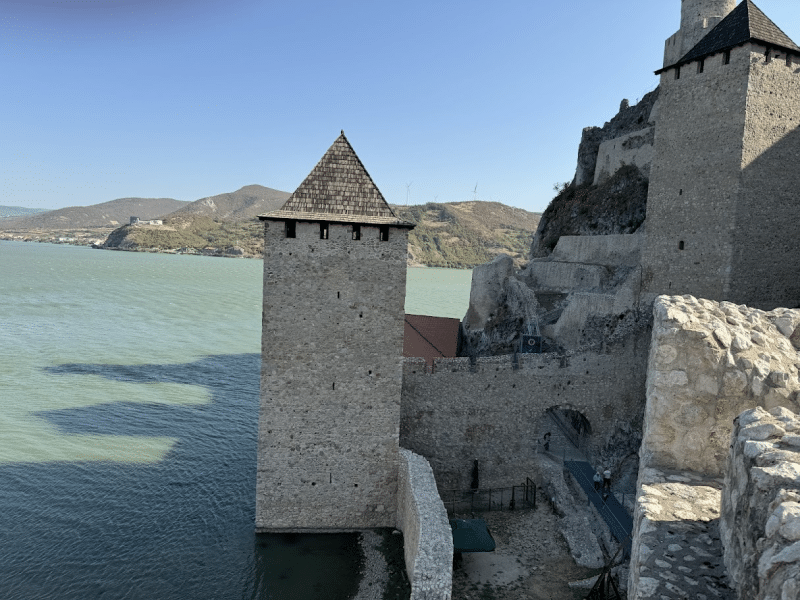
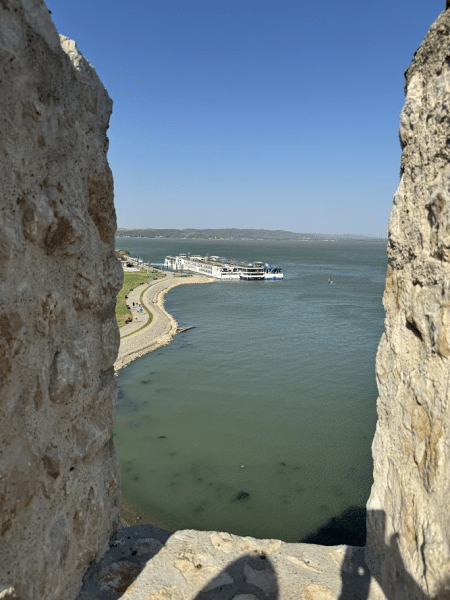


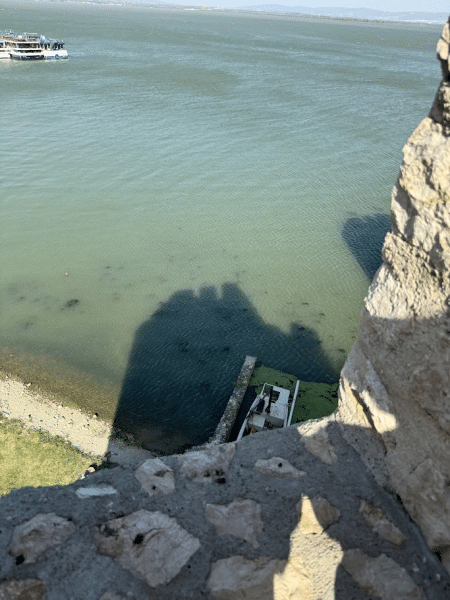
Today was a different day in that we had an hour-long tour from the ship to the nearby Golubac Fortress. I was very impressed with our young guide who spoke excellent English. She said she perfected her spoken word by watching television and reading the subtitles while listening to the dialect.
From the discoveries traced to the time of construction and the existence of the Golubac Fortress, the most notable are ceramic bowls, tools, jewelry, and coins. What stands out is a circular building used for baking lime mortar during the 14th and 15th centuries, which was the mortar used for construction.
The reconstruction of the Golubac Fortress complex lasted from 2014 to 2019, and the European Union invested over 8 million euros in the project. In addition to the works, extensive archaeological research was carried out, which led to discoveries, which will complete the knowledge about the history of this medieval fortress.
Going through a lock after the gates were opened. 1 minute 22 seconds.
If you watch the above 1-minute 22-second video above, please note the black walls on the left and right. That represents the amount of water that was pumped from the lock to allow the ship to get to a lower level to proceed along the Danube River.
By 10:00 am we started sailing again for Vindin, Bulgaria, with our first experiences of passing through two locks, implying that our arrival time was uncertain, depending on the number of vessels ahead of us. A treat was passing through the Iron Gates.
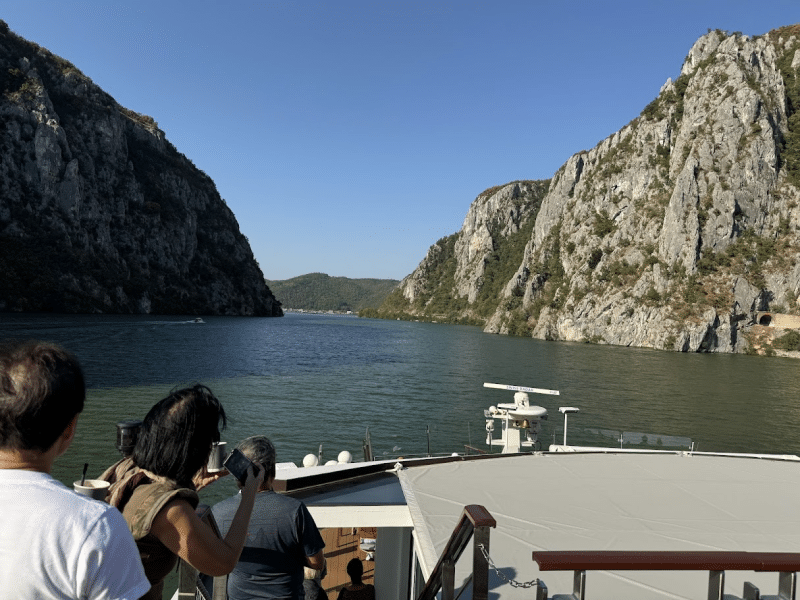


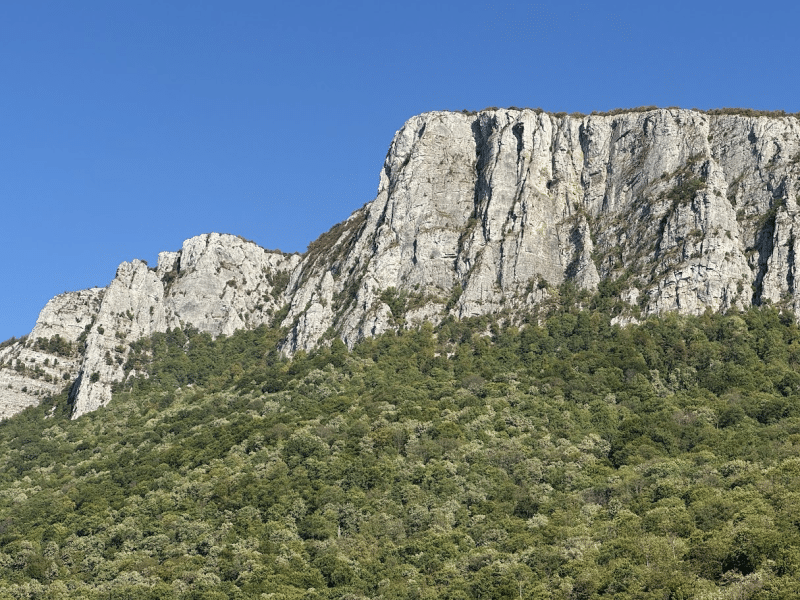

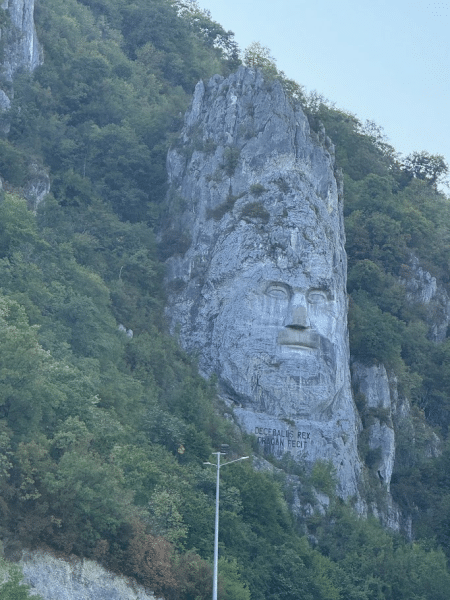


The Iron Gates is a gorge on the river Danube. It forms part of the boundary between Serbia (to the south) and Romania (to the north). In the broad sense, it encompasses a route of 134 km (83 miles); in the narrow sense, it only includes the last barrier on this route, just beyond the Romanian city of Orșova, which contains two hydroelectric dams, with two power stations, Iron Gate I Hydroelectric Power Station and Iron Gate II Hydroelectric Power Station.
At this point in the Danube, the river separates the southern Carpathian Mountains from the northwestern foothills of the Balkan Mountains. The Romanian side of the gorge constitutes the Iron Gates Natural Park, whereas the Serbian part constitutes the Đerdap National Park. A wider protected area on the Serbian side was declared the UNESCO global geopark in July 2020.

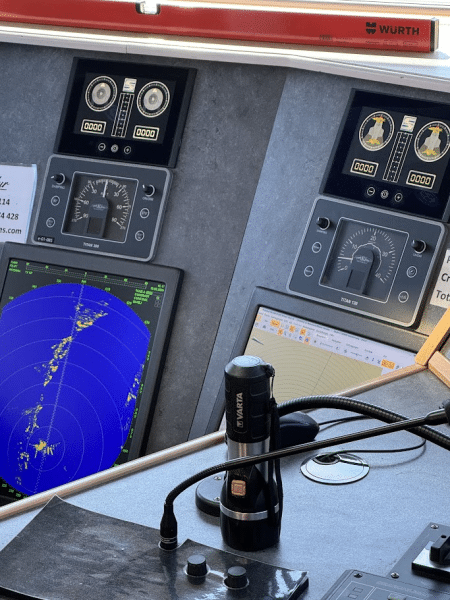

Today was an unusual day on board our cruise. After an hour-long visit to the Golubac Fortress, we had a very relaxing day. Other than lunch outside on the top deck in the sun, and dinner in the lounge, we just relaxed. Our excitement and education was a 10-minute visit to the captain’s Wheelhouse, except these days there is no wheel, it is all electronic. We learned that the ship is diesel-electric driving 8 motors. Everything is electronically controlled with several display units to inform the status of the ship. The captain requires two licenses, one for the ship and one to navigate the Danube. In addition, the captain must be able to speak Russian, especially for the northern part of the Danube, I am uncertain of the other language required but must be fluent in each language as they pass through the different territories.
We attended talks by an 18-year-old boy and girl describing their lives and plans in Bulgaria. The night ended with a fancy dinner. The setting was to celebrate a Bulgarian meal. Viking certainly goes out of their way to make each day special. During the night we passed through the third lock, but I did not hear it.
Plans to have an early night. Tomorrow another early excursion an hour’s drive away from the ship.
Day 12, Monday, September 9, 2024, Viking Ullur, Day 6, Vidin, Bulgaria
Woke early with my being a little uncertain since I think that we lost an hour overnight due to a time zone change, but the iPhone takes care of that, yet I still managed to wake up just before 6:00 am beating my alarm setting.
On our first day on the boat and with our first meal, we sat at a table with Melo from Portugal, and Eka from Bali as our servers. Since we enjoyed the way that they served us, we tried to sit at tables where they were our servers, not that it was always possible as other passengers got to our table before we did. This morning Eka was sharing with us that he was from Bali, married with no children. He works on the Viking ships for 10 months and then returns home for two months. It went through my mind the sacrifice one needs to make to earn a living. He did say that on his next visit home, they may try for a family.


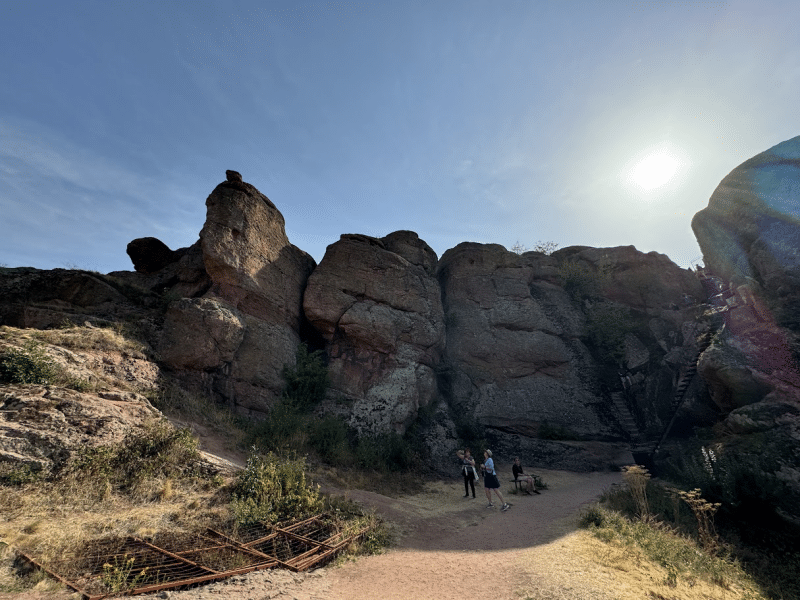


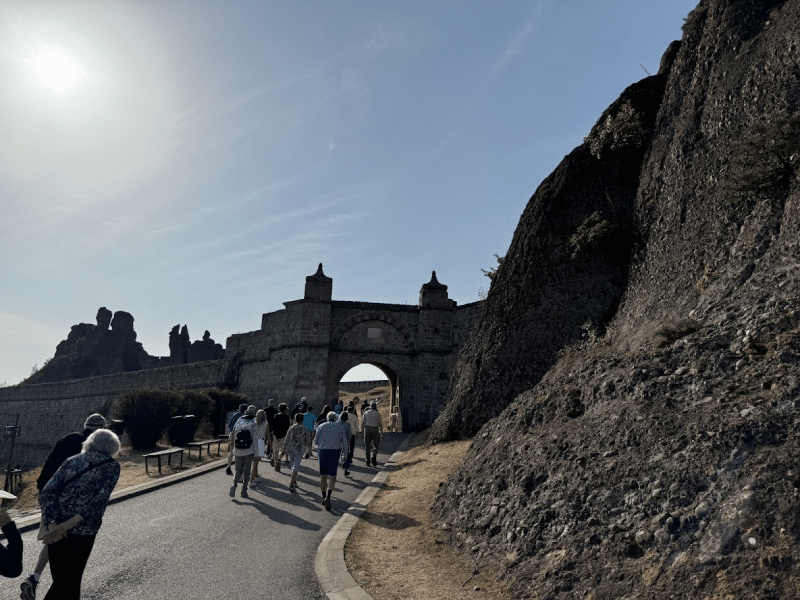
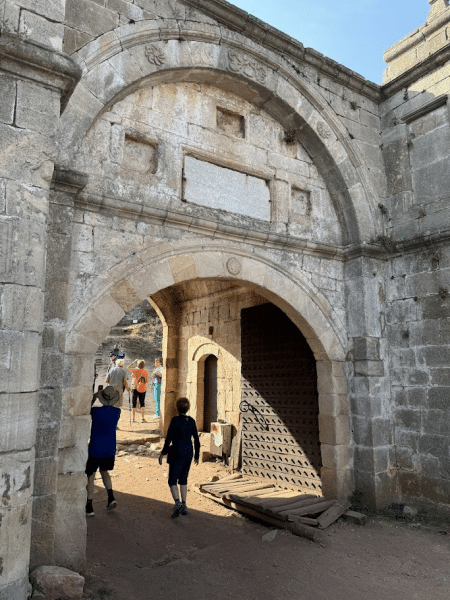
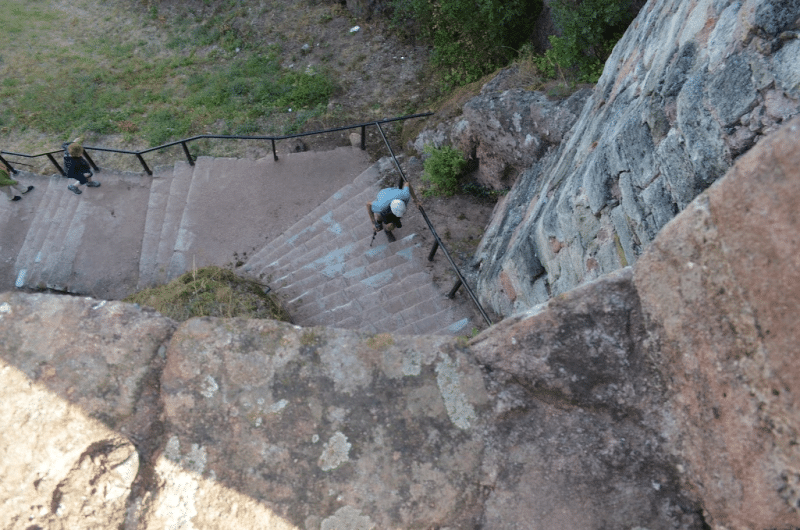
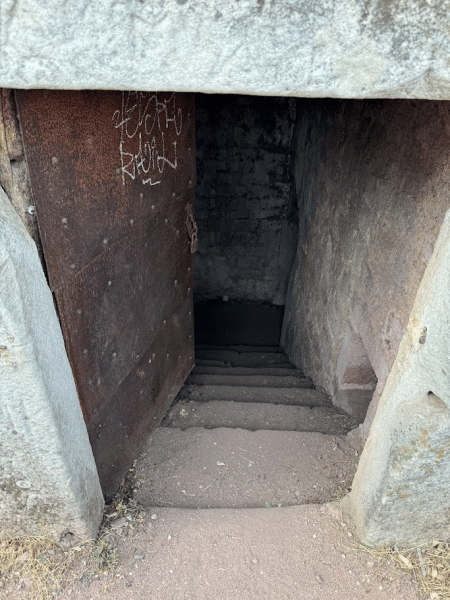

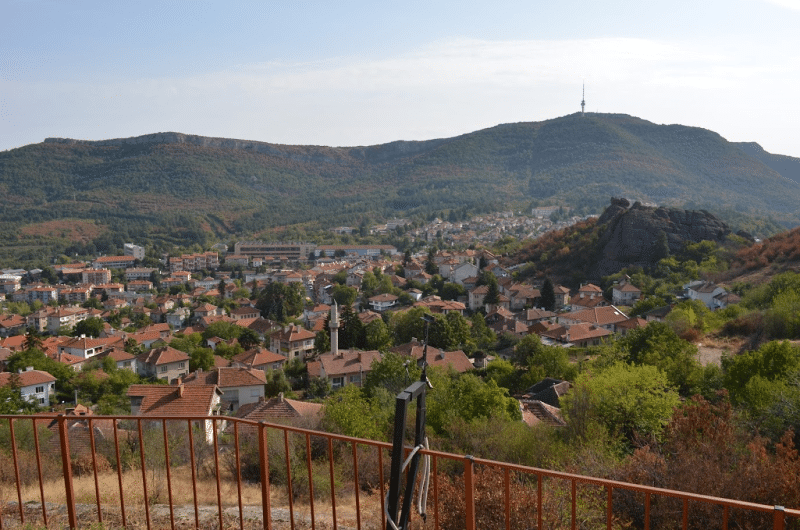
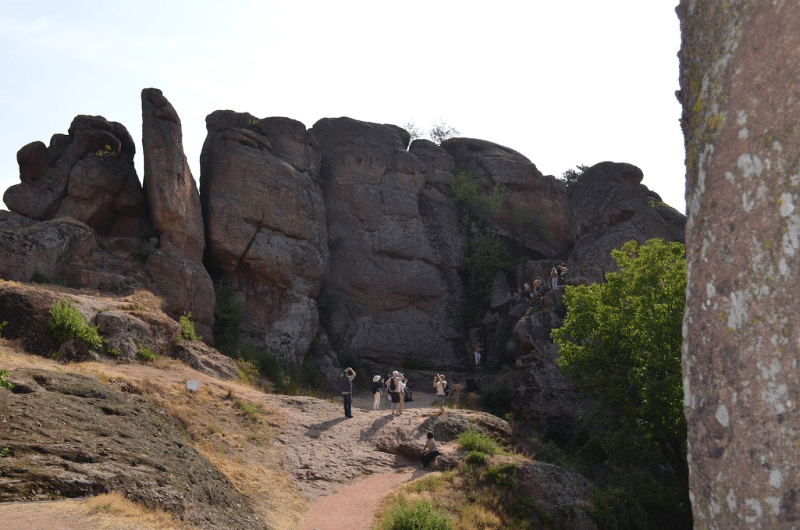
We enjoyed a 4-hour onshore excursion to the Belogradchic Rocks and Fortress.
The Madonna. Centuries ago, between the Belogradchik rocks were two monasteries – a convent and a nunnery. Sister Valentina could not hide her beauty under a cassock and the rumors spread everywhere. A young shepherd named Anton used to come night after night and reveal his love to her with a wooden flute, which sounded like a whisper and an ephemeral kiss. Valentina’s heart leaped passionately with joy and anguish and one night she hung down a rope from her cell. They fell deeply in love, but soon their love was revealed. A cry of a child was heard in the monastery after some time. The Sinner was cursed and chased away. Anton rode his horse to take away his beloved but the monks went on to fight for her. Then a miracle happened. God, the witness of this unblemished love, sent storms, thunders, and earthquakes. The convent lay in ruins. Everybody petrified. Monks on their way to the monastery turned to stone, Lonely Madonna with a child in her arms, and Anton stood on his horse waiting for his beloved forever.
All these stone figures exist: Madonna, the horse rider, the monks, and the monastery site.
We learned today again that communism destroyed the country, and after communism, with no funding, the country was destroyed. Many children, after school, left for university outside of Bulgaria and finally to another country resulting in a brain drain. The older people, many of whom might have left the country during communism, often had to give up their homes, only to return and find their homes destroyed, yet not have the funds needed to repair their homes.
Frankly, I was shocked to see how the majority of vehicles were from the 1970s and 1980s, and yes, they are intermingled with a few newer vehicles. Driving out to the Rocks, the roads are unbelievably narrow, and how two large busses can pass each other on these roads is a mystery.
The hour-long bus ride had several surprises. The villages we drove through looked derelict and showed signs of poverty. The bus driver was phenomenal in that he seemed to know where all the trouble spots were and slowed the bus. The roads are very narrow and not in great shape. Climbing the mountain proved to be challenging with the tight curves.
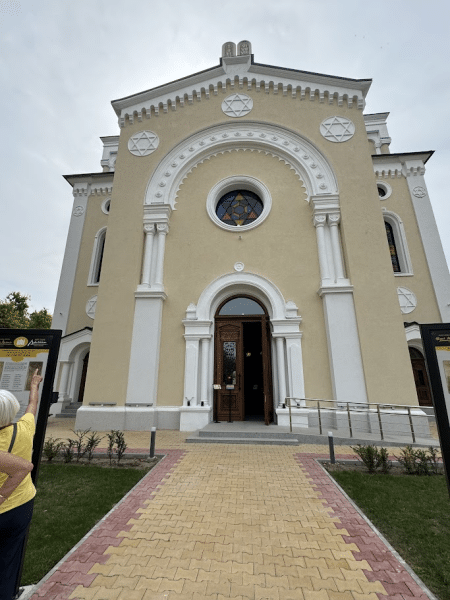

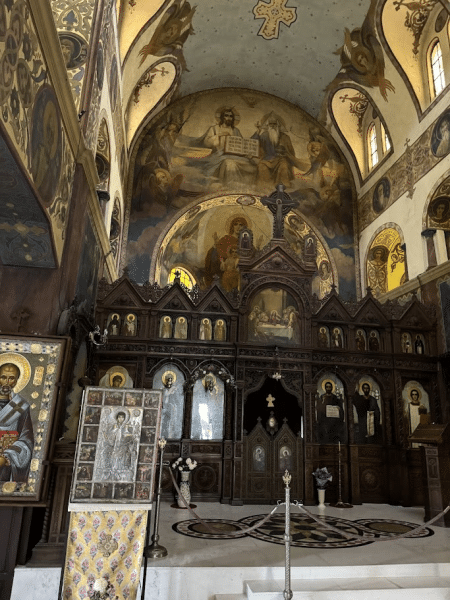
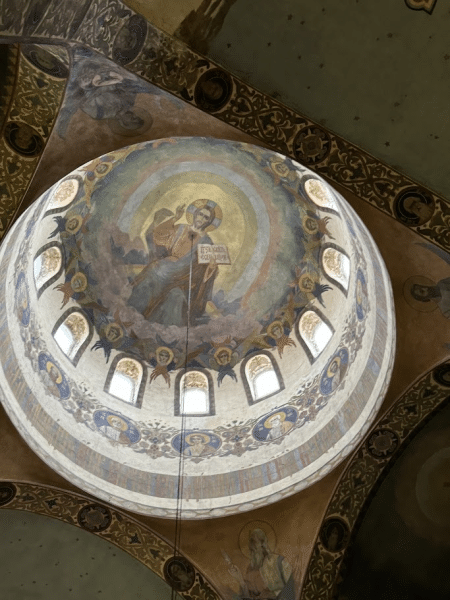


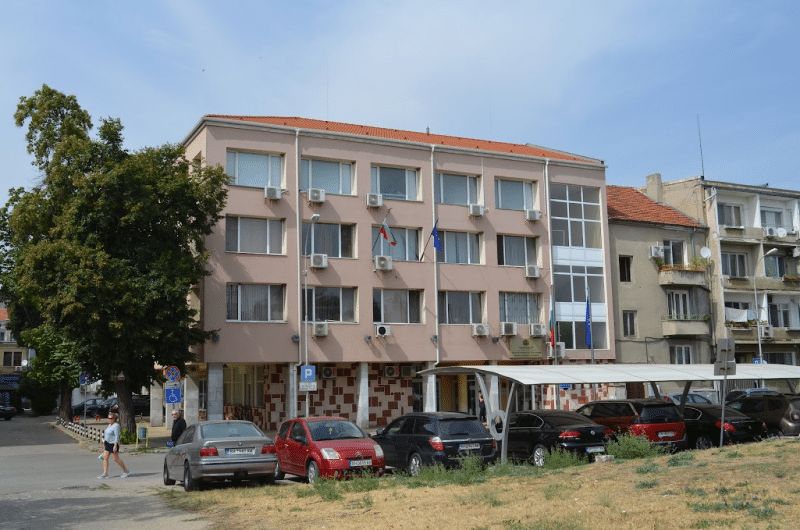


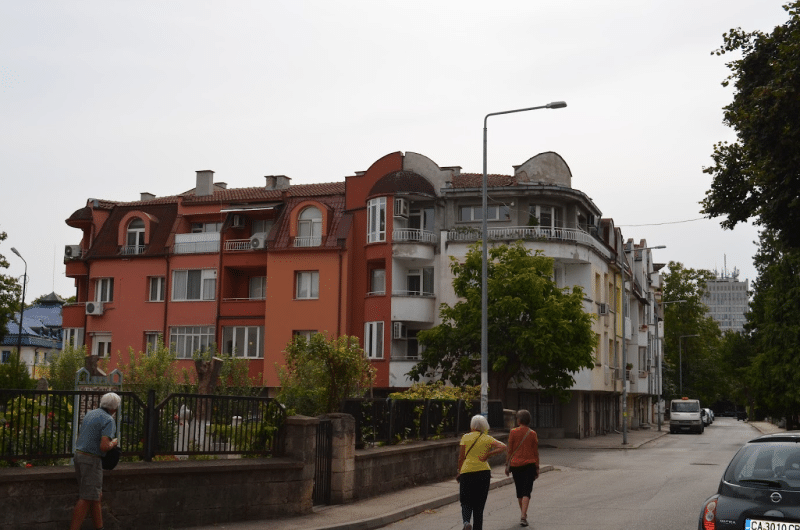

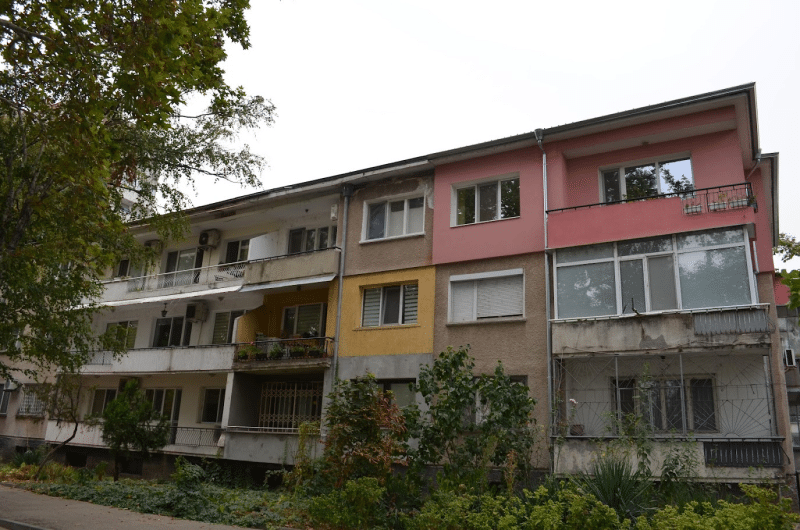
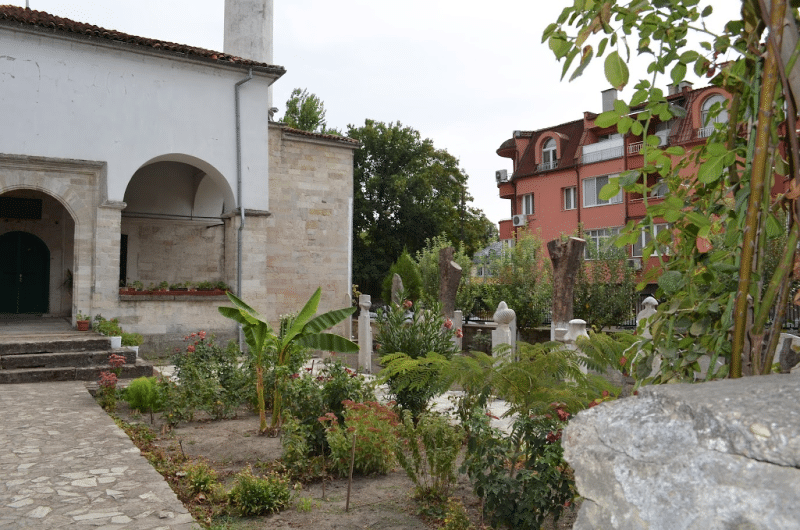
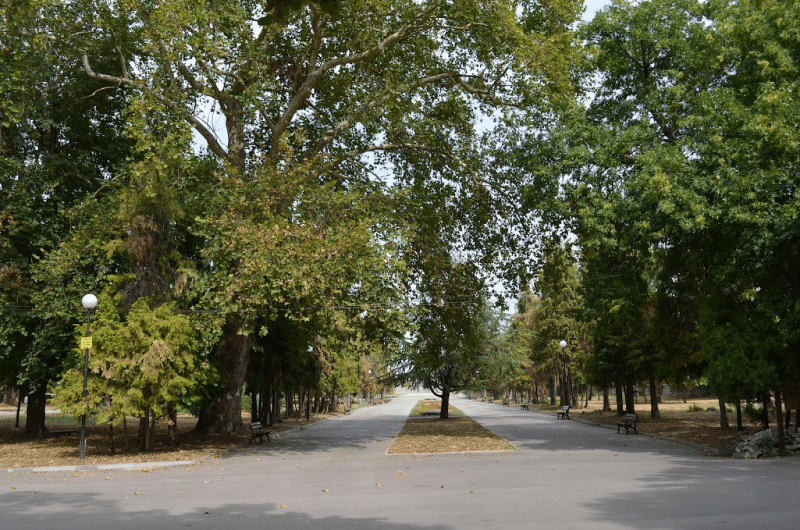


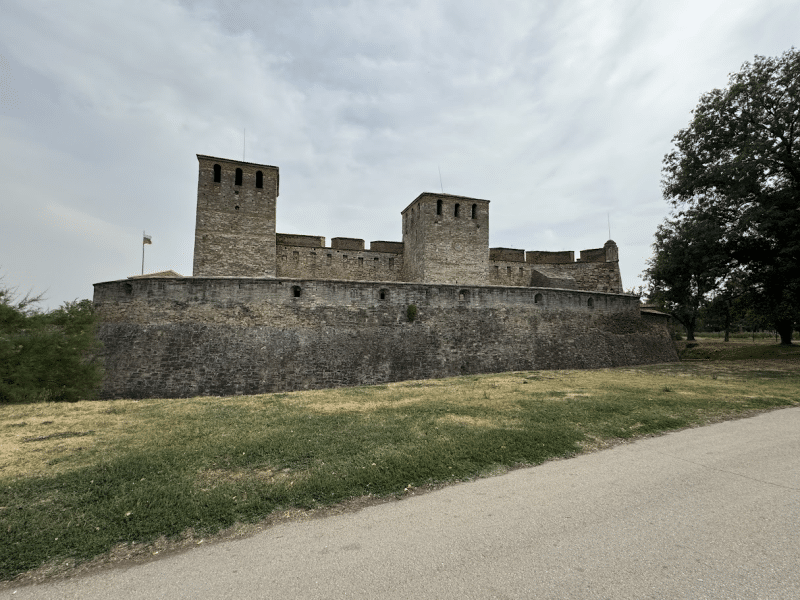
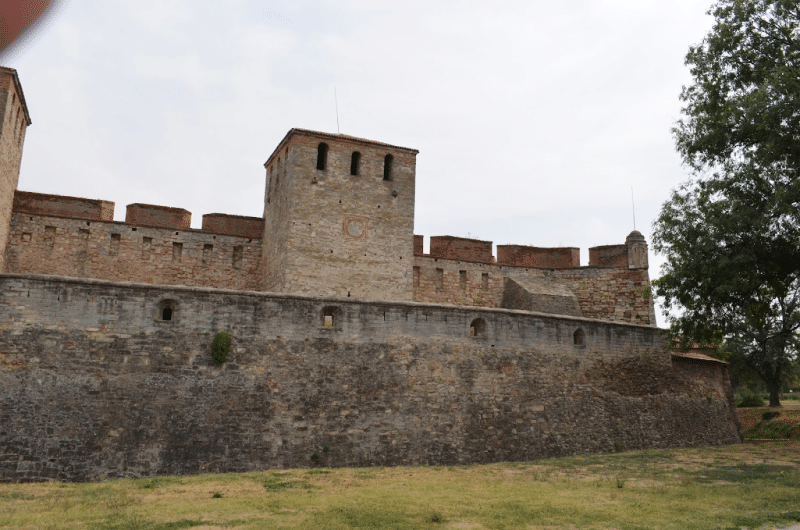

The first Bulgarian Kingdom. Vidin falls within the borders of the Bulgarian state right from its creation in 681. During the reign of Khan Omurtag (814-831), the city was the starting point in the conquest of the Avar territories beyond the Danube. In the 9th century, Vidin became the center of one of the 10 newly formed committees within the boundaries of the first Bulgarian Kingdom. In the second half of the 9th century, there were 7 metropolitan centers in Bulgaria and one of them was in Vidin. During his escape from Constantinople in 971, where he was in Byzantine captivity, the future Bulgarian Tsar Roman settled in Vidin, which shows the importance of the Vidin fortress. Immediately before the fall of the city under Byzantine rule, it was ruled successively by Tsar Samuil and his son Tsar Gavrail-Radomir. At the end of 1002, Vidin was captured by the Byzantines after an 8-month siege by Emperor Vasilii II using Greek (Median) fire. The Byzantine emperor pointed to the pivotal role of Vidin in his subsequent actions against Bulgaria, saying that after the capture of the city, the doors to Bulgaria were open to him.
After dinner on board the Viking, we were entertained by Bulgarian Folk Dance routines. 58 seconds.
Day 13, Tuesday, September 10, 2024, Viking Ullur, Day 7, Ruse, Bulgaria
We have a crazy day today. Yesterday when we checked it was supposed to rain all day. Now just awake, there is hardly any rain in the forecast. Tonight, we have to pack everything, and then tomorrow at 7:00 am they will take our luggage to transfer it to our hotel in Bucharest. We have an all-day tour today, but I am vague on details. Essentially the water level has dropped in the Danube and at some point, we stop sailing south and all of us get bussed to Bucharest. On a personal note, our 8:00 am flight to Warsaw on Thursday has been canceled and rebooked on a 5:15 am flight. So, I guess we will be up at 3:00 am to get a bus to the airport. Bottom line, this vacation has been phenomenal and treated like royalty all along the line as you read in my blog.
Several of our dinner guests shared some of their remarkable stories. We met one couple celebrating their tenth Viking cruise, including Riverboats and large ships. One couple’s wife has Parkinson’s, and the husband has a lung condition caused by COVID-19 and needs an oxygen supplement. Several had walking challenges and were more remarkable because of the many walks we went on, but they ambled along as best as they could. There is one gentleman, whom I might describe as eccentric, who comes down to breakfast every morning in his full-length navy blue gown.
One tidbit of information I learned along the way, Uber was banned in Bulgaria and Romania. They had to register as taxis and pay taxes as all taxi operators must. The roads in villages are in terrible condition with unending potholes and patches.
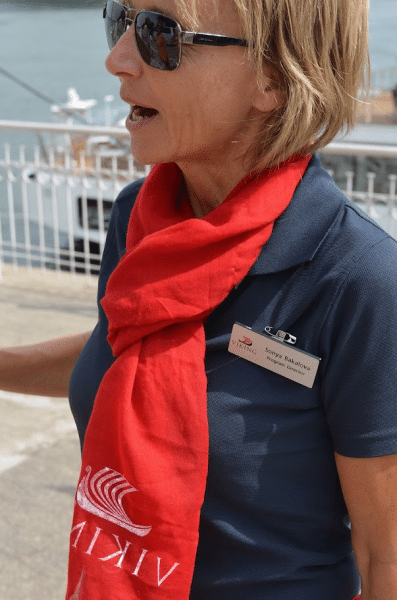
I would be remiss if I did not recognize Sonya Bakalova, our ship’s Program Director. Quite seriously at the end of the cruise, I asked her if I could bundle her up and pack her in our luggage to take her home with us. For some reason, she said, no! From the moment we first set foot on the ship, Sonya was available to organize everyone and everything. She took care of our entertainment at night, introduced the entertainers at the events, and gave updates on what we would enjoy the following day. Sonja has a fantastic personality, the very definition of professionalism, and single-handedly made this trip the pleasure it was.
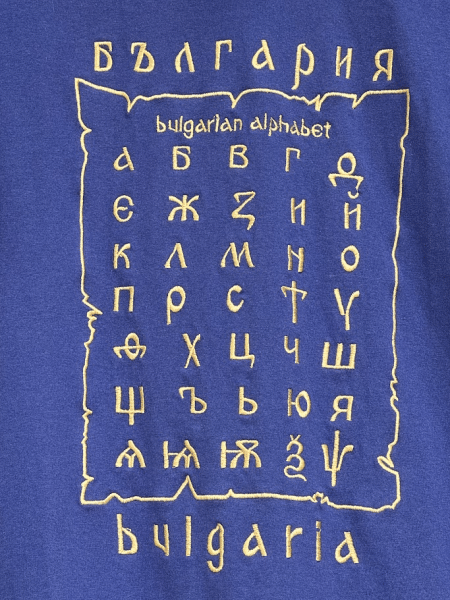



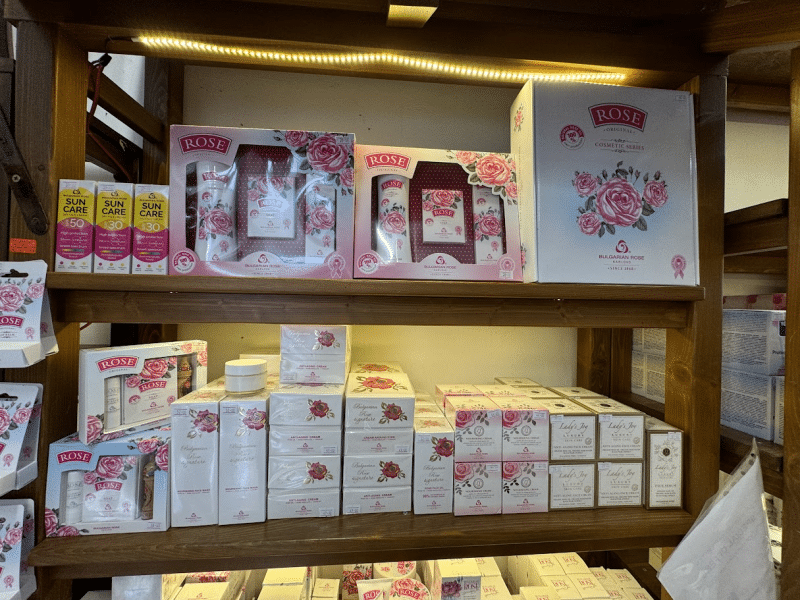
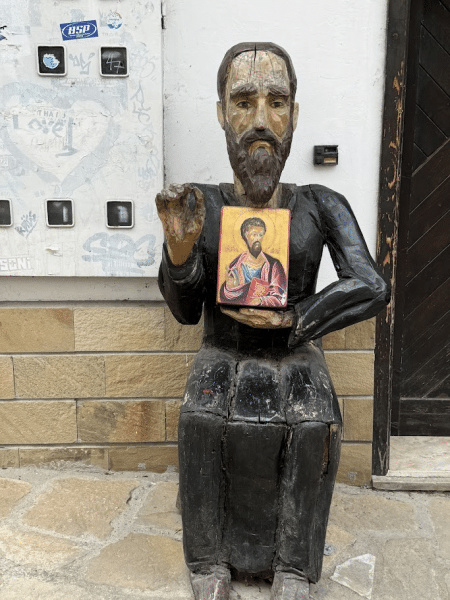


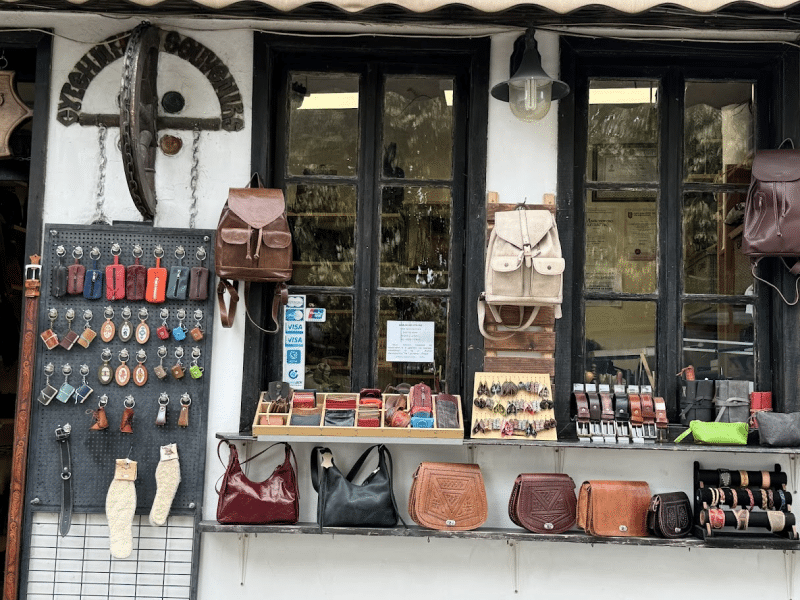


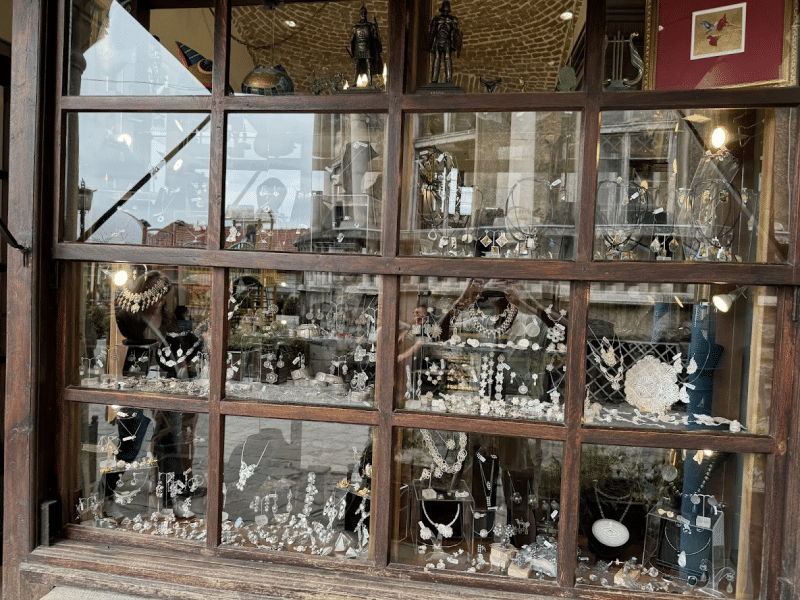

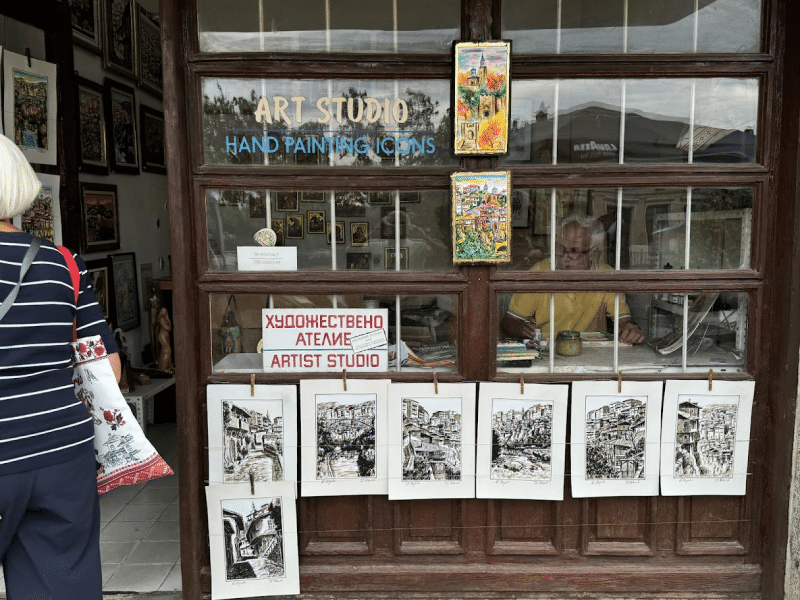
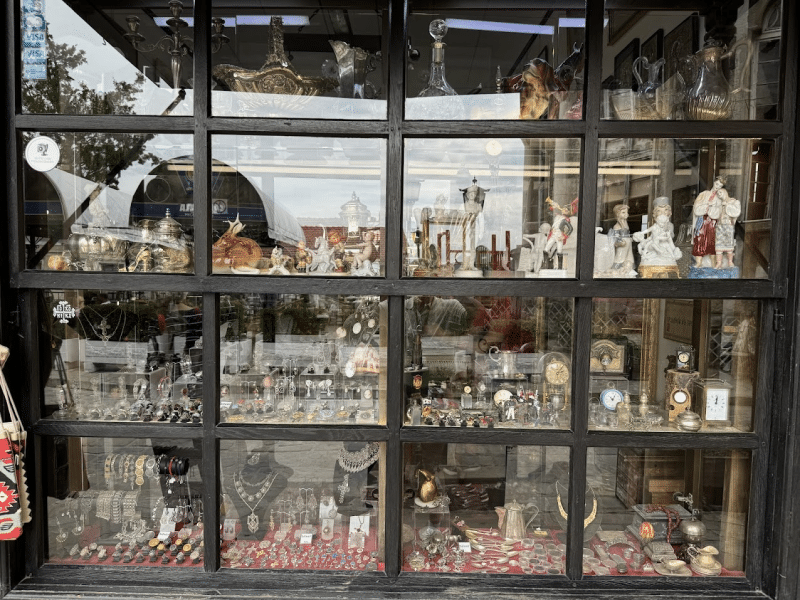
We journey through this shopping area today and are now the proud owners of some of the wares we purchased here.

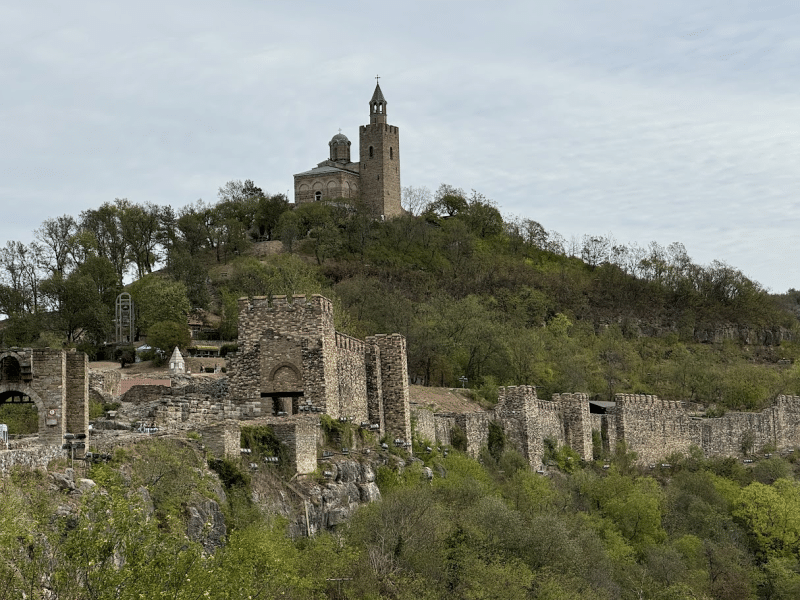
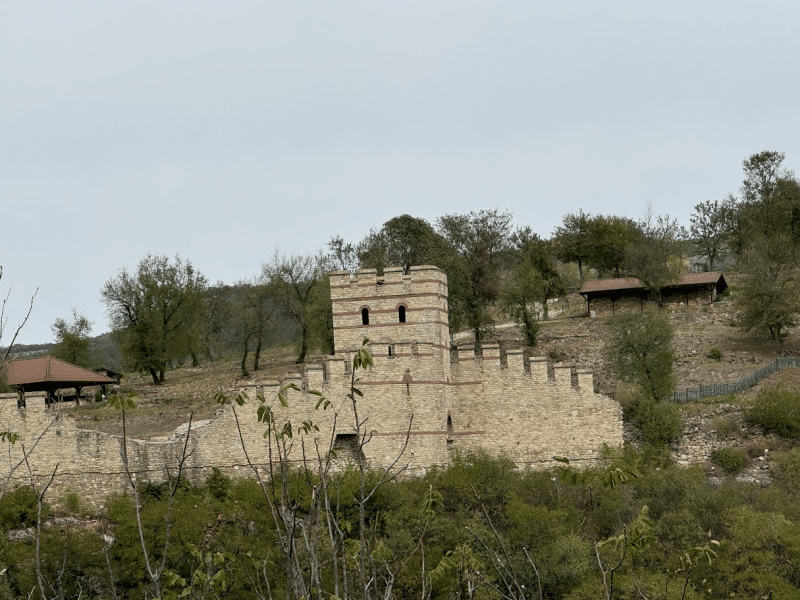

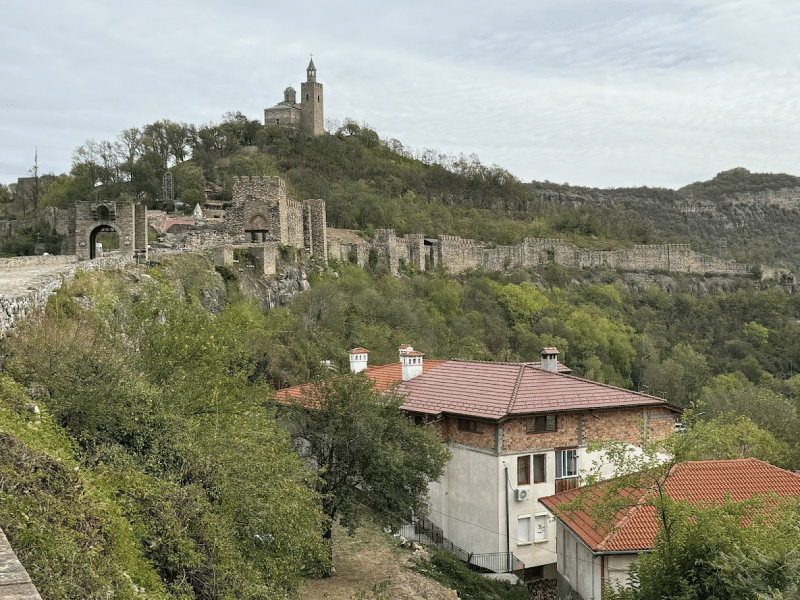


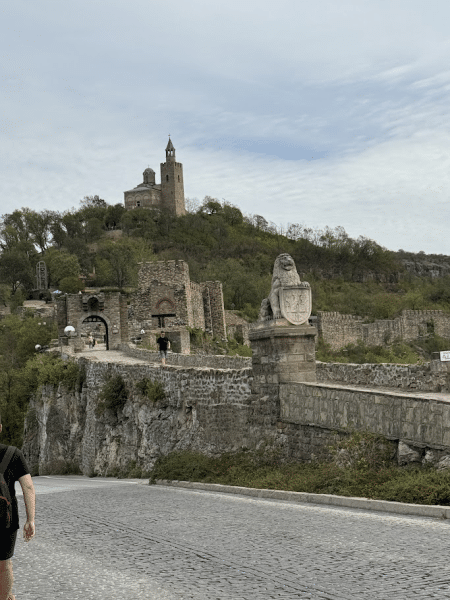
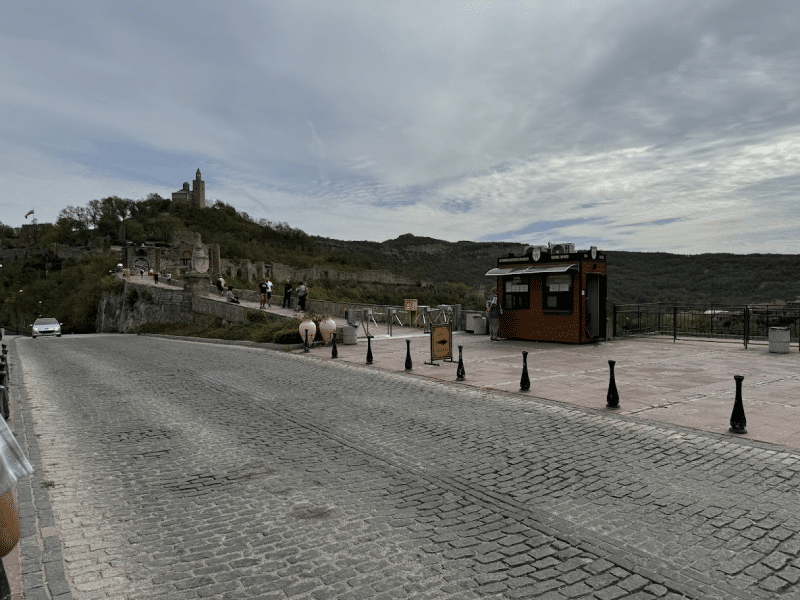
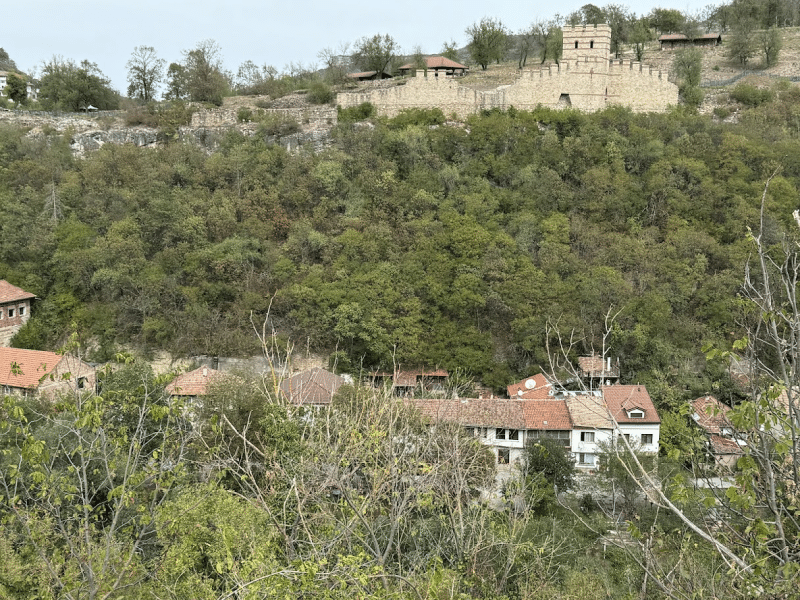


As part of our tour, we walked around the Tsarevets Fortress in Bulgaria.


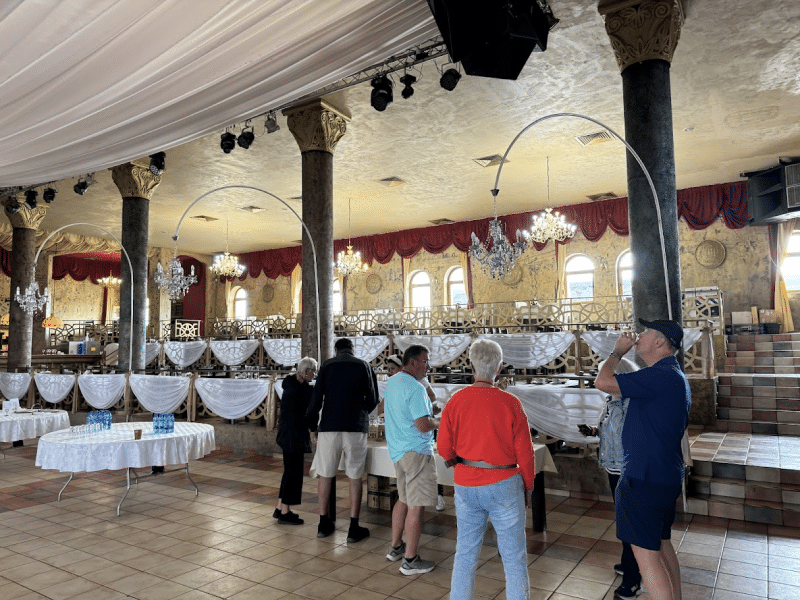
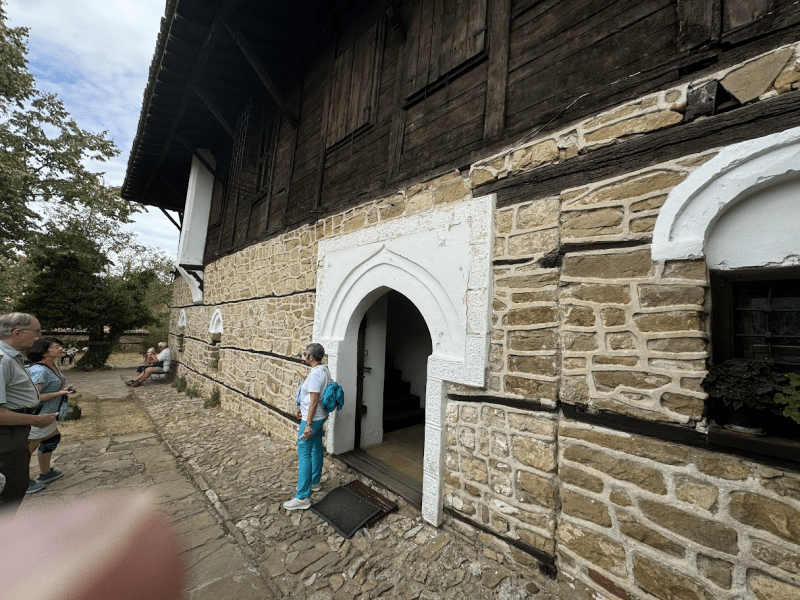
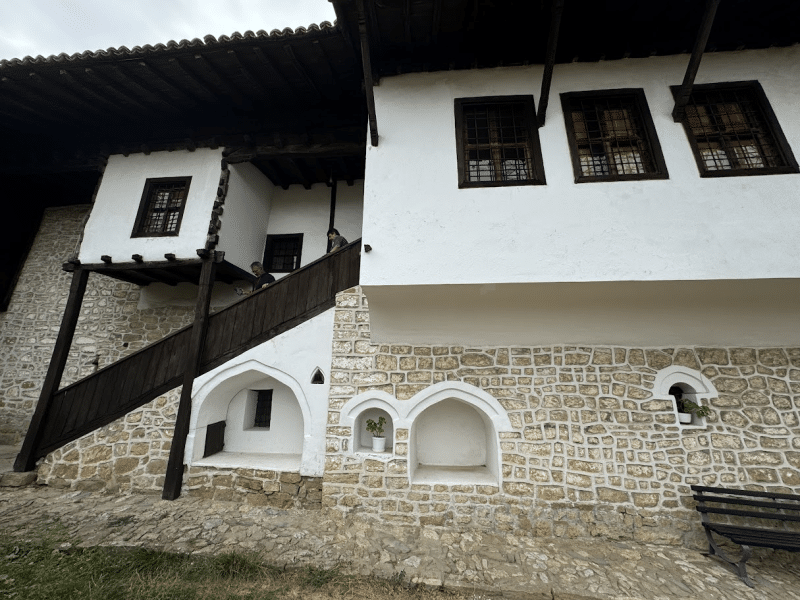
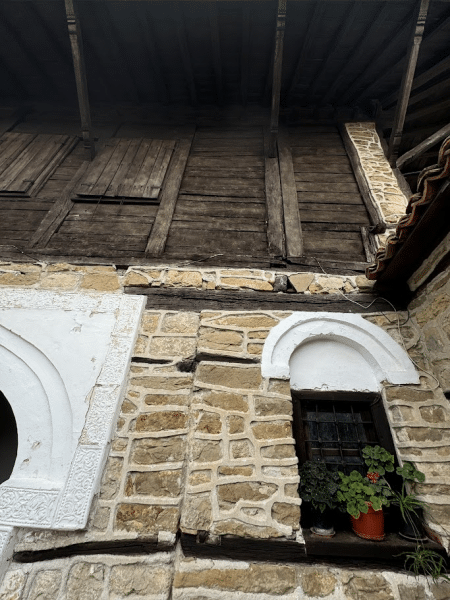
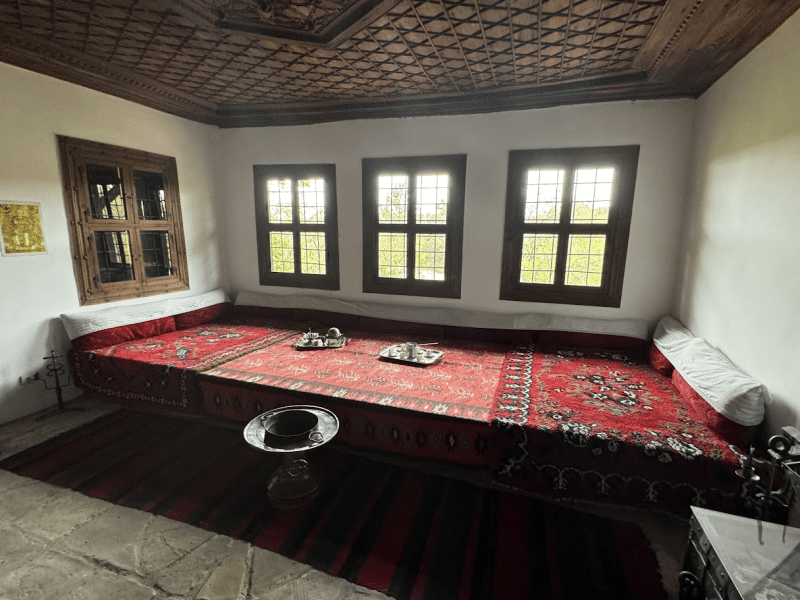

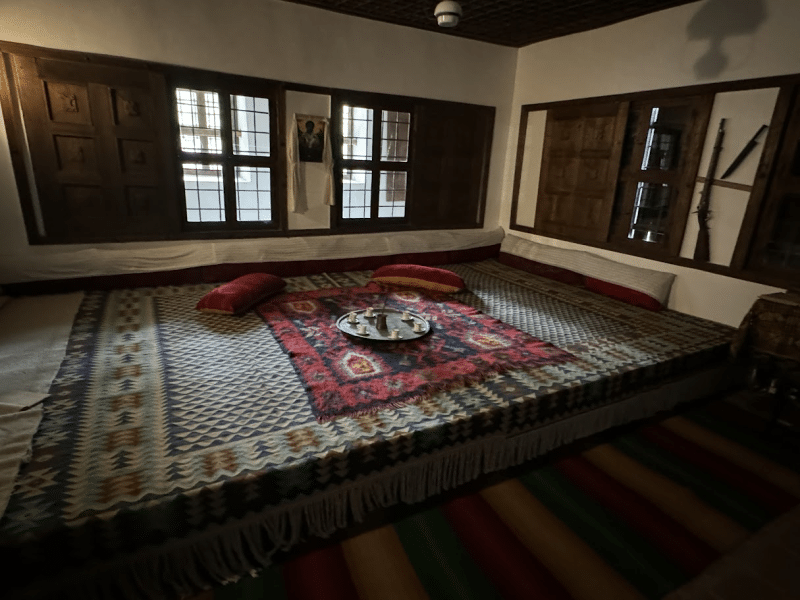
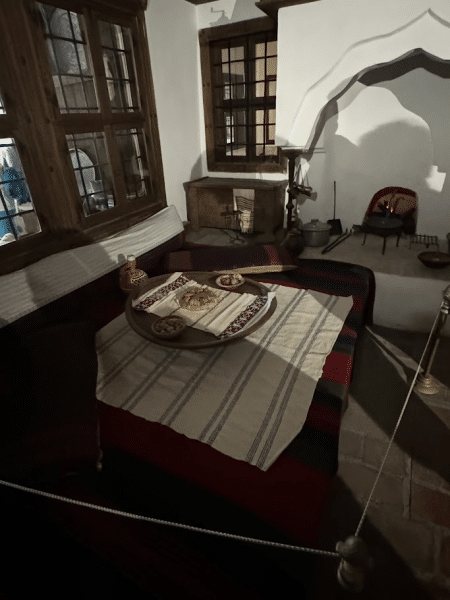
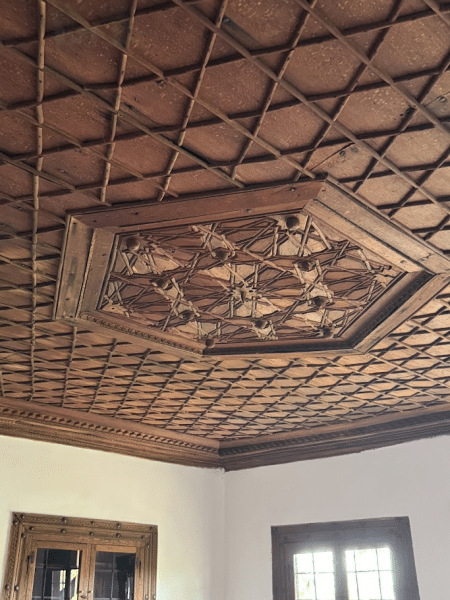

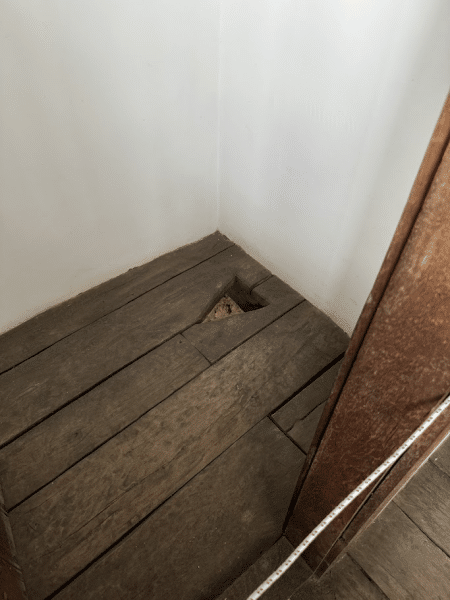
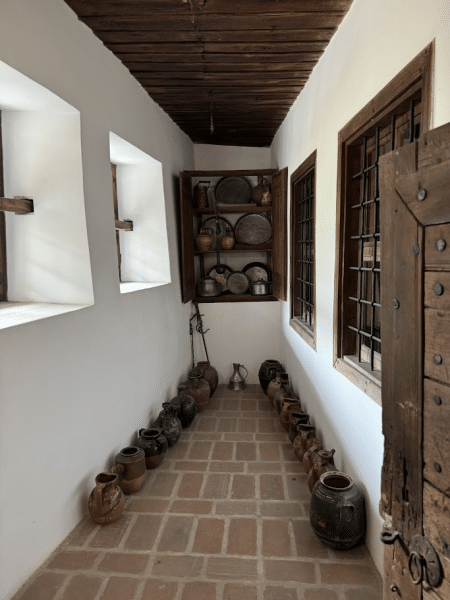

The photographs above were taken inside an Arbanasai home. The pictures with the triangles in the wooden boards are their “indoor plumbing.” Squatting accurately was important. Notice the size of the beds, large enough to accommodate a family, but only younger children shared the beds with their parents.
“The houses of Arbanassi were unique and original not only in their architectural planning but also in their decoration. A quotation from a XIX century book says that the decoration reached perfection which was hardly to be seen even in a city home or the richest Turkish houses.
“The variety is not only in the separate rooms but also among the decoration of one and the same room – the ceilings, the walls, the doors and the window shutters, the niches and shelves, the dzhamali (the built-up stoves) and the cornices, even the floor tiles are decorated.
“The decorative elements are skillfully combined – the white-washed ceramic ornaments, the fine monochromatic painting, the application, and the wood carving.
“The lines of the ornaments are fine and delicate – there are geometric shapes, as well as floral elements – inscribed squares and triangles, polygonal sun shapes, rosettes, and stylized flowers.”
Day 14, Wednesday, September 11, 2024, JW Marriott Bucharest, Romania
Due to the shallow water levels in the Danube, the boat moved across the Danube to the other side. We were then bussed from Bulgaria to Bucharest, Romania a trip, with stops, that took most of the day. We left at 8:15 am and arrived at 5:30 pm.
According to CBS News, a recent summer drought has caused the water levels in the Danube River to drop significantly. It reveals the wrecks of Nazi ships that were sunk during World War II, particularly near the Serbian riverport town of Prahovo. These ships were scuttled by the retreating German forces and are now visible due to the low water levels. (This is a fascinating read. I recommend you follow the link and read the full article).
Starting at the end of the trip, Bucharest is a large city, and traffic conditions are a challenge. I was feeling for the bus driver stuck in a traffic gridlock for hours with all the challenges the country suffered under communist rule, there was very little planning, in a country with a history that spans millennia.
On the road to Bucharest. Some of these smaller villages define poverty with their derelict homes and unoccupied places. Occasional two lanes in one direction for overtaking I found it interesting at the number of traffic circles on the road to Bucharest. Roads were narrow carrying two-way traffic and for a large part, we had rain. I was born after WWII as a leading-edge baby boomer. I was fascinated that all our guides are much younger, but the impact of the war and communism was mentioned during all their experiences. It even came up on the drive to Bucharest in Romania. Some people decided to get on a different bus messing up the count on a full bus and then the guide was left to sort out the mess.

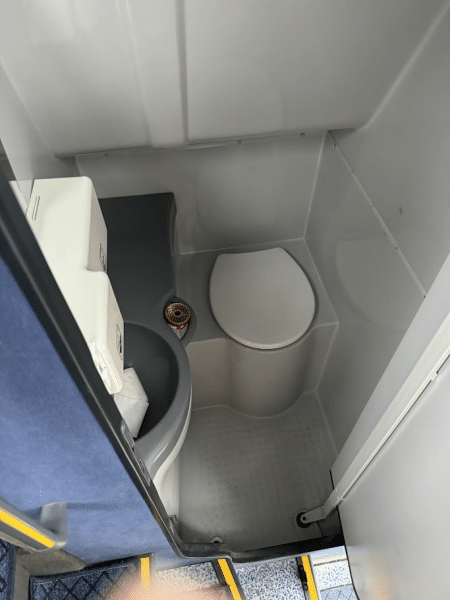
Would you believe that I used the toilet on the bus? It was a moving/swaying sensation.
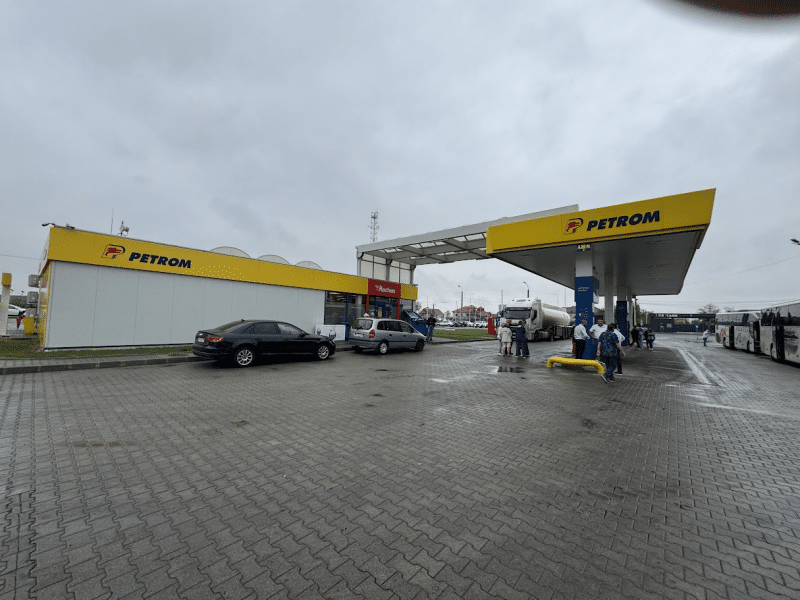
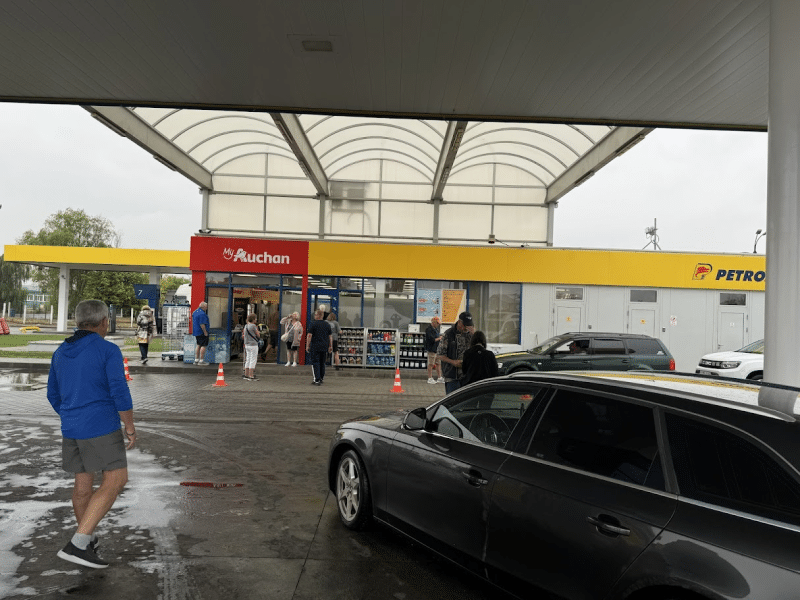
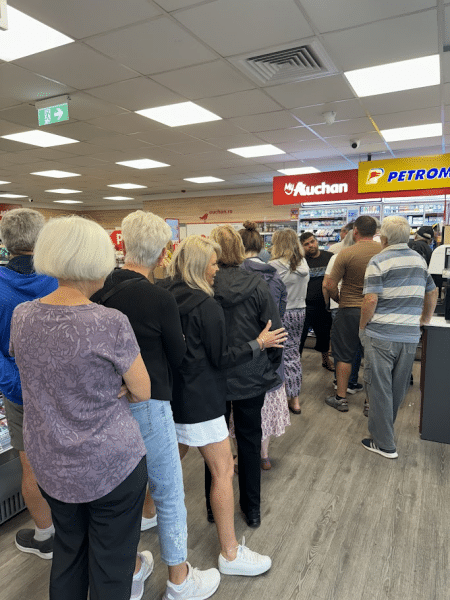
Chaos at the toilet stop for 6 buses. At the gas (petrol) station, Linda and Jenny had to use the men’s toilet due to the very long lines in the ladies’ toilet. With earlier tours, they used an A, B, C, D, and E classification. This time they used numbers so we went from group B to number 11. After the toilet stop, there was chaos as many could not find their numerically numbered buses. Most of us are too old to learn a new system.
We were treated to a meal at a local restaurant and entertained to Romanian Folk Dancing. 1 minute 2 seconds
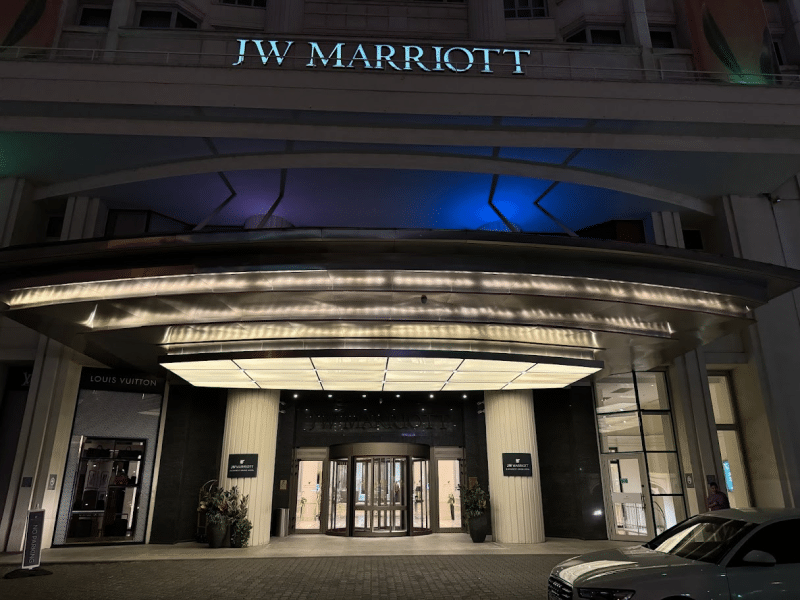
We checked into a JW Marriott, their top-of-the-line brand, and my first experience of staying in this level of luxury hotel. As to be expected, everything was great, and the only regret is that we could only get four hours of sleep before we had to take on our day.
The hotel is amazing in that the shops are very expensive brand name you have heard of including Versace and Valentino.
Listening to the emergency vehicle sirens outside, I trust that we get a good night’s sleep as this JW Marriott is located in the city center. I am an Elite member of Marriott’s frequent visit club, but this is the very first time that we have stayed at the highest-rated of their prestigious hotels. Strange as it may seem, our room is a handicapped unit that provides some challenges. The shower area is enormous, obviously to accommodate a wheelchair, and the challenge was to not flood the bathroom with a shower that provided an abundance of water under pressure.


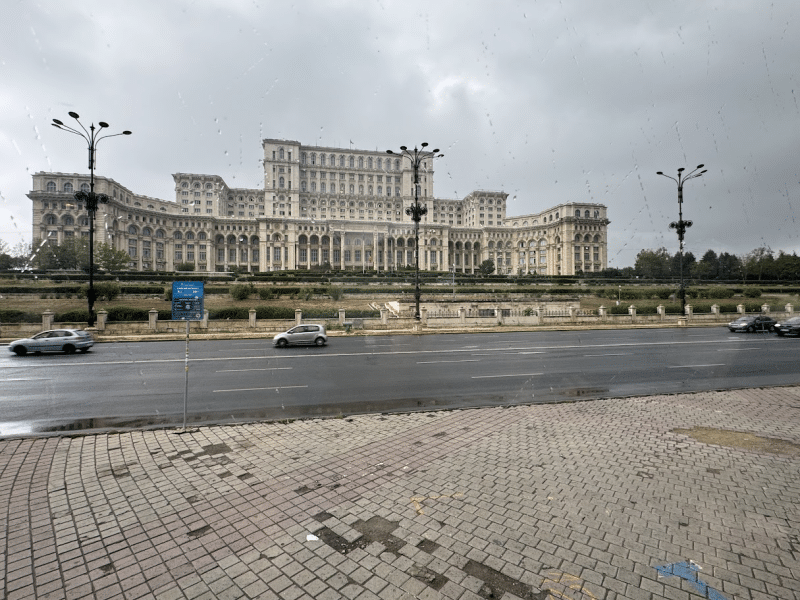
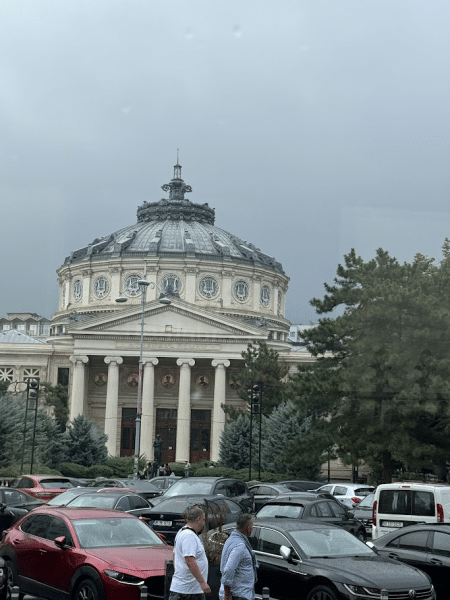


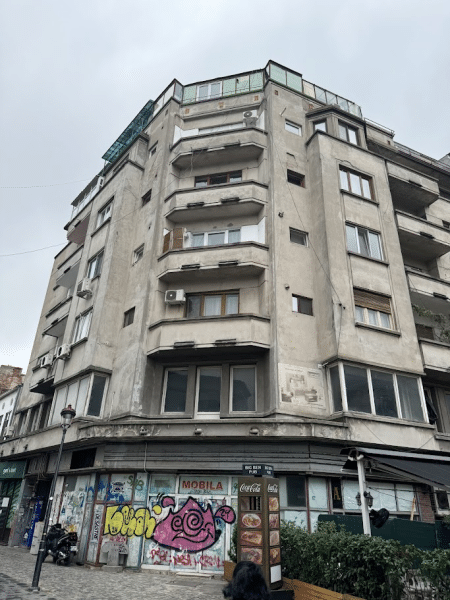


This city is unique with abundant trees everywhere including the parks. The bus driver experienced a slow drive traveling from one traffic light to the next traffic light. Driving in Bucharest’s city center was gridlock in every direction. On the road to Bucharest, we ran into a traffic jam in all directions, literally from north, south, east, and west, so the driver took a detour to keep driving. I saw two of our Viking buses stuck in this congested mess. The roads finally developed into dual-lane double roads. The driver had to contend with occasional rain, however it was not too disruptive.
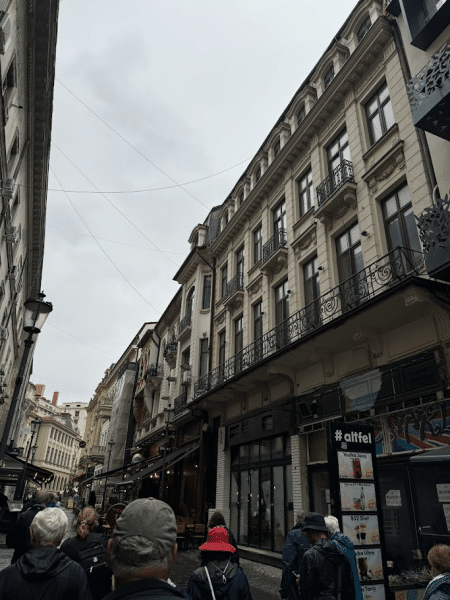
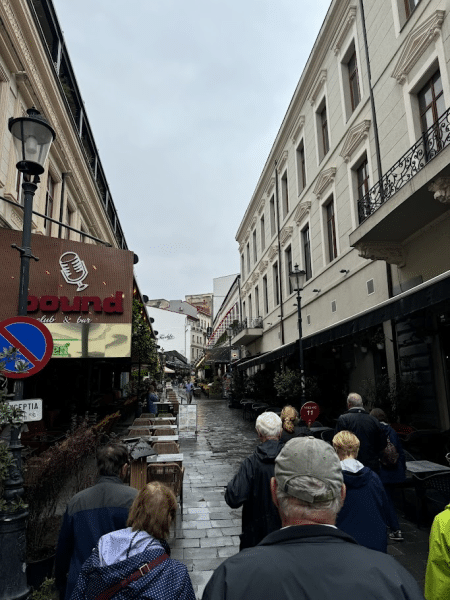

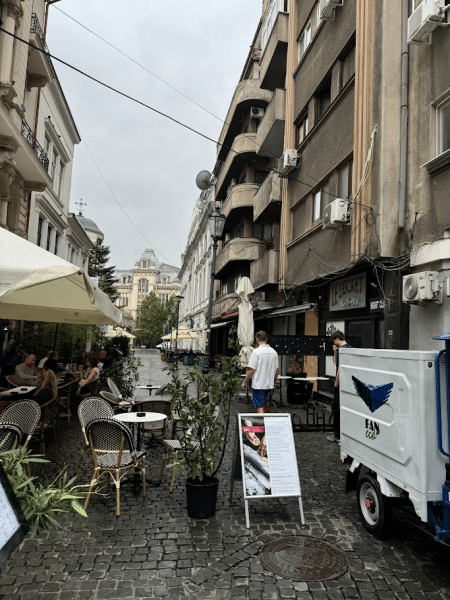


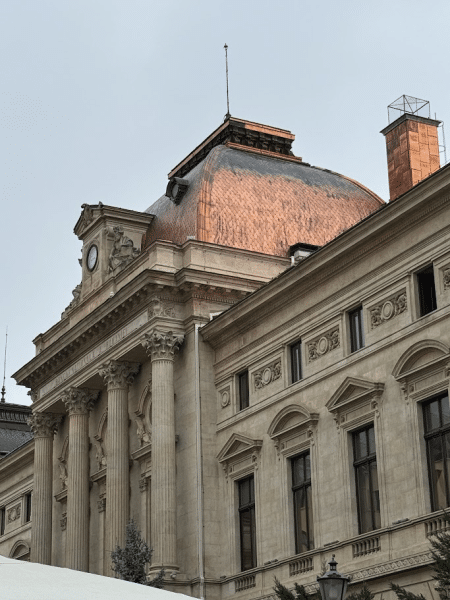

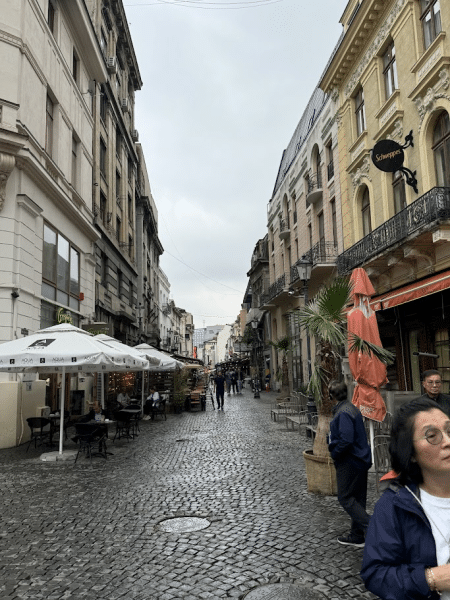



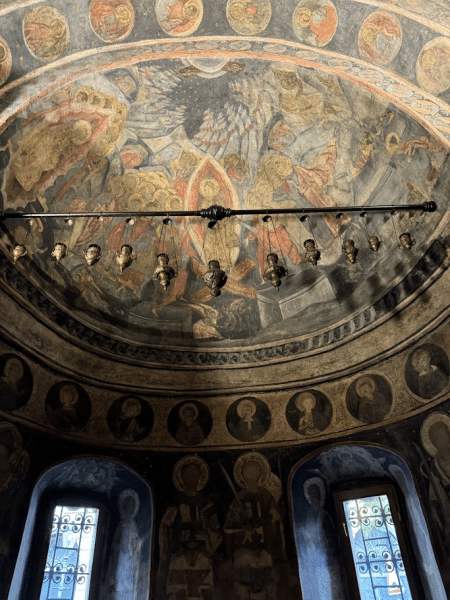

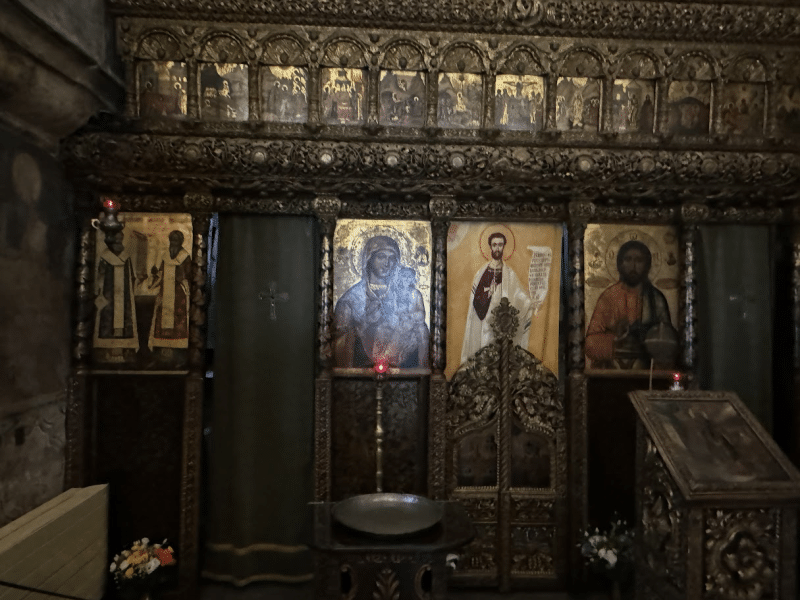
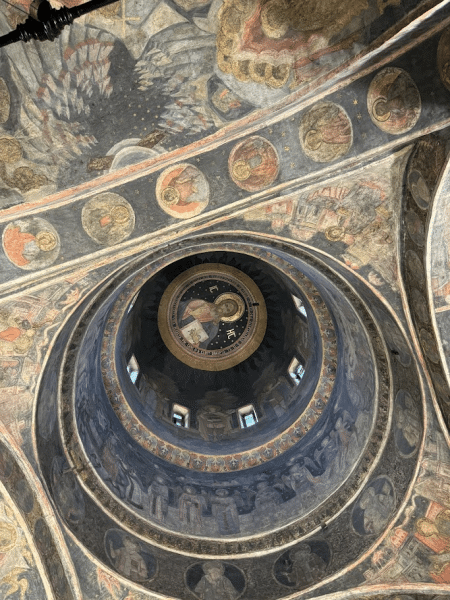
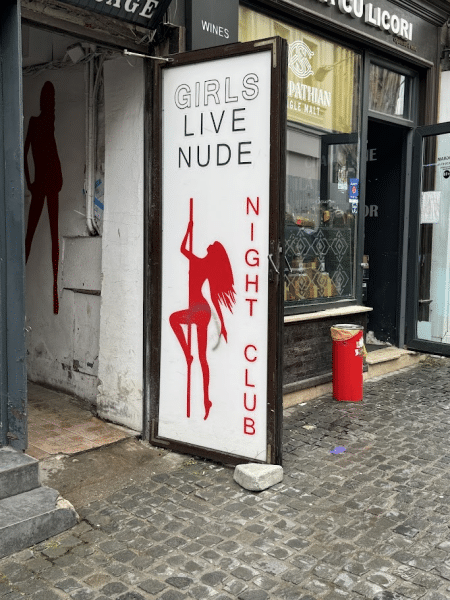

I was amused to see the fly encased in the ceramic bowl, obviously in place to help boys and men to aim.


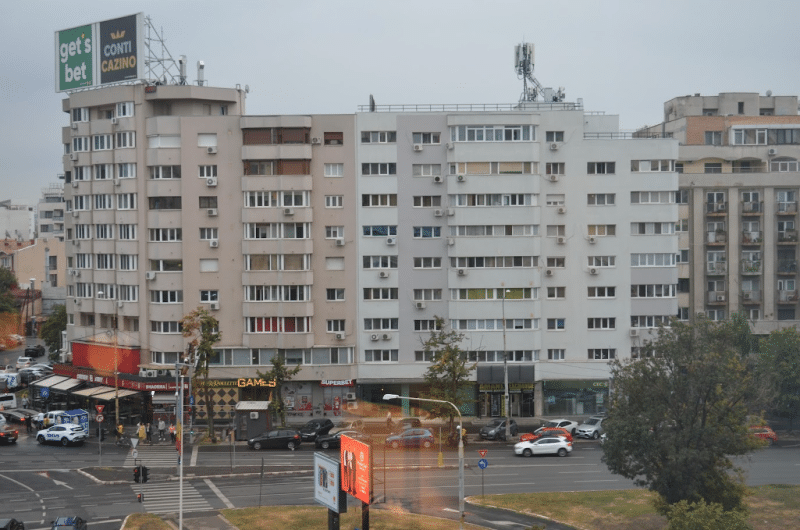

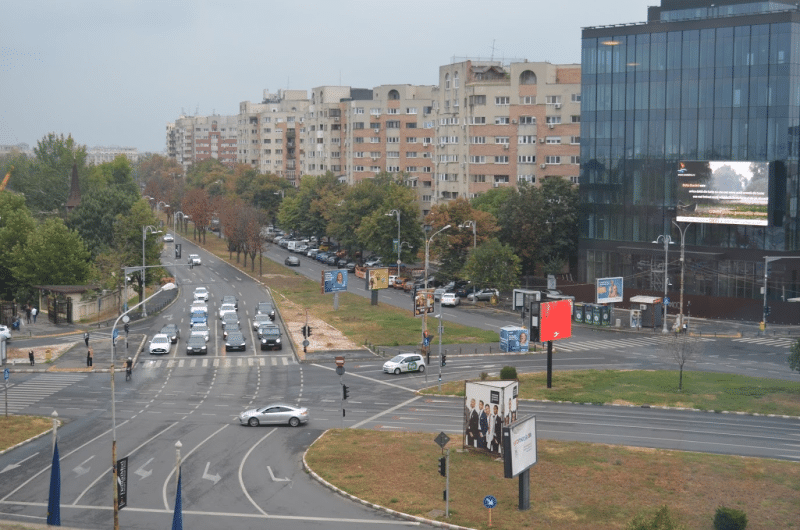


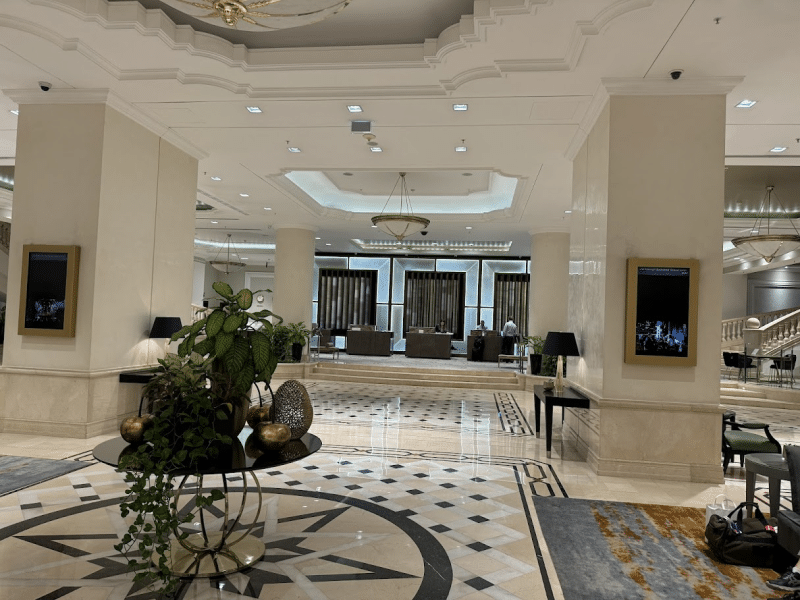

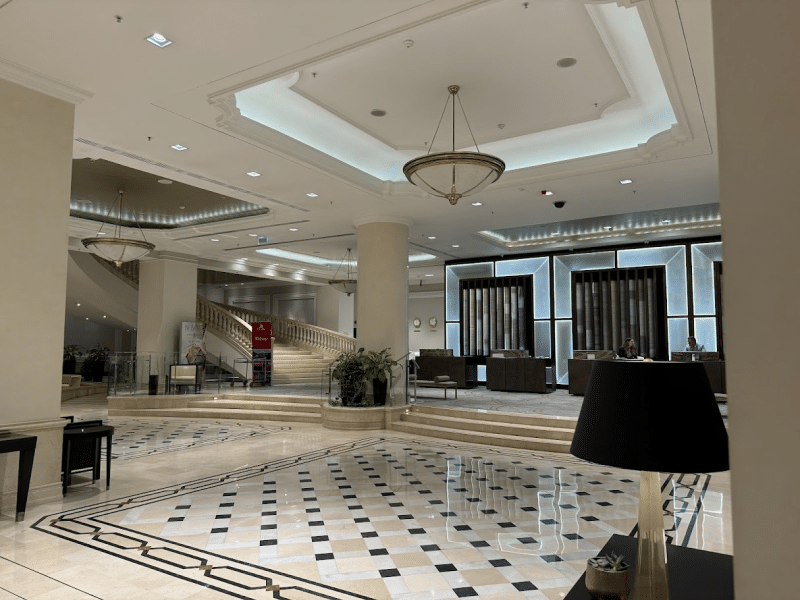

The shock of our situation is that we have to be up just after 1:00 am tomorrow to be driven to the airport for a 5:00 am flight to Warsaw, Poland. Our original flight was at 8:00 am, but that was canceled and rescheduled to this very early hour. The net result is that we will spend many hours at the airport to get our connection to Chicago’s O’Hare airport. As usual, Viking has taken very good care of us and made all the necessary travel arrangements
Day 15, Thursday, September 12, 2024, Lot Polish Airlines, Chicago, IL
We rose at 1:00 am today to shower and pack our final items. We left our luggage outside our hotel room door where Viking collected it. Viking gave us a breakfast basket consisting of an apple, water, fruit juice, a yogurt drink, a few Danish delights, and two sandwich wraps. They arranged a small bus for the four of us, including the Brinks, and we were shuttled to the airport.
One more time with much lighter traffic at 3:00 am I understood why the city operates with a chaotic traffic pattern. Our journey passes through city streets for quite a distance before we hit the open road much like an interstate highway. In the city, it is as if every intersection is controlled with a traffic light and they operate without any synchronization. The driver goes from one red light to the next red light.
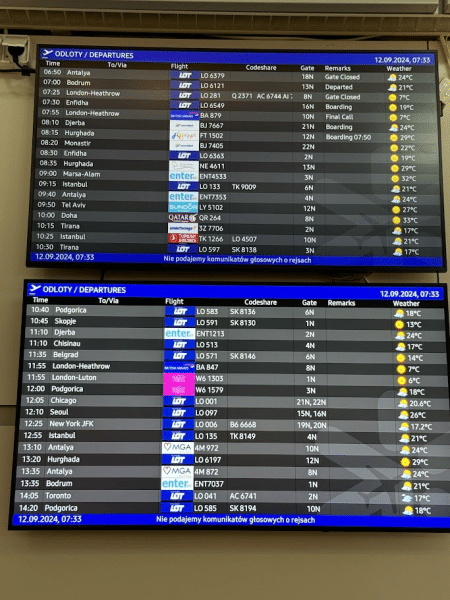
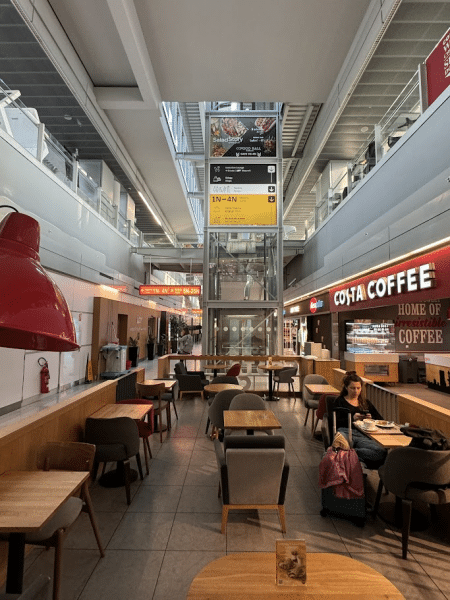

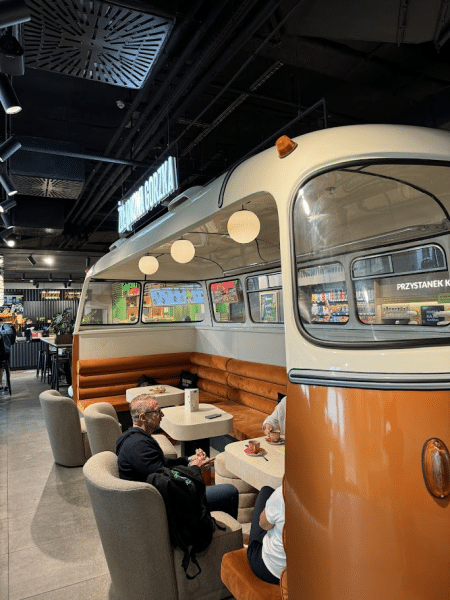
See the many cities and countries they fly from this airport.
Arriving at Henri Coanda International Airport, before 4:00 am, it was like a madhouse with more than a hundred flights scheduled through noon, and thousands of passengers at the check-in counters, and snaking their way through security.
We had to show our passports and driver’s licenses to get boarding passes. Linda and I sat near the back of the aircraft in row 22.
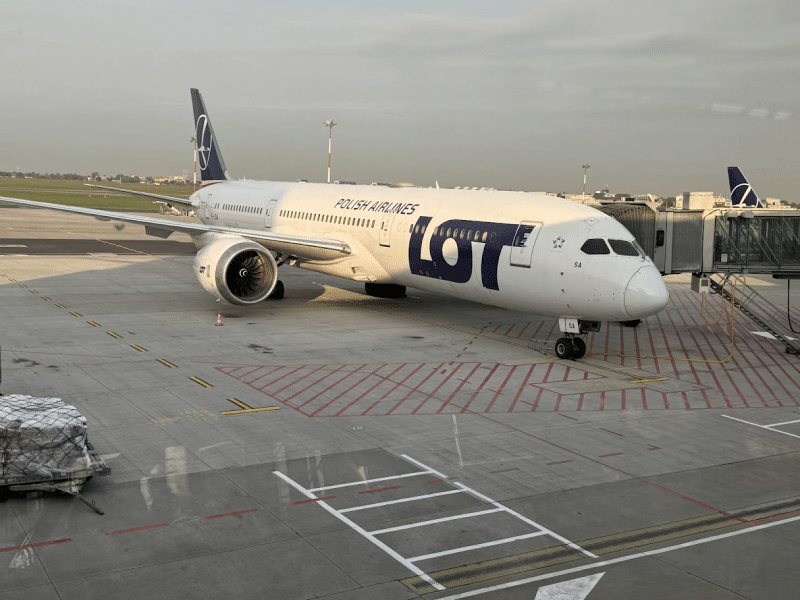
I felt like I was back in the good old days of South Africa as we boarded two buses and driven to our plane on the outskirts of the airport, then climbed the stairs to board our Embraer 190-100 aircraft. In fairness this situation was an exception as most of the other flights left from the terminal building.
The plane was full and we were handed sanitary wipes, a choice of two croissants, and tea or a very powerful cup of coffee. One surprise is that they did not collect the cups and other waste and required us to store them in the seat back pockets.
We are flying on Lot Airline from Bucharest to Warsaw in Poland, and on to Chicago where we take a bus to Milwaukee and finally an Uber to our home.
When we got to Warsaw Chopin Airport, we were in for the surprise of our lives. When we received our boarding passes in Bucharest, we requested to be checked through to Chicago. In Warsaw we discovered that I was booked in row 14, and Linda in row 28! We spoke to an agent from Lot Airlines who said that the flight was full and there were not two seats alongside each other. If we wanted to upgrade to business class, there were two seats one behind the other in two rows. The cost to upgrade is $1,000 each! We declined the offer. The problem is that it is a long flight to Chicago taking several hours while gaining time zones.
Would you like to hear a good news development? The Lot Airline representative we had spoken to earlier saw us walk past an hour later and beckoned us to approach her. She changed Linda’s boarding card to sit one row behind me. Both of us are now near the front in rows 14 and 15. Ultimately, we exchanged seats with other passengers who occupied seats in our respective rows, and behind us, so we ended up sitting together.
We indulged ourselves at the airport by purchasing Toblerone Chocolates in the duty-free shop. Something to enjoy over time when we get home.
The lot Polish Airlines plane was a Boeing 787-8 Dreamliner. After all the crazy challenges of getting seats together, when we boarded, and found a young couple also split up between the rows where Linda and I were supposed to be seated. After a few changes, they sat together as did we. The couple are from the Ukraine programming computers, and they work remotely for American companies and are now relocating to a home in the Chicagoland area. Another brain drain for the Ukraine.
Our lunch on our flight was delicious. Served about 2:00 pm Warsaw time. I am not smart enough to tell what we ate, but the chicken dish and rice was extremely heat hot and with a delightful spice adding to the flavorsome meal. Naturally, we had dessert and I went with water for my liquid refreshment.
As we cross the ocean, I believe that we save 7 hours with time zone differences. That makes it a very long day for us.
I mentioned the chaotic situation with the traffic in Warsaw. Boarding this flight was no different. They supposedly board by zone, but there is no place to line up, and it appears to be a free-for-all. Much to Linda’s disgust, I used the confusion and boarded early. I am always concerned that there is no overhead space for my carry-on luggage. Everything worked out well.
I’ll readily admit to being a frequent flyer, even with crossing the Atlantic. I am very familiar with aircraft having blinds that you close to be able to sleep. This aircraft makes the windows go blue so that it looks dark outside even though it is bright sunlight.
When I think back to the trip we did to Vancouver last June and encountered lots of turbulence, this flight was very smooth. Just chatted to the young lady sitting in our row. Anna comes from Armenia and is studying at Northwestern University in Chicago. She says that she has done this cross-Atlantic trip six times. Believe it or not, she plays rugby and promised to invite us to watch it when she plays in Milwaukee.
After hearing about the challenges faced by the Eastern European countries we visited, Anna shared with us some of the challenges Armenia has faced adding to the horrors of what we have been learning, and the impact of communism on their societies.
As I end my blog here, with the details of what we experienced, allow me to end on a sad note. When we got home, Linda and I both got colds, but a few others contracted COVID-19, and the good news is that it passed reasonably quickly. On the good news side, Viking alerted us on October 2, 2024 that Conde Nast Traveler voted them as #1 for Rivers, Oceans, and Expeditions. I will stress that this was an awesome experience, and look forward to our next venture, planned for September 2025 on a Rick Steves trip to Ireland. Thank you for reading.
RESEARCH DOCUMENTATION.
The following are additional details about Viking, the company, its founder, and its operation, plus a brief history of the countries we visited. (For the record, I gleaned most of the country information below from Wikipedia and contribute to them annually).
Torstein Hagen started Viking Cruises in 1997, at age 54, with four riverboats in St. Petersburg, Russia. His vision is that travel could be more destination-focused and culturally immersive. In May 2024, Viking went public on the New York Stock Exchange, raising more than $1.5 billion. They have grown into one of the world’s leading travel companies, with nearly 100 small, state-of-the-art ships. The company expanded into the American market in 2000, establishing a sales and marketing office in Los Angeles, California. Viking offers river, ocean, and expedition voyages on all seven continents.
Torstein Hagen became involved in cruising as a McKinsey and Company consultant who helped the Holland America Line survive the 1973 oil crisis, then was CEO of the Royal Viking Line from 1980 to 1984, and made money in the Russian private equity markets. He bought a controlling stake in a Dutch shipping company that failed in the mid-1990s, leaving him almost bankrupt. In 1997, Hagen helped some Russian oligarchs buy a shipping company, and in exchange, they sold him four river cruise ships cheaply, which became the founding fleet of Viking River Cruises.
In 2000, Viking purchased KD River Cruises of Europe, which brought Viking’s fleet total to 26, making it the largest river cruising fleet in the world.
Our cruise ship, the Viking Ullur was built in 2019 by Neptun Werft, headquartered in Rostock Germany. Viking Ullur has 95 staterooms for 190 passengers, 53 crew, and flies the Swiss flag. It is 443 feet (135 meters) long.
Sailing Europe’s storied rivers, the award-winning fleet of identical Viking Longships® provides a variety of stateroom categories and true two-room suites with full-size verandas. Onboard amenities include a restaurant, bar and lounge, library, and expansive sun deck. The ships feature al fresco dining on the revolutionary indoor/outdoor Aquavit Terrace, elegant Scandinavian design, and environmentally considerate features, such as solar panels, an onboard organic herb garden, and energy-efficient hybrid engines for a remarkably smooth ride.
Viking Ullur – Norse God of the Hunt. Stepson of Thor, Ullur is the god of the hunt, known for his great skill as an archer. He is also a wily wizard, able most notably to cross the seas without the use of a vessel but, instead, upon a length of bone resembling a ski on which he has cast a spell.
The following is an extremely brief historical detail of the countries we visited. So why did I add this section? The more I learned about some of the Eastern European countries, the more fascinated I became, and I decided to share just a glimpse of what took place in these territories in the hope that you will do more research and learn about this troubling period.
With the recent Olympics from July 26, to August 11, 2024, behind us, these are the medal awards for the countries we visited.
| Ranking | Country | Gold | Silver | Bronze | Total |
| 14 | Hungary | 6 | 7 | 6 | 19 |
| 23 | Romania | 3 | 4 | 2 | 9 |
| 26 | Bulgaria | 3 | 1 | 3 | 7 |
| 27 | Serbia | 3 | 1 | 1 | 5 |
| 28 | Czechia | 3 | 0 | 2 | 5 |
| 30 | Croatia | 2 | 2 | 3 | 7 |

The Czech Republic, also known as Czechia, was historically known as Bohemia. The Czech Republic has a hilly landscape that covers an area of 78,871 square kilometers (30,452 square miles). It has a mostly temperate continental and oceanic climate. The capital and largest city is Prague; other major cities and urban areas include Brno, Ostrava, Plzeň, and Liberec.
The Czech Republic’s history dates back to 800 years BCE (Before the Christian Era). The more modern history is addressed here. The Republic of Czechoslovakia was declared in October 1918. It was a democratic presidential republic. In 1920, its defined territory was not inhabited only by Czechs and Slovaks, it contained significant populations of other nationalities: Germans (22.95%), Hungarians (5.47%), and Ruthenians (a historic name for Ukrainians 3.39%). The Great Depression starting at the end of the 1920’s together with the rise of the National Socialist Party in neighboring Germany during the 1930s caused increasing tensions between the different nationalist groups in Czechoslovakia. In foreign relations, the newly established republic relied heavily on its western allies of Great Britain and France. That proved to be a mistake as in 1938, both allied countries agreed to Hitler’s demands and co-signed the Munich Treaty, stripping Czechoslovakia of its borderlands, leaving it indefensible.
In February 1948, the Communist Party of Czechoslovakia seized power in a coup d’état. Klement Gottwald became the first communist president. He nationalized the country’s industry and collectivized its farms to form Sovkhozs inspired by the Soviet model. Czechoslovakia thus became a part of the Eastern Bloc. Attempts at a reformation of the political system during the Prague Spring of 1968 were ended by the invasion of armies of the Warsaw Pact. Czechoslovakia remained under the rule of the Communist Party until the Velvet Revolution of 1989.
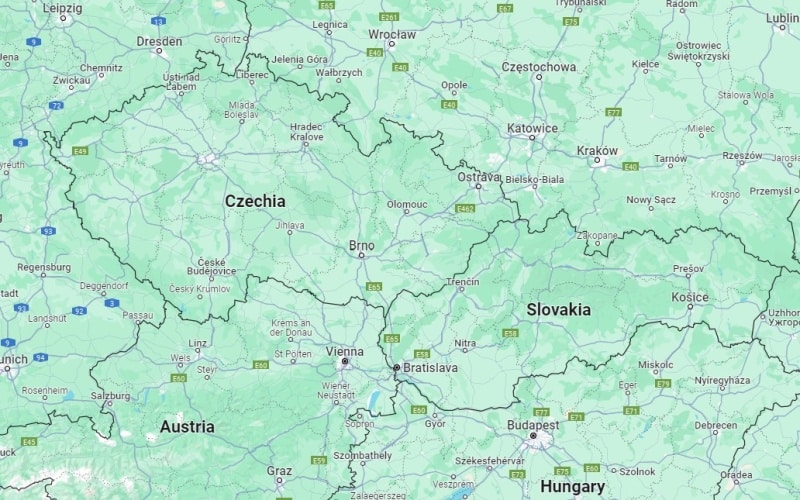
One of the leaders of the dissent, Václav Havel became the first president of democratic Czechoslovakia. Slovakia’s demands for sovereignty were fulfilled at the end of 1992 when the representatives of Czechs and Slovaks agreed to split Czechoslovakia into the Czech Republic and the Slovak Republic. The official start of the current Czech Republic was set on 1 January 1993. The Czech Republic became a member of NATO on 12 March 1999, and the European Union on 1 May 2004.

Between 1919 and 1944 Hungary was a rightist country. Forged out of a counter-revolutionary heritage, its governments advocated a “nationalist Christian” policy; they extolled heroism, faith, and unity; they despised the French Revolution, and disregarded the liberal and socialist ideologies of the 19th century. The governments saw Hungary as a bulwark against Bolshevism and Bolshevism’s instruments: socialism, cosmopolitanism, and Freemasonry. They perpetrated the rule of a small clique of aristocrats, civil servants, and army officers, and surrounded with adulation the head of the state, the counterrevolutionary Admiral Horthy.
Hungary was in a state of military anarchy and occupation between August and November 1919. The Paris Peace Conference wished to end the chaos and establish a stable government that could sign a peace treaty. They placed heavy pressure on Romania to withdraw and sent George Clerk to Budapest to help establish a functional Hungarian government. The evacuating Romanian army pillaged the country: livestock, machinery, and agricultural products were carried to Romania.
The worldwide Great Depression that began in 1929 induced a drop in the standard of living and the country’s political mood shifted further towards the right. In 1932, Horthy appointed Gyula Gömbös as prime minister, who changed the course of Hungarian policy towards closer cooperation with Germany and started an effort to Magyarize the few remaining ethnic minorities in Hungary. (Magyarization, after “Magyar” was an assimilation or acculturation process by which non-Hungarian nationals living in the Kingdom of Hungary, then part of the Austro-Hungarian).
During World War II, the Kingdom of Hungary was a member of the Axis powers. Nazi Germany and Fascist Italy sought to enforce the claims of Hungarians living in territories Hungary lost in 1920 with the signing of the Treaty of Trianon, and the two Vienna Awards returned parts from Czechoslovakia and Romania to Hungary. During the 1930s, the Kingdom of Hungary relied on increased trade with Fascist Italy.
On 1 September 1939, Nazi Germany invaded Poland and started the Second World War.
On 28 December 1944, a provisional government was formed in Hungary under acting Prime Minister Béla Miklós. Budapest unconditionally surrendered to the Soviet Red Army on 13 February 1945. On 20 January 1945, representatives of the Hungarian provisional government signed an armistice in Moscow. The Soviet Army occupied Hungary from September 1944 until April 1945. The siege of Budapest lasted almost two months, from December 1944 to February 1945 (the longest successful siege of any city in the entire war, including Berlin), and the city suffered widespread destruction, including the demolition of all the Danube bridges. On 23 October 1956, a peaceful student demonstration in Budapest produced a list of 16 Hungarian revolutionaries for reform and greater political freedom.
In 1989, the Parliament adopted a “democracy package” that included trade-union pluralism; freedom of association, assembly, and the press; a new electoral law; and in October 1989 a radical revision of the constitution, among others. Since then, Hungary has reformed its economy and increased its connections with Western Europe. It became a member of the European Union in 2004.
Please note, that this is a very abridged version of Hungary’s history, but only to provide a flavor of the country and its struggles.

The period from the 15th to the 17th centuries was marked by intense struggles between the Ottoman Empire to the south and the Habsburg Empire to the north.
Following the First World War and the dissolution of Austria-Hungary in 1918, Croatian lands were incorporated into the Kingdom of Yugoslavia. Following the German invasion of Yugoslavia in April 1941, the puppet state Independent State of Croatia allied to the Axis powers, was established. It was defeated in May 1945, after the German Instrument of Surrender. The Socialist Republic of Croatia was formed as a constituent republic of the Socialist Federal Republic of Yugoslavia. In 1991, Croatia’s leadership severed ties with Yugoslavia and proclaimed independence amidst the dissolution of Yugoslavia.
On 22 April and 7 May 1990, the first free multi-party elections were held in Croatia. Franjo Tuđman’s Croatian Democratic Union (HDZ) won by a 42% margin against Ivica Račan’s reformed communist Party of Democratic Change (SDP) who won 26%. Croatia’s first-past-the-post election system enabled Tuđman to form the government relatively independently, as the win translated into 205 mandates (out of 351 total). The HDZ intended to secure independence for Croatia, contrary to the wishes of some ethnic Serbs in the republic and federal politicians in Belgrade. The excessively polarized climate soon escalated into complete estrangement between the two nations and spiraled into sectarian violence.
On 2 May 1991, the Croatian parliament voted to hold an independence referendum. On 19 May 1991, with a turnout of almost 80%, 93.24% voted for independence. Krajina boycotted the referendum. They had held their referendum a week earlier on 12 May 1991 in the territories they controlled and voted to remain in Yugoslavia. The Croatian government did not recognize their referendum as valid.
On 25 June 1991, the Croatian Parliament declared independence from Yugoslavia. Slovenia declared independence from Yugoslavia on the same day.
Following the ratification of the Treaty of Accession 2011 and the successful 2012 Croatian European Union membership referendum, Croatia joined the EU on 1 July 2013.
In the 2014–15 Croatian presidential election, Kolinda Grabar-Kitarović became the first Croatian female President
In January 2020, the former prime minister Zoran Milanović of the Social Democrats (SDP) won the presidential election. He defeated center-right incumbent Kolinda Grabar-Kitarović of the ruling Croatian Democratic Union (HDZ). In March 2020, the Croatian capital Zagreb experienced a 5.3 magnitude earthquake which caused significant damage to the city. In July 2020, the ruling center-right party HDZ won the parliamentary election.
On 1 January 2023, Croatia became a member of both the Eurozone and Schengen Area.

The history of modern Serbia began with the fight for liberation from the Ottoman occupation in 1804 (Serbian Revolution). The establishment of modern Serbia was marked by the hard-fought autonomy from the Ottoman Empire in the First Serbian Uprising in 1804 and the Second Serbian Uprising in 1815.
Serbia repulsed three Austro-Hungarian invasions (August, September, and November–December 1914), the last of which was when Belgrade was held temporarily by the enemy. But during 1915 an epidemic of typhus decimated the Serbian army, and a renewed invasion in early October, this time involving also German and Bulgarian forces, resulted in the occupation of the whole country.
After the military victory over Austria-Hungary in the First World War, the Kingdom of Serbia was restored and was joined with other South Slavic lands formerly administered by Austria-Hungary into the newly formed Kingdom of Serbs, Croats, and Slovenes (which was renamed Yugoslavia in 1929). This new South Slavic kingdom was created on December 1, 1918, and de facto existed until the Axis invasion in 1941.
From 1918 to 1941, Serbia did not exist as a political entity, since the SCS Kingdom of Serbs, Croats, and Slovenes (later the Kingdom of Yugoslavia) was a centralist country divided into administrative provinces that were not created in accordance with ethnic or historical criteria. However, the country was ruled by a Serb king and dominated by a Serb political elite.
In 1944, the Soviet Red Army and Yugoslav Partisans expelled all Axis troops from Serbia and the area was included into the restored Yugoslavia. Unlike pre-war Yugoslavia, which had a centralist system of government, post-war Yugoslavia was established as a federation of six equal republics. One of the republics was Serbia, which had two autonomous provinces: Vojvodina and Kosovo.
The new Serbian constitution from 1990 greatly reduced the autonomy of Kosovo and Vojvodina and strengthened the central government in Serbia. After the breakup of the Socialist Federal Republic of Yugoslavia in 1991–1992, Serbia and Montenegro formed a new federation of the two republics naming it the Federal Republic of Yugoslavia. Following the clashes between the Kosovo Liberation Army and Serbian and Yugoslav authorities, as well as the NATO bombing of Yugoslavia in 1999, Kosovo became a UN protectorate. In 2003, the Federal Republic of Yugoslavia was transformed into the State Union of Serbia and Montenegro, and following the Montenegrin Independence Referendum of 2006, Serbia and Montenegro were transformed into two independent states. In 2008 Kosovo declared independence from Serbia and the majority of other countries in Europe and the World subsequently recognized this.
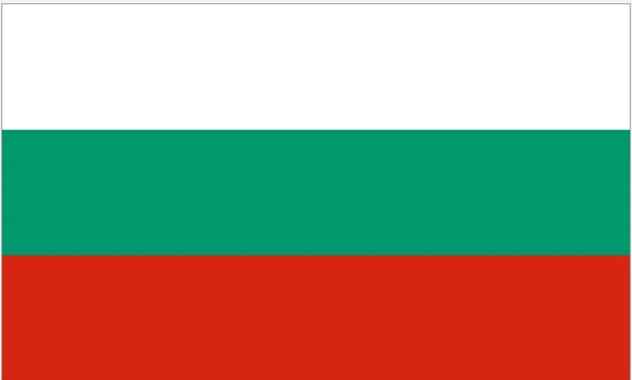
From 1946 to 1991 the country was known as the People’s Republic of Bulgaria (PRB) and was ruled by the Bulgarian Communist Party (BCP). The BCP transformed itself in 1990, changing its name to “Bulgarian Socialist Party”.
By the time the impact of Mikhail Gorbachev’s reform program in the Soviet Union was felt in Bulgaria in the late 1980s, the Communists, like their leader, had grown too feeble to resist the demand for change for long. In November 1989 demonstrations on ecological issues were staged in Sofia and these soon broadened into a general campaign for political reform. The Communists reacted by deposing Zhivkov and replacing him by Petar Mladenov, but this gained them only a short respite.
In February 1990 the Communist Party voluntarily gave up its monopoly on power and in June 1990 the first free elections since 1931 were held. The result was a return to power by the Communist Party, now shorn of its hardliner wing and renamed the Bulgarian Socialist Party. In July 1991 a new Constitution was adopted, in which the system of government was fixed as a parliamentary republic with a directly elected President and a Prime Minister accountable to the legislature.
Since 1989 Bulgaria has held multi-party elections and privatized its economy, but economic difficulties and a tide of corruption have led over 800,000 Bulgarians, including many qualified professionals, to emigrate in a “brain drain”. The reform package introduced in 1997 restored positive economic growth but led to rising social inequality. The political and economic system after 1989 virtually failed to improve both the living standards and create economic growth. According to a 2009 Pew Global Attitudes Project survey, 76% of Bulgarians said they were dissatisfied with the system of democracy, 63% thought that free markets did not make people better off and only 11% of Bulgarians agreed that ordinary people had benefited from the changes in 1989. Furthermore, the average quality of life and economic performance remained lower than in the times of socialism well into the early 2000s (decade).
Bulgaria became a member of NATO on 29 March 2004 and of the European Union on 1 January 2007. In 2010 it was ranked 32nd (between Greece and Lithuania) out of 181 countries in the Globalization Index. The freedom of speech and of the press are respected by the government (as of 2015), but many media outlets are beholden to major advertisers and owners with political agendas. Also, see Human Rights in Bulgaria. Polls carried out seven years after the country’s accession to the EU found only 15% of Bulgarians felt they had personally benefited from the membership.
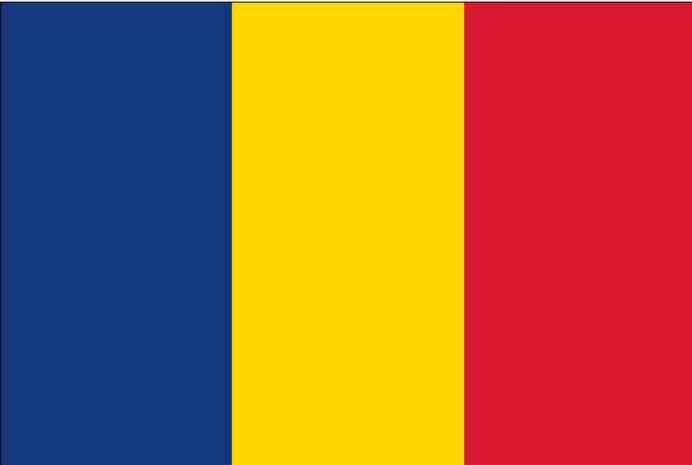
By 1541, the entire Balkan peninsula and the southern and central parts of Hungary became Ottoman provinces. Moldavia, Wallachia, and Transylvania came under Ottoman suzerainty but remained fully autonomous until the 18th century and had some internal independence. However, some Romanian Cities (Tulcea, Constanta, Giurgiu, Turnu, Braila, Timișoara, Arad, Pecica, Tighina, Catetea Alba and Basserabia) were completely under Ottoman control.
Due to Romania’s unfavorable location between the Russian Empire and the Kingdom of Bulgaria and King Carol I of Romania’s German heritage, Romania had a secret treaty of alliance with Germany and Austria-Hungary since 1883. When the war began in 1914, King Carol I summoned an emergency midnight council where he revealed the secret treaty of alliance.
Before World War I, the union of Michael the Brave, who ruled over the three principalities with the Romanian population (Wallachia, Transylvania, and Moldavia) for a short period, was viewed in later periods as the precursor of a modern Romania, a thesis which was argued with noted intensity by Nicolae Bălcescu.
In 1940 Romania’s territorial gains made following World War I were largely undone. In July, after a Soviet ultimatum, Romania agreed to give up Bessarabia and northern Bukovina (the Soviets also annexed the city of Hertsa, which was not stated in the ultimatum). Two-thirds of Bessarabia was combined with a small part of the Soviet Union to form the Moldavian Soviet Socialist Republic. The rest (northern Bukovina, the northern half of Hotin county, and Budjak) was apportioned to the Ukrainian Soviet Socialist Republic.
In Romania proper, Soviet occupation following World War II facilitated the rise of the Communist Party as the main political force, leading ultimately to the forced abdication of the King and the establishment of a single-party people’s republic in 1947.
In December 1991, a new constitution was drafted and subsequently adopted, after a popular referendum, which, however, attracted criticism from international observers. The constitution was most recently revised by a national referendum on 18–19 October 2003 and took effect on 29 October 2003.
Post–Cold War Romania developed closer ties with Western Europe, eventually joining NATO in 2004.
In November 2021, Nicolae Ciucă became Romania’s new prime minister. He formed a coalition government between former arch-rivals, his own center-right National Liberal Party (PNL), and the center-left Social Democratic Party (PSD). On 15 June 2023, Marcel Ciolacu (PSD) was sworn in as the new Romanian Prime Minister. Rotating premiership had been long agreed as part of a deal by the ruling coalition.