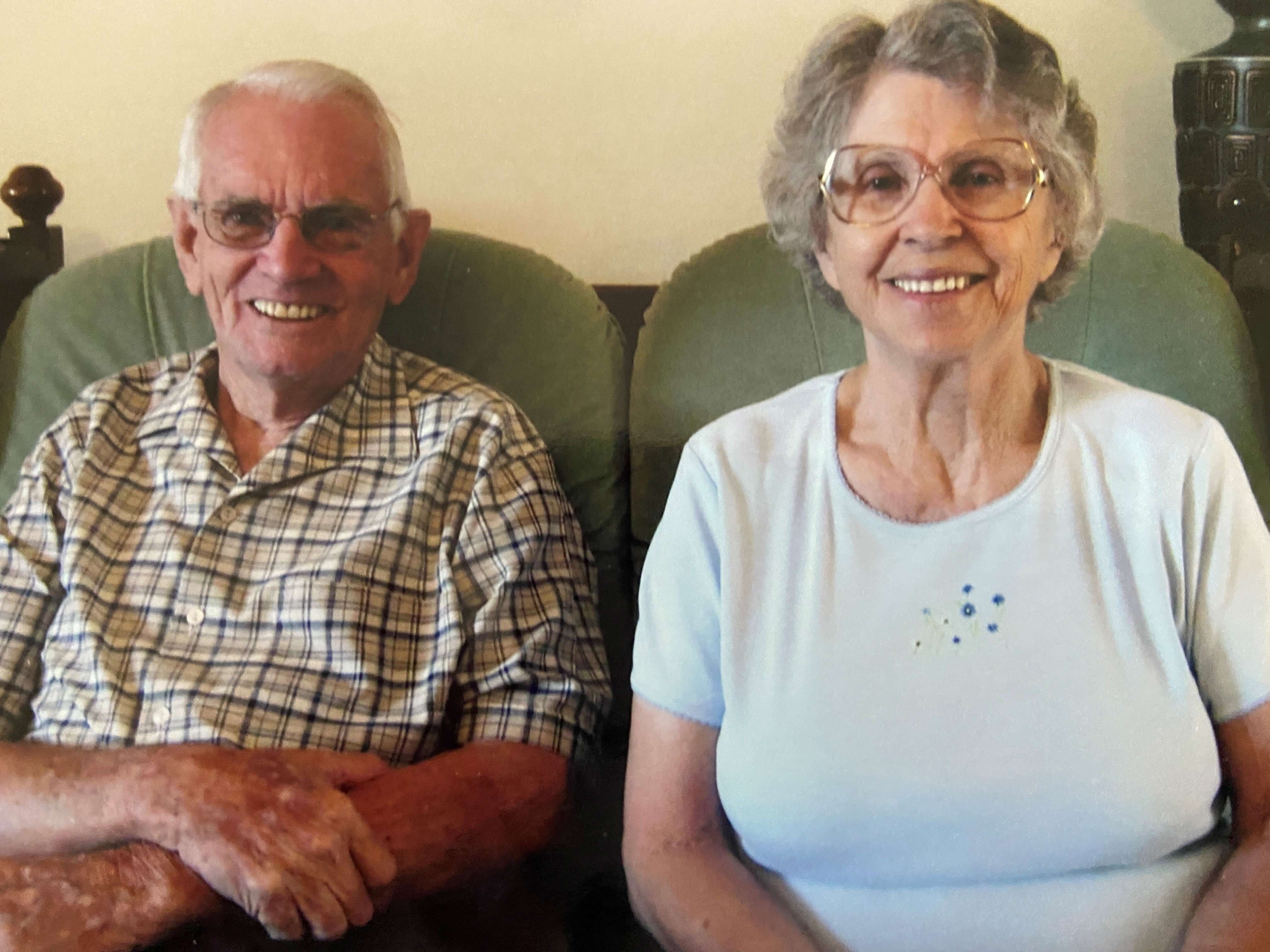
A loving tribute by John, Monica, and Gail in 2024.
Dad
Our dad, Frederick Jacobus Barry, who went by Fred, was born July 25, 1920, in McGregor, Western Cape, South Africa. The Western Cape was previously known as the Cape Province when he was born. Dad passed away on November 22, 2013, at the age of 93. He was the third oldest of six siblings.
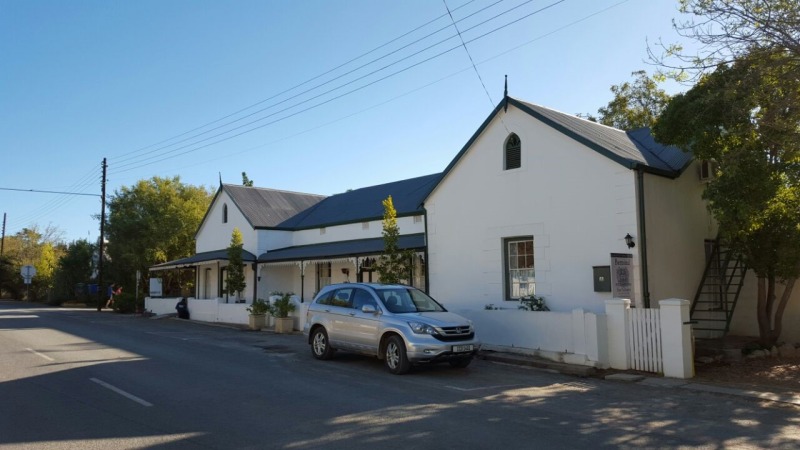
Dad’s parents’ home in McGregor, Western Cape

Map from Claremont to McGregor
Driving to McGregor from Cape Town, where we lived as kids, is a 2-hour journey of 175 Kilometers (108 miles) along the N1 (national road), ultimately taking you to Johannesburg. You pass through the Huguenot Tunnel, in the scenic Du Toitskloof Pass, to Worcester, where you turn off for Robertson, and finally to the village of McGregor. The latest census shows that McGregor has a population of 3,125.

Dad was born left-handed. When he started school, his teachers forced him to write with his right hand. Failure to do so resulted in him getting smacked. Ultimately, Dad was ambidextrous, and to watch Dad work with tools, switching hands at will, was a delight to see.

Before heading to school in Cape Town, Dad was the proud owner of an aviary filled with homing pigeons. Dad was unhappy to set all his birds free to attend school away from his beloved flock.
While at school, Dad was tall at over 1.8 meters (6 feet), physically strong, and participated in rugby and boxing. Growing up, Dad pleaded with John to never take up boxing as a sport because, although good at it, Dad hated it.
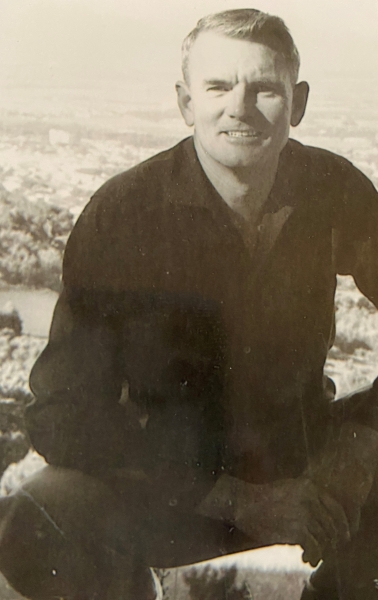

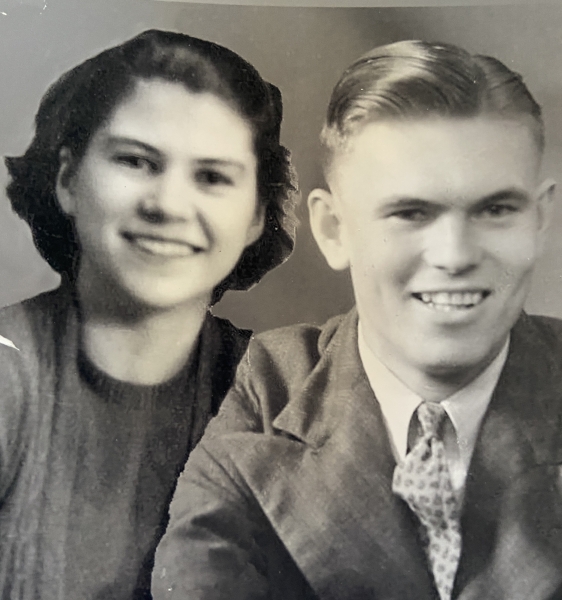
Dad, in his younger days, and with the supplemental oxygen as he aged, Mom and Dad after marriage.
Dad’s family was Afrikaans-speaking and raised in Afrikaner traditions.
One tradition was that the oldest son inherited the family businesses, so Dad was obliged to find and fund his way in life. Dad’s career started with General Electric Company repairing refrigeration units on ships in Cape Town’s harbor. Dad enrolled with the Cape Town Highlanders, a reserve infantry regiment of the South African Army. Dad said there was one inviolable rule: under no circumstances were you allowed to push a pram while wearing your kilt.
As coincidence would have it, John sat next to Peter at high school, whose father also served in the Cape Town Highlanders. Peter relayed this story to John about his father. “My Dad served as the Commanding Officer as Commandant and was subsequently installed as the Honorary Colonel of the Regiment. He met his untimely death attending a regular meeting at the Cape Town Castle, stepped in a hole, and fell while returning to his car at the end of a meeting. He died within days/weeks after that, not being able to recognize me.”
During World War II, Dad did double duty. He spent 8 hours repairing the refrigeration units in ships in Cape Town’s docks. After work, Dad boarded a train for Simonstown, in today’s road traffic, a distance of a one-hour drive, 44 kilometers (27 miles), and worked another 8 hours repairing the military ship’s refrigeration units in that port. Dad caught a train back home, walked home, got 4 hours of sleep, returned to the train station, and repeated the ritual for the rest of the week. Dad was not allowed to take active military duty on the front line during the war as he was considered an essential worker. Mom said that by the war’s end, Dad was skin and bones. One benefit for the family was overcoming rationing restrictions. Dad could often get a supply of flour as a gratuity from the ship’s personnel.
Mom and Dad
During this period, Dad was sent on maneuvers to Port Elizabeth, today some 9 hours away by car from Cape Town, or 750 kilometers (470 miles). While there, he met an attractive young lady, Monica Marais, who would later become his wife. Mom and Dad married on February 8, 1944. Mom was only 16 at the time.


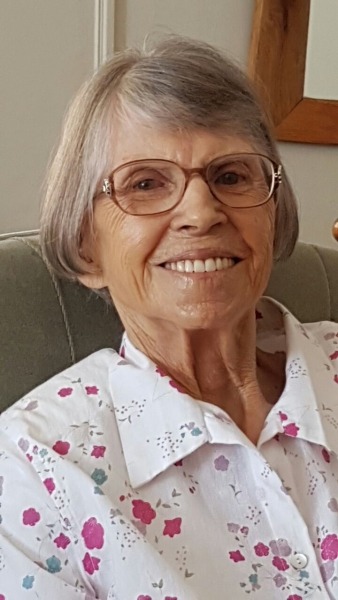
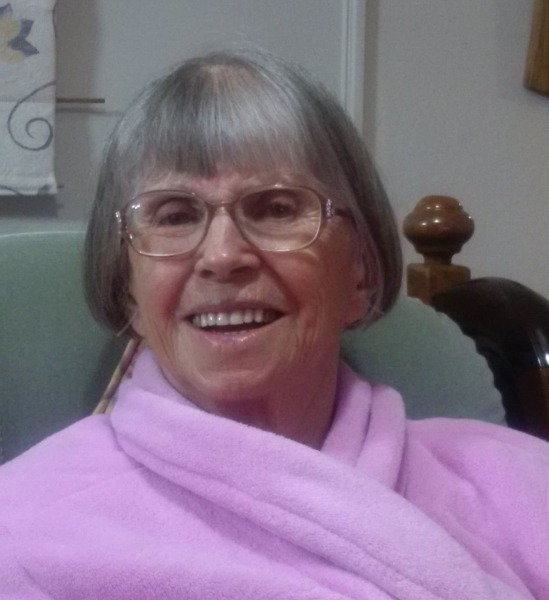
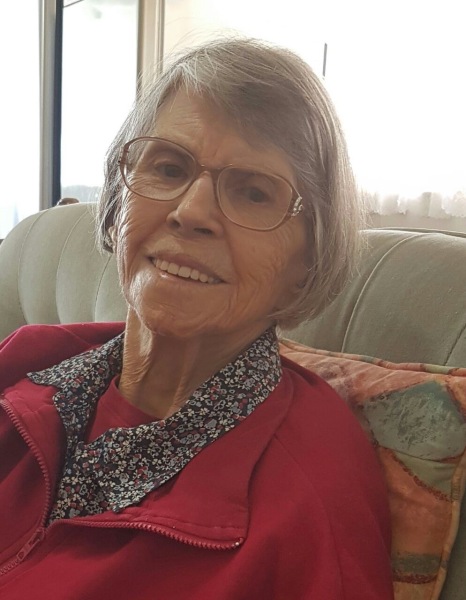
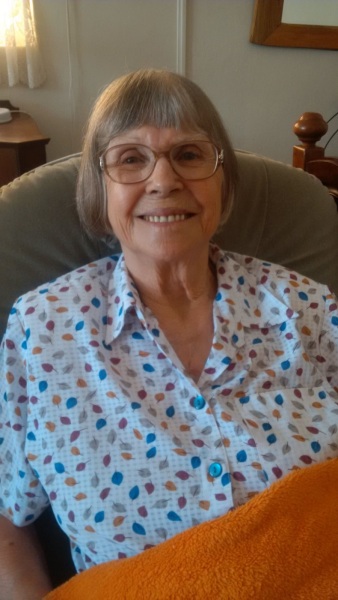
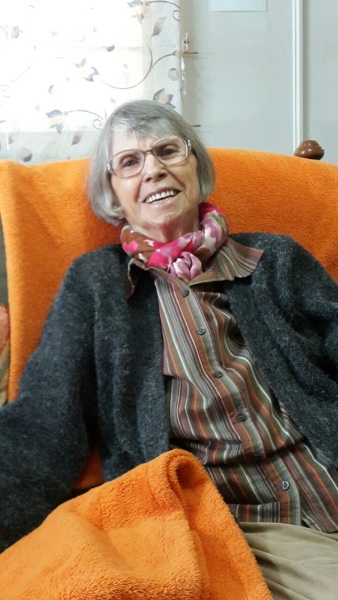
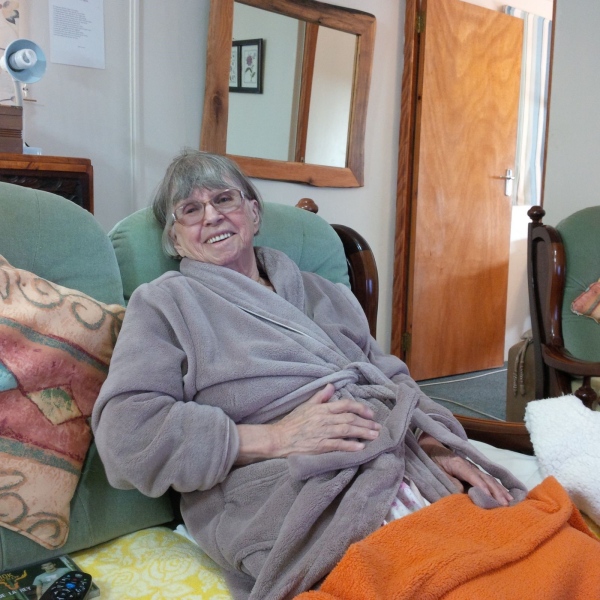
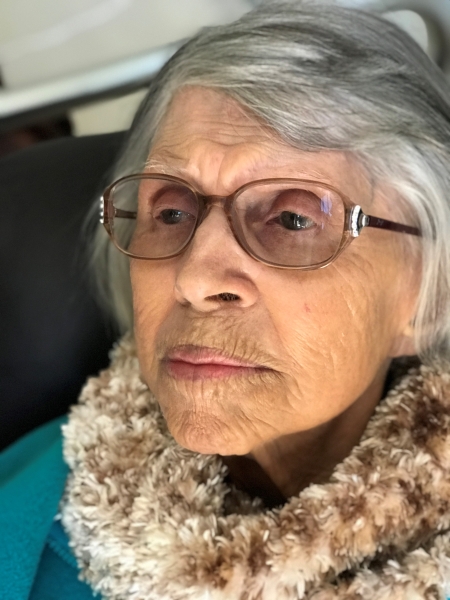

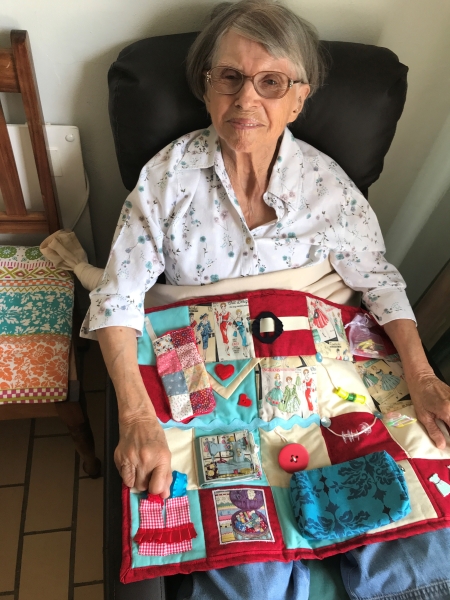
With Mom being cared for in Bonnievale, we took many photographs of her.

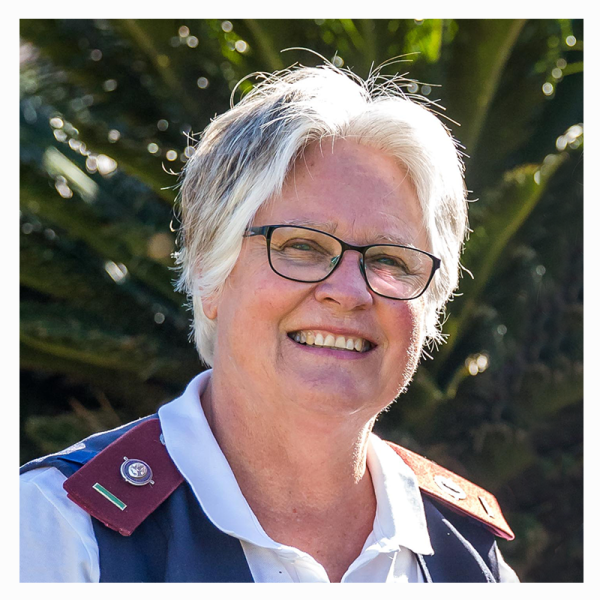
Jane Phillips
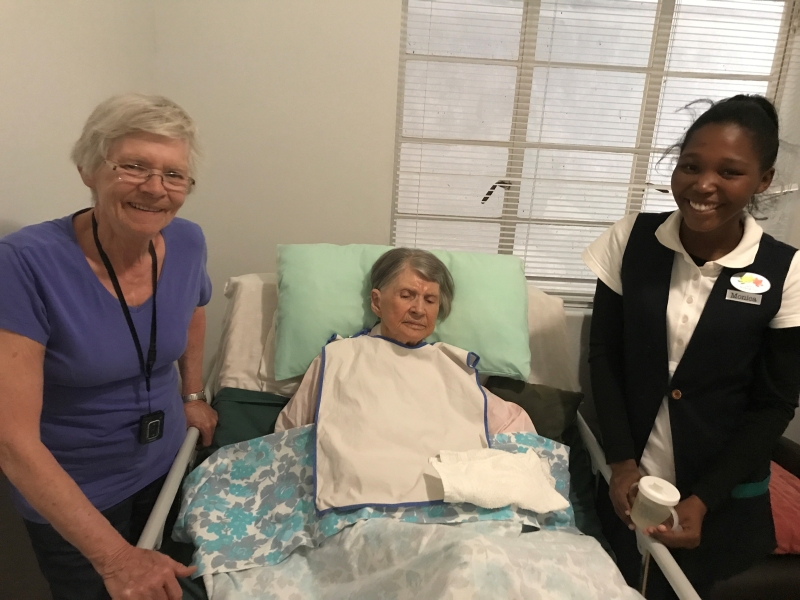
Three Monica’s: Monica, Mom, Monica–the caregiver at Jane’s Nursing Home.
Our parents grew up during the Great Depression, a period of hardship. The Great Depression (1929–1939) was a severe global economic downturn that affected many countries across the world. It became evident after a sharp decline in stock prices in the United States, leading to a period of economic depression. The economic contagion began around September 1929 and led to the Wall Street stock market crash of 24 October (Black Thursday). This crisis marked the start of a prolonged period of economic hardship characterized by high unemployment rates and widespread business failures.
The Great Depression had a pronounced economic and political effect on South Africa, as it did on most nations at the time. As world trade slumped, demand for South African agricultural and mineral exports fell drastically. It is believed that the social discomfort caused by the depression was a contributing factor in the 1933 split between the “gesuiwerde” (purified) and “smelter” (fusionist) factions within the National Party (ruling government at the time) and the National Party’s subsequent fusion with the South African Party.
The sudden lack of demand destroyed prices on commodities that were profitable to many Afrikaner farmers. For example, the price of wool fell 75% between 1925 and 1933. A large portion of the agricultural industry was unable to repay mortgages on their over-capitalized farms. Thus, the National Party found itself losing favour with one of its largest constituencies—conservative, rural farmers.
South Africa was saved from a complete collapse by the gold mining industry—one of the largest and most advanced at the time—as the price of gold rose rapidly, as investors sought a haven from the dead securities market. Growing gold exports compensated somewhat for the loss of other trade revenue. However, like the situation with the Boers (farmers), the National Party lost support as the weak economy forced the gold corporations to replace white labourers with lower-paid blacks.
The National Party-led government staved off bankruptcy by raising taxes on imports, petrol, and postage, amongst other things. This “unfair” taxation led to a further dislike of the ruling government.
The coalition government between Jan Smuts and J.B.M. Hertzog was successful in 1933 partly because Smuts presented the public with a mock budget showing how South Africa’s economic malaise could be lifted by floating the South African pound and removing it from the Gold standard, thus making exports more attractive, and creating a scenario in which undue taxation could be removed.
Mom
Our mother, Monica Marais, was born on March 5, 1928, in Sandflats, District of Alexandria, now known as Paterson, in the Eastern Cape. Mom passed away on November 29, 2019, at age 91, staying at Huis Martha Jonker, in Bonnievale, Western Cape, in the care of Jane Phillips and her compassionate team.
In 1954, our family visited our maternal grandmother, traveling by car. Ouma (grandmother) lived in a house on a small holding in Sandflats, now Paterson, in the Eastern Cape. Ouma’s home had no electricity or running water. A large storage tank outside the kitchen was situated to trap rainwater from the roof. When you require water, use a bucket, and release as much as you require.

It was the first time we realized the poverty that Mom endured as a child. Mom told stories of only owning one best dress that had to be used to attend church every Sunday, and one pair of shoes to go with the outfit. Mom’s clothing for school was well-worn.
When our maternal grandmother died, she left a small estate split between our mother, brothers, and sister despite her impoverished circumstances. Eight years later, the attorney informed Mom that there was no money to distribute. Mom was devastated. She understood that the attorney had used the money over time to feed his pocket, leaving nothing for her and her siblings.
After our Dad’s passing, we needed to draw up a new will. Mom approached an attorney. We can only imagine the negotiation that went on at the initial meeting. Mom would not tolerate eight years to pass, resulting in zero inheritance for us siblings. We will add that the time to wrap up the estate took far longer than anyone anticipated. We had not counted on the COVID-19 pandemic to impact response times, including the fact that many of the regulatory offices in South Africa were either closed or working short-staffed. Eventually, everything worked out well. Our siblings were rewarded with our inheritance a few months late, but in time to celebrate a Happy New Year, 2021. Mom gifted each of her seven grandchildren and three compassionate caregivers.
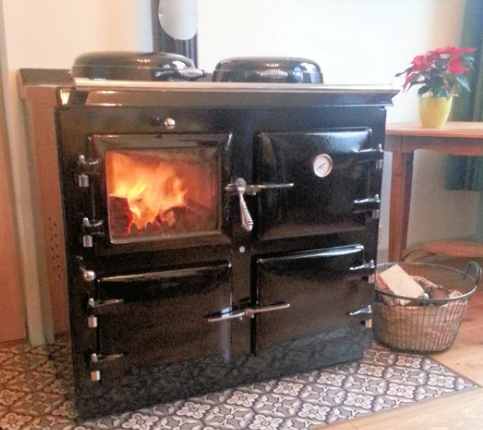
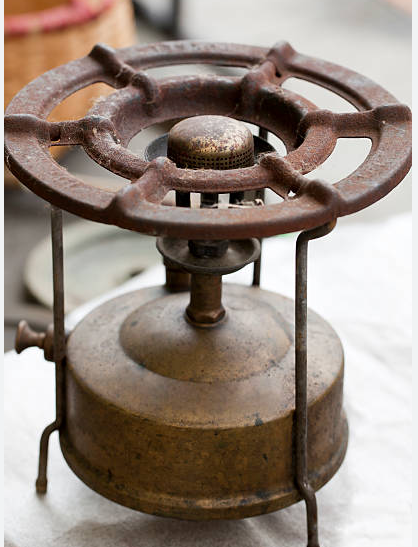
Mom decided not to return home and got a job as a clerk at the train station in Port Elizabeth (or Gqeberha as it is called today). Since Mom did not finish high school, she became an obsessive reader, devouring a tome such as War and Peace by Leo Tolstoy. Mom also loved movies, repeatedly watching The Quiet Man, a 1952 American romantic comedy featuring John Wayne, Maureen O’Hara, Victor McLaglen, Barry Fitzgerald, and Ward Bond.
Mom’s other favorite movie was Seven Brides for Seven Brothers. It is a 1954 American musical film, directed by Stanley Donen, with music by Gene de Paul, and lyrics by Johnny Mercer.
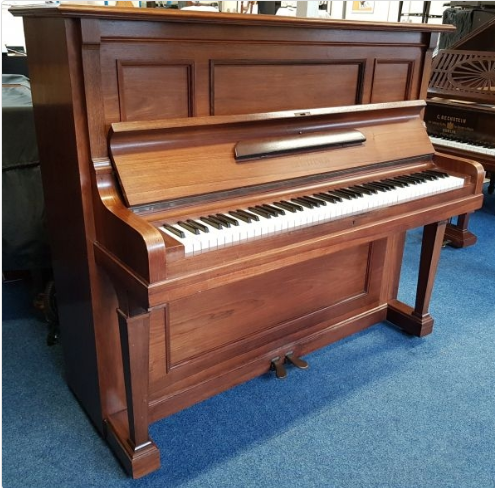
Dad, too, had books that he loved. His favorite author was Zane Grey, who wrote Western novels, some of Dad’s favorites. Pearl Zane Grey (1872 – 1939) was an American author.
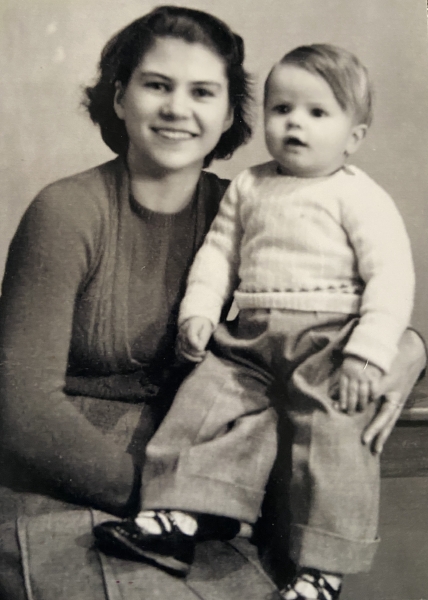
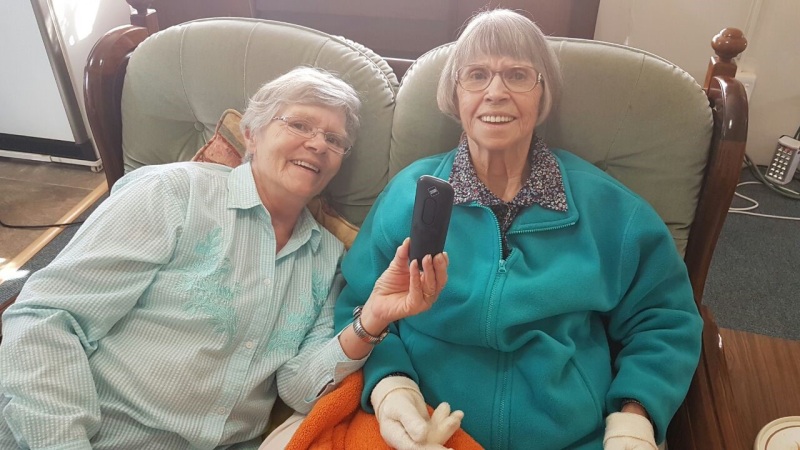


Mom with John when young, Monica, Gail, and John in recent times.
Growing up, Mom had personal and societal community issues. Her mother married, divorced, and remarried. Due to the divorce, they were not a respected family within their judgmental village in this small and highly religious community. To make matters worse, the new husband was a policeman, and again, not a respected profession. These are issues that motivated Mom to move on.
Mom’s heritage was French from her father’s side (Marais), and Spanish from her mother’s side (Ferreira). She traced her ancestry to the arrival of the French Huguenots, who escaped the religious persecution of Protestants. Today, the Marais District in the 4th arrondissement of Paris is home to the gay and lesbian community.
Mom was overly concerned that at some point our family could face a significant shortage of food, so Mom kept months of supplies on hand, including canned goods and other non-perishables. We are uncertain of her rationale, but it might have had something to do with growing up poor or stories about the Great Depression.
One superstition Mom was raised with is that if you drop a utensil, allow someone else to pick it up, or you may get an (unwelcome) visitor.
With Dad on military maneuvers in Port Elizabeth, he was introduced to my mother through a mutual friend. Mom’s qualities included the fact that she was a beautiful brunette, and Dad was smitten. They married, and Dad took Mom back to Cape Town. In all sincerity, we were not sure that Dad’s parents were happy about this arrangement, but Dad was independent and decisive.
Dad found Mom to be a challenge in many ways, but he remained faithful and supportive to Mom through all their ups and downs of marriage and exhibited a fantastic example of loyalty for us siblings.


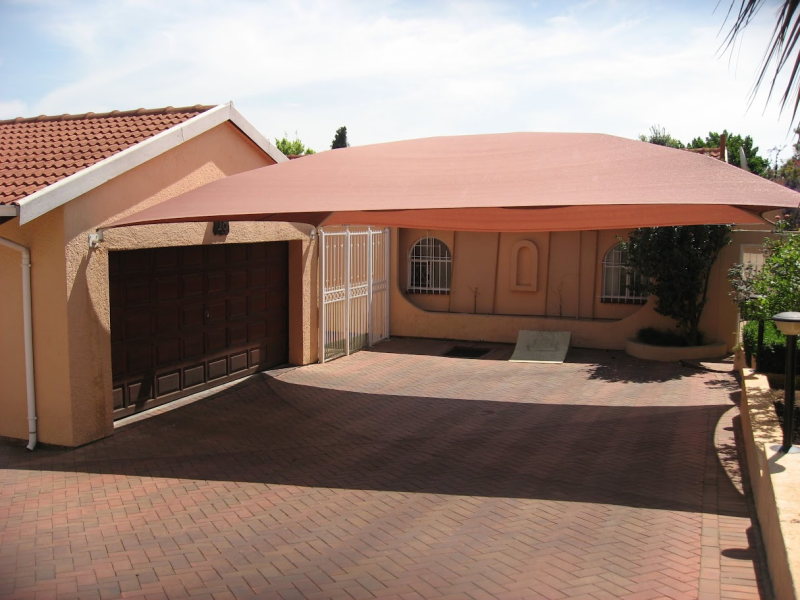
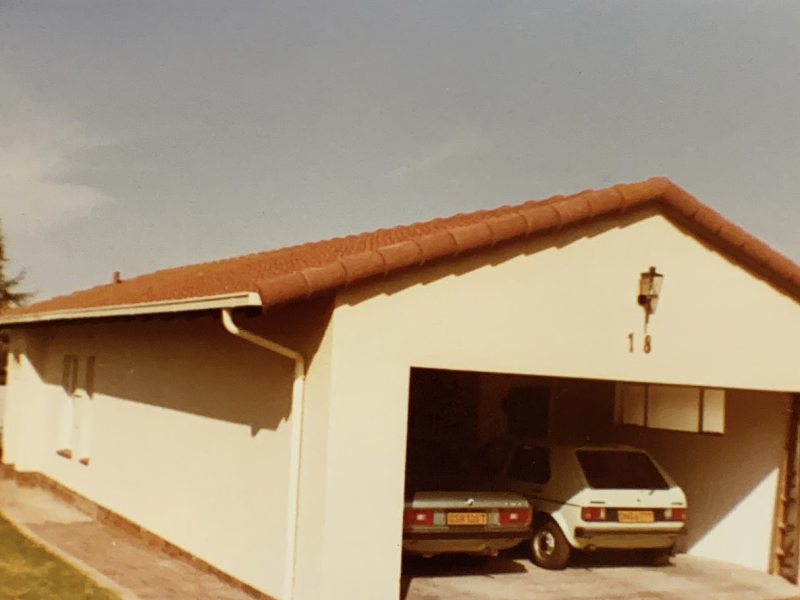
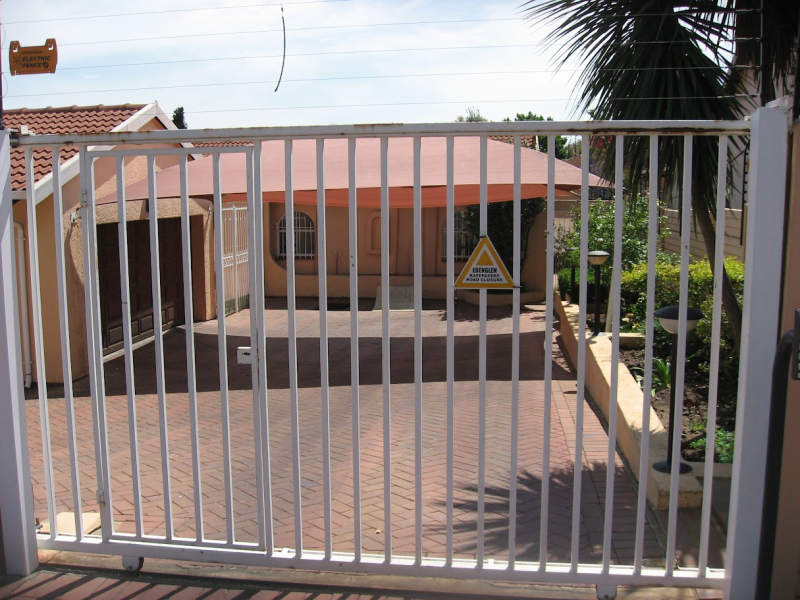
10 (20) Alpina Road and 72 Ranelagh Road, Claremont, Cape Town
The photographs above were taken on a recent trip to Cape Town, and notice the security walls and gates that were added since our time due to crime.
After marriage, Mom and Dad moved into a rental home in Rosebank, a southern suburb of Cape Town. Later, they moved to a semi-detached house at 10 Alpina Road, Claremont, not too far from Rosebank. (10 Alpina Road has been renumbered to 20 Alpina Road, after residential developments in the community). Their telephone number was 614752.

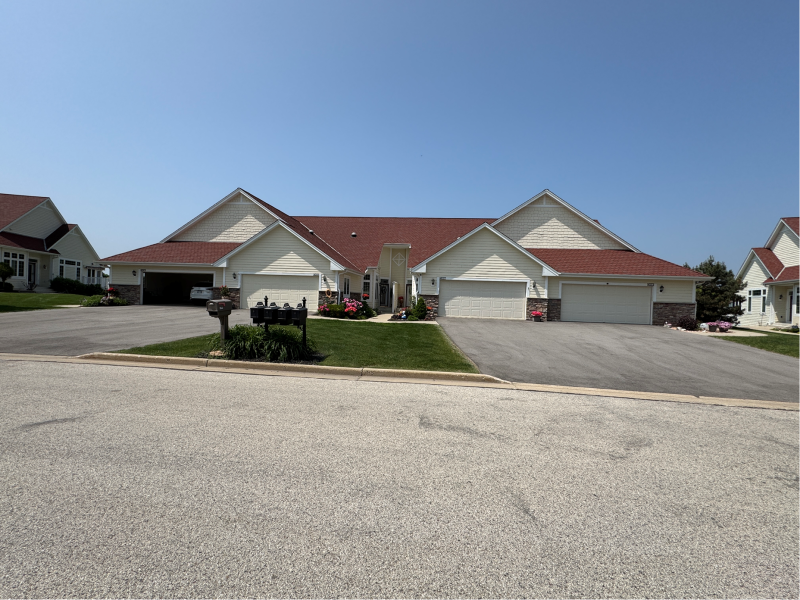

While the family lived in the semi-detached house in Claremont, and John must have been about 15 at the time, his bedroom overlooked the driveway to the garage at the end of our lot. One Saturday afternoon, there was a knock on his bedroom window, and friends asked if he would like to come out and play. John hopped out of the bedroom window without telling his parents. The group of friends walked up Keurboom Road to a field that later would become the grounds for Groote Schuur School.
They played Red Rover. They removed their shoes and socks and lined up on one side of the field. A guy was chosen to be Red Rover and had to stand a short distance away in the middle and shout “Red Rover.” They all ran across the field to the other side, the challenge not to get caught. If you were caught, you became the next Red Rover, and then they all ran across the field to the starting position, trying again not to get caught.
When John ran across, he headed left to avoid the Red Rover. John ran into a clump of grass, not seeing that it concealed a rotten tree stump. John sliced his right heel open, with it bleeding badly. The friends decided to carry John home with his bleeding heel. While walking back to John’s home along Keurboom Road, John recalled that Dad had a work colleague who lived nearby, so they stopped in at his home. The colleague looked at John’s heel and rushed him to the hospital. The doctors removed several splinters and stitched John’s heel. The colleague drove John home to the astonishment of his parents. To this day, John still bears the scar.
John bears another scar from those times. When about 5 years old, John got an electric shock. His bedroom consisted of a central ceiling light with an on-off switch provided by a long electric cord at his bedside. John decided to inspect the switch while the electric power was on. The plug attached to his left hand caused him to gyrate wildly across the bedroom floor until Dad could switch the power off. The burn scars still exist on his left index finger and thumb.

When John had to attend his Matic (senior) dance, Dad borrowed a tuxedo so that John could look special with all the rich boys at school. John asked Jenifer Flower to accompany him to the dance. She lived nearby, John didn’t know her, but plucked up the courage to invite her. Dad drove them to the dance and fetched them after the event ended. The tuxedo was ill-fitting, and John never asked Jenifer out again.
Another recollection from those early days is that there was a large sports field opposite our home. Today it has been developed with several apartments and houses. Back then, a British family moved into our area with children around our age. We were playing on the field and asked one of the children why they had such a strong body odor. They informed us that they only had a bath once or twice a week in England. That was acceptable since they did not grow up with the heat we experienced. We questioned their parents about this situation, and they wanted to know if we thought the kids were ducks that needed constant bathing in water!
A Dutch family moved into our neighborhood as well. Most remarkable was the mother screaming, “God verdoms Abbiegale, waar is yay”. (Good God, Abbiegale, where are you?) A refrain we heard frequently.
John initially grew up speaking Afrikaans. Mom and Dad wanted him to be raised in an English environment for a better future in South Africa. They changed their home language to English. Dad joked that the only words he knew in English were “yes” and “no,” and he often got those mixed up. When John was in Standard 3 (Grade 5), he won the class prize for speaking Afrikaans.
Growing up, we had a dog as a pet. With our homes in Claremont, we had a German Shepard or an Alsatian. At a young age, we were taught to love animals. We also had bicycles and learned to ride at a young age.
We had near neighbors, Earnie and Beckie McGee. They attempted to get their boys, Michael and Alan, into Rondebosch, but were unsuccessful. They both attended Marist Brothers, a nearby Catholic school. Between our home and the McGees lived the Neitler’s The father was a builder. They had a daughter, Esme. We were all about the same age.
The Trautmans lived on the other side of our home and shared the driveway to our respective garages. The Trautmans ultimately emigrated to Australia.
John was a Boy Scout. Dad erected a sign for the scout hall to be visible to passing motorists. Tony van Ryswyk was his scoutmaster and also his Judo coach while at university. On one scouting camping trip, they were handed a chicken to take care of for a few days, then slaughter, cook, and eat it.
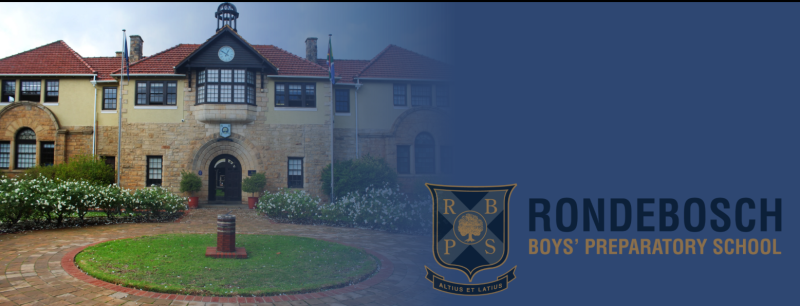
Rondebosch is an interesting school in that there was a mix of boys from wealthy homes, and others like us, decidedly middle class. In John’s early years, Mom would take him home by bus after school. Mom readily admitted that she had difficulty identifying John with this sea of boys in identical uniforms, so she waited until he ran up to her.
When John got to the age when he needed to start shaving, Dad insisted that he use an electric shaver and bought John a battery-operated device that was gentle on his skin. Dad did not like shaving with a razor blade, as you were inclined to cut yourself. John still uses an electric charged battery-operated shaver to this day.
Mom and Dad lived in Claremont when Dad did double duty at General Electric and the army. After the war, Dad started his own business. It was an electrical shop, selling electrical supplies and performing electrical work for people requiring his services. Unfortunately, Dad was underfunded and took in a partner who literally drained the cash register to purchase alcohol. The partner was an alcoholic, and Dad’s business folded.
At about this time, a year into their marriage, Mom had a tragic experience. She delivered a full-term baby boy who died a few days later from hydrocephalus (water on the brain), a condition that is curable today. John was born a year later in 1946.
John is a leading-edge baby in the Baby Boomer demographic, those born between 1946 and 1964, including Monica and Gail. The term “baby boom” refers to a noticeable increase in the birth rate. The post-World War II population increase was described as a “boom.”
Monica’s birth followed John 4 years later in 1950, and Gail 14 years after John in 1959. Mom and Dad said that getting pregnant with Gail was not a mistake. In Afrikaans, “ ‘n laat lammekie” (a late lamb). John recalls when he went to school while Mom, 31 at the time, was pregnant with Gail, Mom thought she was going to have a miscarriage. Naturally, it was a false alarm. John was emotional at school, and the teachers helped calm him.
Dad was a pack-a-day smoker, very much the fashion in those days. When John was born, Mom put her foot down and said she would not tolerate secondhand smoke, and Dad stopped smoking cold turkey. We should add that we grew up in a household where our parents were teetotalers, so we never saw alcohol in our home.
Mom and Dad stopped having friends around to visit if the motivation was to get free alcohol. As an aside, John had a girlfriend who offered him a Kola Tonic during his university days. He declined, thinking it was an alcoholic beverage. Oh, to be born so naive.
Mom’s advice to John while growing up was to get a job, stay with the company until retirement, and enjoy the benefits of a pension. It was our Dad’s course of action. He spent 45 years with Mobil Oil and retired with a pension and medical aid policy. Dad continued to receive this benefit after Mobil withdrew from South Africa due to its apartheid policies and sold its assets to mining giant Gencor in 1989. Today, Mobil petrol/gas outlets in South Africa are branded as Engen. Mom and Dad soon realized they could not live on his pension and started a knitting business from home, investing in electrically operated machines.
Dad needed a job to support his family, so he joined The Joint Pump Company, a combination of Caltex and Mobil Oil in Cape Town. When the operation was later disbanded, Dad was assigned to work for Mobil Oil Company, where he served for 45 years.

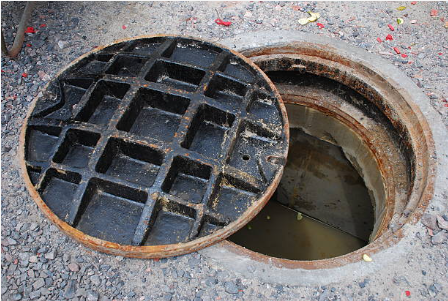
The head office stipulated that all utility covers had to be square or rectangular, and no engineering drawings existed permitting round covers. After a detailed review, the engineering department drew new plans for round utility hole covers. Over time, the square and rectangular covers were replaced by round utility ones. For the record, circular utility covers cannot fall down the hole; rectangular covers can. Dad made this engineering change that saved the company a fortune in repair and replacement bills. Dad never received thanks for the savings generated or the initiative he took.

Dad stopped to assist a motorist involved in a serious vehicle accident. The driver had turned into his driveway across oncoming traffic. The motorist got T-boned and was incensed as he kept shouting, “Everyone knows I live here.”
Dad loved the idea that OHIO was spelled “oh aitch ten.” Addison, John’s oldest granddaughter, will attend Ohio University in Athens, Ohio, beginning in September 2024.
Dad had a ritual of eating two bananas a day. This is a habit that John currently follows. Dad never ate a tomato without a sprinkle of salt. It was a problem when Mobil called multiple employees to help farmers invest in fuel storage tanks on their farms. Dad was attempting to sell a farmer with a large tomato field, who offered Dad a juicy ripe tomato that Dad begrudgingly ate without salt. When in sales mode, you do what you need to do.

Growing up in apartheid South Africa, the Nationalist Party governed the country, with strict white supremacy and racist laws where non-white people were considered inferior humans, and blacks did not have a soul. Most Afrikaners supported the Nationalist Party, and the church supported the racist policies on religious grounds. Many of these ideas were based on the American Jim Crow laws of the South. What impressed us was that our parents always voted for the opposition United Party and did not support these racist policies.
We strongly believe that racism and hate are taught, and normally by parents, family, and sometimes your peer group. We saw multiple examples growing up where our parents treated everyone, of all races, with their due respect. During John’s high school and university years, he worked at Mobil during vacations, where his dad worked. Here, John saw firsthand how the many Whites, Coloureds, Indians, and Blacks under Dad’s leadership would go out of their way to share with John the respect they had for Dad because he treated them with dignity, fairness, and compassion.
Due to the family’s financial situation, Dad had to purchase affordable second-hand vehicles and needed to rebuild them. This benefited John in learning how to remove, strip, and rebuild engines while working closely with Dad.
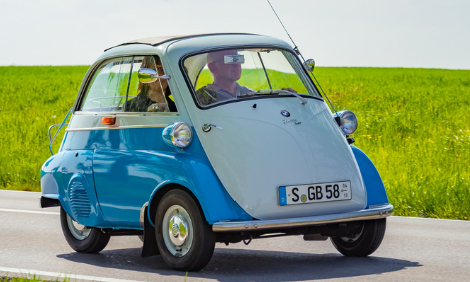


BMW was on the ropes in the mid-1950s. Its V8-powered luxury cars proved to be slow sellers and nearly left the carmaker bankrupt. To right the unsteady ship, BMW started building tiny city cars that were manufactured under license from the Italian company Iso, which itself was pivoting from refrigerators to motorcycles and some very small automobiles.
The Iso Isetta was a remarkably compact microcar with a 59-inch wheelbase, a rear-mounted 236-cc two-stroke single, and a clever one-door, two-seat arrangement that had the entire front end open up, windshield and all, for passenger access. The steering column was mounted to the door via a stamped steel collar that also held the single gauge. A U-joint at the bottom of the column, just before it met the floor, allowed for the door to open and the steering column to swing out with it.
BMW Introduces Its Isetta
Unfortunately for Iso, it didn’t sell many cars, but it licensed companies in France, Spain, Great Britain, Brazil, and Argentina to make the charming little car. In Germany, BMW held that license and also purchased some body tooling from Iso. While it largely retained the Iso’s body, BMW made some significant changes to its version of the Isetta, notably in the drivetrain by including a 247-cc four-stroke, single-cylinder motorcycle engine, sourced from the BMW R25 and slightly modified for use in the Isetta. BMW’s Isetta made the most of each of its 12 horsepower on tap to achieve a top speed of 53 mph.
BMW introduced its Isetta in the spring of 1955. Within a year, the Isetta 300 was introduced with a 298-cc version of the four-stroke single with slightly higher compression that yielded one more horsepower in total but was said to offer a more tractable driving experience, though the top speed rating was not changed. Later in 1956, changes were introduced as BMW began to put more of its own stamp on the design. Gone were the bubble windows, replaced by flat, sliding windows.
At $79,800 on a Hemmings Make Offer listing, this little Bimmer is the highest price one has sold to date via an online marketplace.
Dad was intelligent, and yet at the same time very practical. When John was working full-time for Mobil in the corporate office in the computer department in Cape Town in 1969, Dad met him for lunch one day in the restaurant downstairs. While eating there, a tradesman was hanging murals on the wall. He would drill a hole, insert a rawlplug, screw the mural in place, and painstakingly use a hacksaw to cut the excess screw length off. Dad watched this guy struggling and eventually could not take it any longer. He demonstrated to the artisan that if he would make a small cut in the screw, and use a hammer to break off the excess, the result was quicker, neater, and less fuss.
Dad did not attend university. John was complaining to him one day about a problem with a question he needed to answer in his chemistry homework. Dad asked John to describe the issue, and Dad solved the problem using common sense. Why do you think that we admired and loved our Dad?
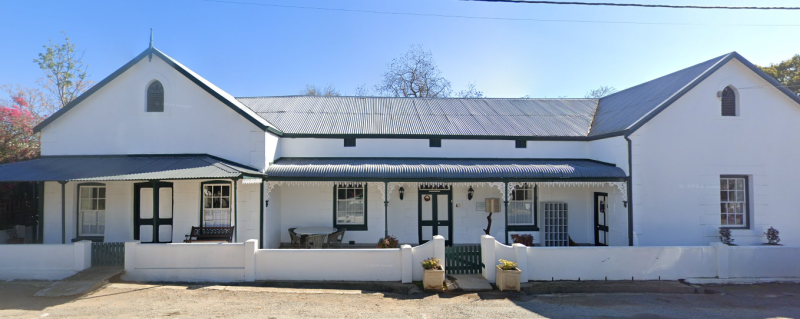
John recalls staying at his paternal grandparents’ home when he was about 4. Ouma decided to bathe John. John did not know that your bottom had to be cleaned so thoroughly and repeatedly to ensure it was sparkling bright. Something so memorable that he still recalls to this day.
On the rare occasions that our family visited their grandparents in McGregor, Oupa would hand John money just as they left for the return trip to Cape Town. No sooner were our family on the road when Mom demanded the money given to John. Mom said she needed this money to purchase food.
We were by no means wealthy growing up. As mentioned, we lived in a blue-collar area in a rental home on Alpina Road until John was 15. Our parents had their house built around the corner from the rental home at 72 Ranelagh Road, Claremont.
The builder was Sforza, an Italian. Shortly after living in the home, they experienced a strong rainstorm. There was a serious leak through the lounge windows. Dad called the builder, who responded, “I’m not for God to make the rain fall.” Sforza had not used proper weatherproofing and had a significant repair job.
Today in South Africa, ESCOM, the electricity generating and distribution company, cannot deliver reliable electrical power to homes and businesses due to maintenance issues at its 18 coal-fired power stations. Escom implemented “load shedding,” where power is cut in two-hour intervals daily up to a dozen times. Dad was well ahead of the curve. With our new home, Dad installed solar power on the roof to heat our water heater, saving us financially from the biggest draw of electricity to our house.
During John’s time at IBM, he consulted with ESCOM to support a new database implementation.
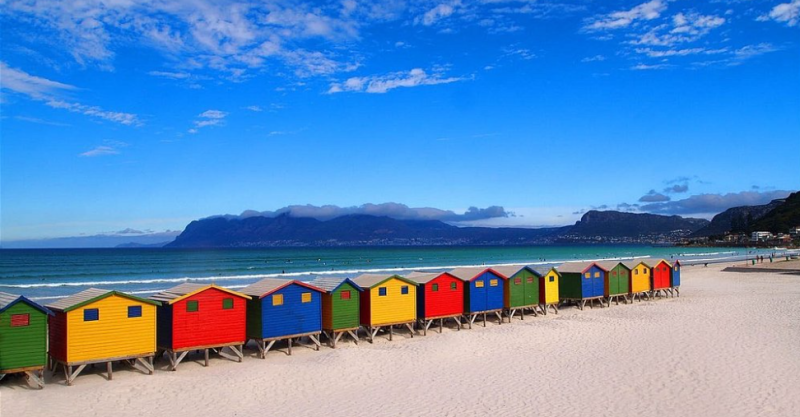
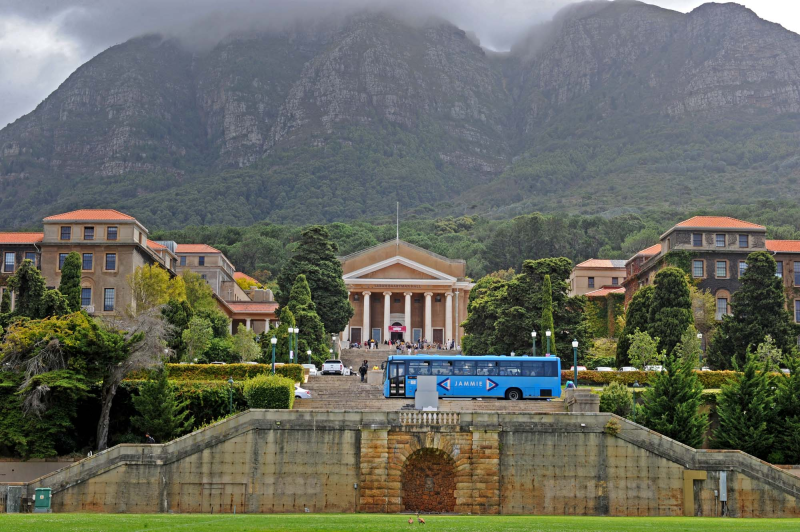
John thinks of the fights that he had with his parents. John must have been about 19 years old. He had a screaming match about something, and John walked out of the house. Permit a clarification! Our front door had a glass pane surrounded by a narrow wooden frame. John stormed right through the glass pane and got a few cuts. It was late afternoon, and John decided to hitchhike to his mother’s sister, Marie Scheepers, in the Eastern Cape, some 750 kilometers (450 miles) away. She was his favorite aunt, and he decided to seek refuge there.
The truckers were accommodating, and several stopped along the way, including the overnight shift, as John kept hiking east. John recalls some moments of intense fear. Picture standing on the side of the road, in the overnight hours, waiting to hitch a ride. A vehicle comes barreling towards you with headlights on bright, as you are standing in a curve, and not certain that they will keep to their lane, with John having visions of them running him over.
John made it to his aunt’s home on a farm outside the village of Sandflats. During this period, John was working a summer job at Mobil, and without any doubt, Dad was embarrassed that John had not shown up to work. John did not know that his aunt had called his parents to alert them that he was at her house. To make a long story short: his aunt arranged for him to get to the airport in Port Elizabeth, and our parents paid for a flight back home. This was the first time that John had flown on an airplane. Frankly, Dad wanted him back at work as soon as possible and used the excuse that John was sick as the reason he had missed work.
Mom’s sister was born Marie Marais. Marie married Gerhardes Scheepers and took the name of Marie Scheepers. Her first husband died and she later remarried, and yes, to another Kalal Scheepers, able to keep her last name or surname.

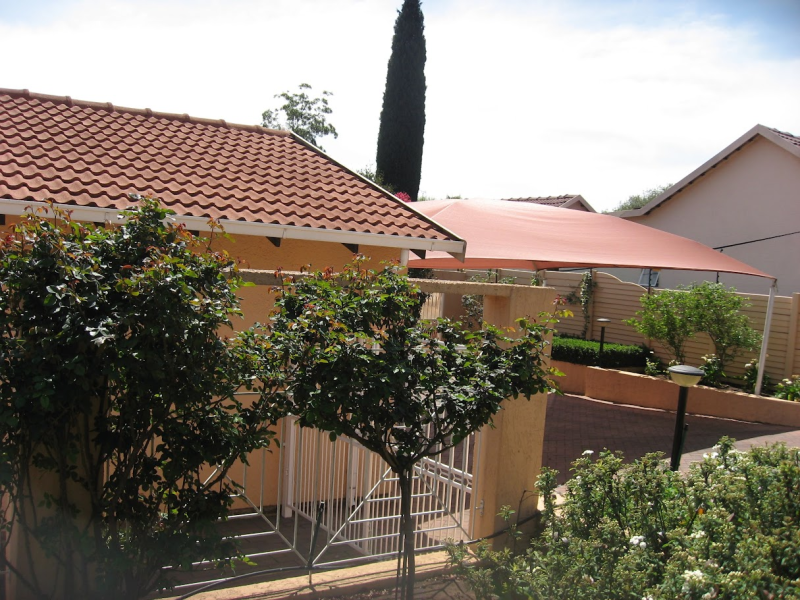



South African Flag –> American Flag
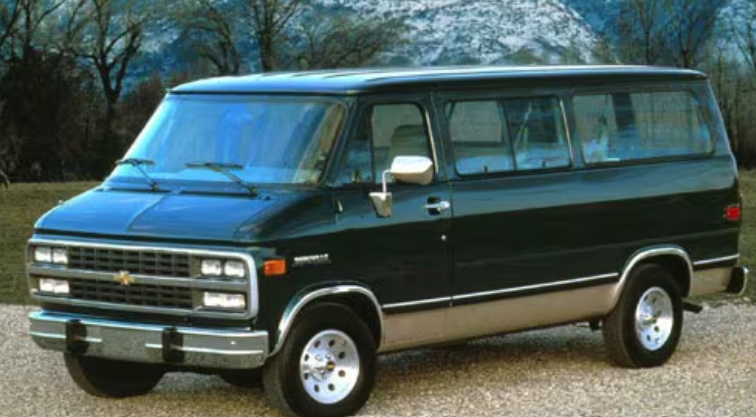
Mom was the fussiest eater in the world and would only eat French Fries from McDonald’s. On returning, Dad fascinated us with his comment that he could not believe he had seen trees along the route for almost the entire trip. The 2,500-mile (4,000-kilometer) trip was most enjoyable with all the sites we visited and experiences enjoyed.
One of Mom’s delights was to make pork lard. Mom would cut up a large portion of pork fat, warm it at a low temperature, stirring frequently, until the lard was rendered out, pour it into a large bowl, and keep it in the refrigerator. When Mom needed to fry eggs or tomatoes, Mom would scoop up some of the lard to help prepare the meal. Sadly, today we understand that this is not a healthy option.
For the most part, Mom did clerical work for several clothing manufacturers over her working career. We recall her working for Cantley, a baby clothing manufacturer. Later, she joined Rex Truform, then M Bertish and Co., which was acquired by Veka, both men’s wear manufacturing companies. While at Veka, Mom was assigned to the prestige showroom on the top floor of the Golden Acre, a high-rise building in Cape Town’s central business district, where she was called on to help select clothing for leading male politicians and businessmen.

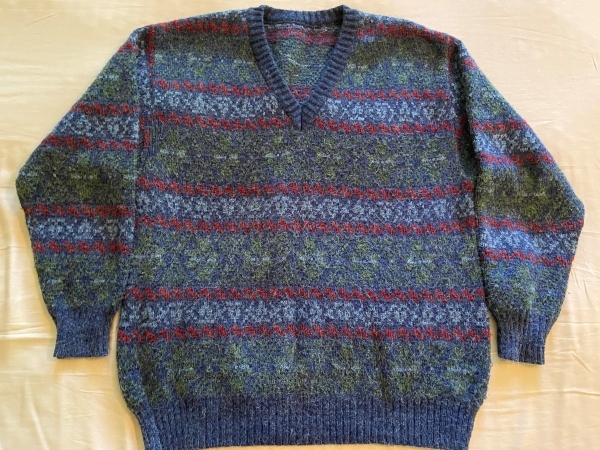
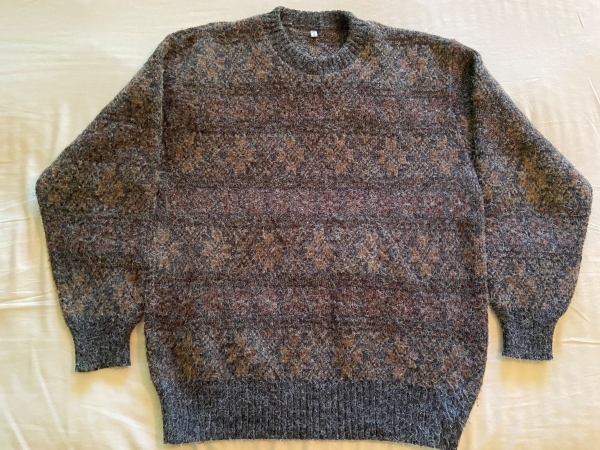
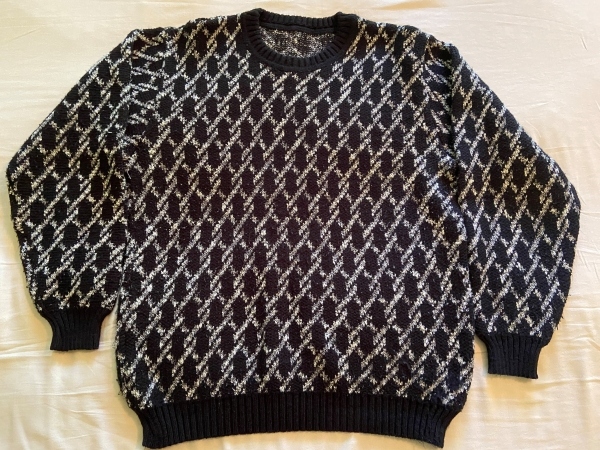
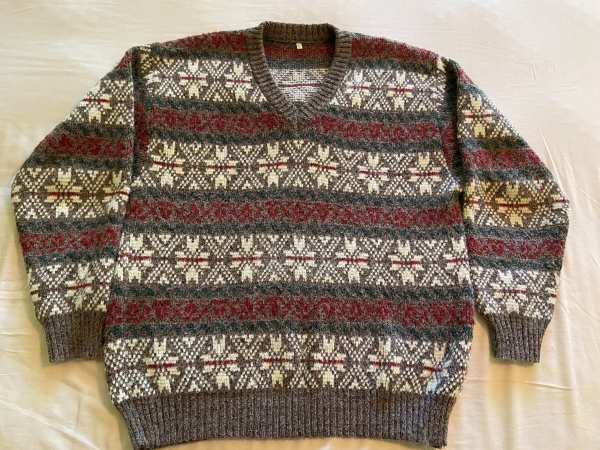
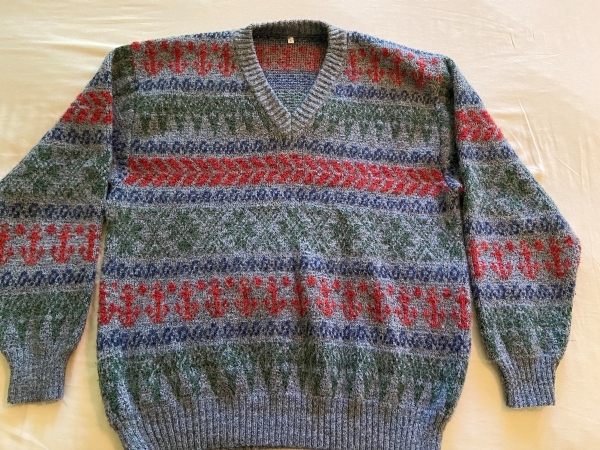
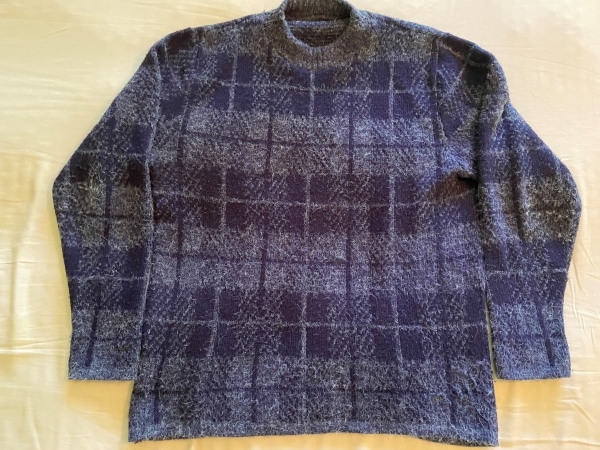

For Dad’s retirement, Mobil gave him a Mavado wristwatch for his 45 years of service. Dad was well-respected at Mobil and received many opportunities for promotion, but each one would have required moving to another city. Mom put her foot down and refused to allow Dad to take any of those opportunities because she did not want John to change schools.
At some point, Mom decided that she no longer enjoyed living in the home they owned in Claremont. She had two justifications. Mom said if she placed a marble in one corner of a room, it would roll to the other side. The floors were not level, and honestly, a fact that we siblings did not believe to be true. The second reason is that she no longer felt safe in the neighborhood because when she walked to the local stores, Mom encountered several vagrants on the streets. John had moved away from home many years before, so he was not in a position to judge or comment on this situation.
During that time, our local grocery store was owned and operated by YK Chong, a Chinese family. Ronny Chong was one of the family members whom our family was very fond of. Ronny always called John Johnny. The pharmacy next door was owned and run by Mr. Felmore. Across Belvedere Road, where the grocery store and pharmacist were located, is a park featuring a train engine on permanent display.
The upshot is that Mom and Dad sold their home and bought a new abode in Pinehurst in the northern suburbs. The first enhancement Mom demanded was to add large exterior blinds on all the windows. Mom had a genetic disorder, Porphyria, that required her to keep out of the sun. Living in a cave was not a prerequisite. For the record, John inherited the Porphyria gene, and other than being selective with the types of drugs he takes, it has not impacted his life, including enjoying sunshine outings.
Porphyria (por-FEAR-e-uh) refers to a group of rare disorders that result from a buildup of natural chemicals called porphyrins in the body. Porphyrins are needed to make heme, a part of hemoglobin. Hemoglobin is a protein in red blood cells. It carries oxygen to the body’s organs and tissues. Eight enzymes are needed to change porphyrins into heme. Without enough of any of these enzymes, porphyrins build up in the body. High levels of porphyrins can cause major problems, mainly in the nervous system and skin.
Their Pinehurst venture did not last too many years when they relocated to an assisted care facility in Montagu, Western Cape, to be near Gail. They did not enjoy the experience of living there and soon after moved into accommodation on the business property belonging to Gail and Derek. Sadly, Mom then began to show signs of dementia, and Alzheimer’s in particular, which resulted in her moving to a small care facility in Bonnievale, managed by Jane Phillips, together with her team. Mom passed away peacefully a few years later on June 22, 2019, at age 91, nearly 6 years after Dad’s passing.
Dad’s passing was quite dramatic. He was sitting in conversation on a couch, dying in the middle of a sentence. The reality is that Dad had an aneurysm, and that is what took his life. Dad passed on November 22, 2013, at age 93.
Mom was proud that she owned a Volkswagen Beetle, a curved front windshield/windscreen model. Mostly what Mom did was to back it out of the garage, wash it, and park it again. When Mom finally sold it, it was like new with very low mileage.
On the day before John returned to high school in his senior year, or matric, in January 1963, he was working his final day at Mobil in the Cape Town docks, where Dad was a supervisor. That day coincidentally was the opening of parliament in Cape Town for its new year political session. When John and Dad arrived at work, the place was teeming with police. As we learned later that day, the armed wing of the Pan African Congress (PAC), known as Pogo, an aggressively violent terrorist group, decided to have a real awakening for parliament. They decided to blow up some of the very large bulk storage tanks holding petroleum products in the facility.
A few Mobil employees had been co-opted to help with this task, but fortunately, they needed to be more intelligent. Each tank holds about 30,000 gallons (110,000 liters) of fuel. The idea was to remove the valve at the bottom of the tank, release all the fuel, and set it alight. Rather than removing the bolts on the tank side of the valve, they loosened the fixtures on the side where the fuel would flow to be pumped to a truck or ship. The net result is that only a few gallons of fuel were released, set alight, and did very little damage. A security guard employed by Mobil saw the fire and summoned the police.
John has no idea what year this event happened, but he recalls the sadness of the occasion. Mom’s mother lived in the Eastern Cape. She went to Johannesburg to spend time with one of her sons. While there, her mother passed away. Mom was contacted and decided we would all drive to Vereeniging for the funeral. Remember, in those days, the vehicle was secondhand, bought and rebuilt. On today’s roads, the distance is 1,400 kilometers (nearly 900 miles). We do not believe that the drive time was less than 16 hours and do not recall if we stayed over on the drive north; it was not something our parents would typically do.
Mom was reduced to tears when we arrived to find that her mother had been buried the previous day. As you might imagine, the anger at her brother for not waiting for her arrival was indescribable.
John tells the story that when he was on a visit to South Africa, Dad went driving with John at the time Mom and Dad were living on Gail and Derek’s business property in Montagu. As John turned onto the main road off the business property, Dad touched him on the leg to remind him that in South Africa, we drive on the other side of the road. At least there was no oncoming traffic.
During the 1971 era, Mom was selling AMC Cookware. Mom and Dad gave John and Linda a stainless steel set with pots and pans for their wedding gift. Mom would be delighted to know that it is still in daily use. What a great and practical present.
So, what did our parents do for us, their children? They allowed us to build our own families with our spouses, children, and grandchildren. They prepared a solid foundation for us, which resulted in us having a better economic position than the one they enjoyed, allowing our children a platform to be a springboard to even higher educational levels and greater financial security.
Growing up, Mom took singing lessons, singing operatic arias, helping to instill in us a love for music.
Mom’s final days were indeed a sad time. Mom started accusing people of stealing from her. We later learned that it was the first signs of Alzheimer’s that eventually took her life. It was a sad experience for us to witness.
The improvement in technology has been a boon. When John, Linda, Robyn, and Sean moved to America in late 1986 and early 1987, a telephone call from the US to South Africa cost US$1.00 per minute. Today, thanks to the internet and the rapid development of technology, telephone calls and FaceTime calls are free. Naturally, that requires a subscription to an internet service provider.
With the expense of communication from 1987 to 2000, Mom would write letters and mail them to John in America. Generally, John would record an audio tape and send it by mail to Mom and Dad. We were fortunate to recently reread about sixty letters Mom had written, reflecting an interesting time in history with lots of family news.
One of John’s greatest memories is that Dad was available to listen to John’s serious personal and private concerns. Dad would consider the situation carefully and provide the best experienced parental advice possible. It was received with gratitude, love, and respect.

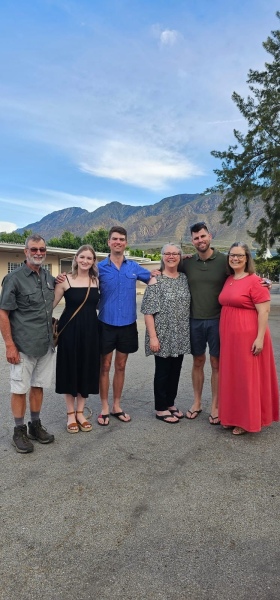

John in his youth
Derek, Celia, John-Derek, Gail, Philip, Noelani
Darin, Robyn, John, Linda, Sean, Front Row: Olivia, Isabel, Audrey, Addison
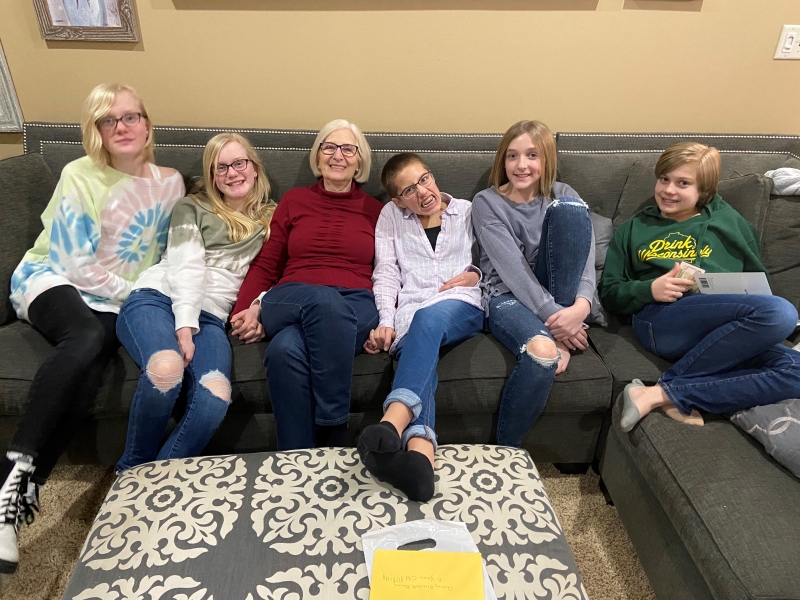
Olivia, Isabel, Linda, Maddy, Audrey
Philosophically, from John’s perspective, is it fair that children move far from their parents? In John’s situation, he moved with his family from Cape Town to Johannesburg, to Wisconsin, United States of America. Then, too, his daughter Robyn and her family moved from Wisconsin to the East Bay Area of San Francisco, California. Ultimately, it is for each person to make the best of their life and move to where the opportunities are. In reality, what do parents want from their children, if not to find the very best opportunities for their respective families?

Addison’s painting of our Mom
These are John’s thoughts about growing up at home. We grew up in a very sheltered environment and were not streetwise about the ways of the world. John recalls an incident where a motorcyclist wanted him to go for rides. Mom prevented this activity from taking place. With hindsight, it was the best advice to provide. That said, John is aware that he grew up sheltered and introverted, and that changed during his first job while working for Mobil. John attended a Conference Leadership Course where he was taught to present material to an audience. Later, he was his activity teaching computer classes to all levels of management. Despite a shielded upbringing, the confidence led John and Linda to move from Cape Town to Johannesburg, and later to America. John’s home life could not have been suboptimum, yet it provided a springboard for future activities and development.
When John and Linda ponder their granddaughters today, how well are they equipped to take on life’s challenges? John and Linda’s greatest concern is that money matters, such as saving and investing, are not part of the teaching curriculum at school. That too was absent during our days at school and growing up. How will they cope when they reach retirement age without this necessary knowledge? Our blessing was moving to America, where our neighbor, Jim Reed, taught Linda the investment skills that helped us to survive during retirement. John and Linda are confident that their son and daughter will provide their daughters with these essential skills.
We are very grateful for Dad and Mom’s leadership, ethical standards, love, guidance, and the life course they established for us. Our parents left us a legacy that we can continue to benefit our children and grandchildren further, and one to be very proud of. In brief, we are better off financially today than our parents and their parents before them. The reality is that our quality of life is significantly better than when we were growing up. What a blessing.