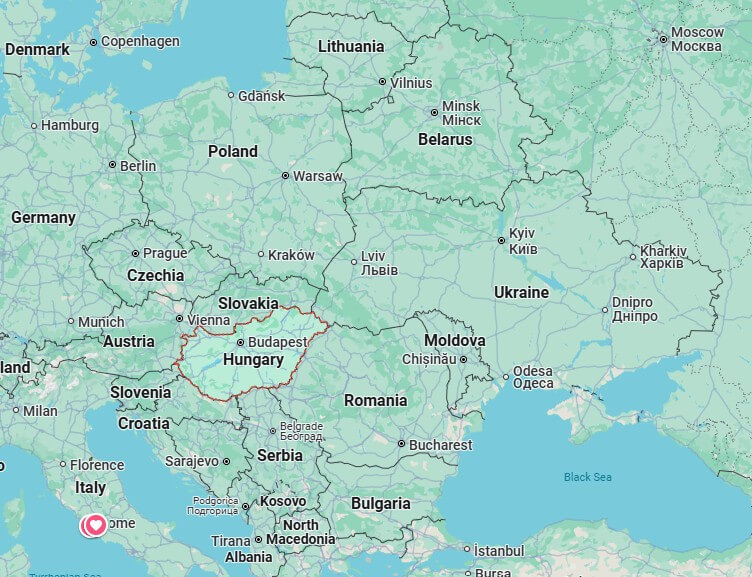
Some of the Eastern European countries are discussed below.
During our cruise to Eastern Europe in September 2024, https://johncbarry.com/viking-river-cruise-to-eastern-europe-september-2024/ A few of our tour guides shared some of their experiences growing up in their respective Communist countries. I elected to keep their names confidential since I did not ask their permission to share this information. The guides did not have English as their first language, so I was obliged to edit their comments slightly to make them more readable.
Tour Guide 1.
This is a reflection of my life as a female growing up behind the Iron Curtain. In growing up, do you know what was my philosophy? It is like looking for a black cat in a dark room, but the cat isn’t there. Karl Marx’s philosophy is you are looking for a black cat in a dark room, but the cat isn’t there, and you keep shouting “I found it, I found it!” From the age of 5 to 25, I lived behind the Iron Curtain, and I learned well to shout, “I found the cat!” I will not dwell on the fact that during the 40s and 50s in the Soviet Union, people kept disappearing.
My dad was from Czechoslovakia, and my mother was from Bulgaria. They met while studying at the oldest university in the world, Charles University, in Prague, Czech Republic, established in 1347. I was an only child, and I had a very happy childhood. My parents wanted me to be bilingual, so I attended school in both countries speaking Czech and Bulgarian, alternating countries each year, and later learning English and German.
Our society kept people equal, or equally poor. In our culture, we had one type of cheese, and one type of bread, but we had a selection of four types of shoes, in dark brown or black. However, we did not know that we could be different. As a child while at school, we belonged to clubs where we did good deeds such as cleaning and painting the school or collecting scrap paper.
In Czechoslovakia we visited 19 of more than a thousand castles, the country with the largest number of castles in the world. Including chateaux, there are over 2,000 structures. Life in Bulgaria was very different and did not have the same type of democratic traditions as in Czechoslovakia. At school we had to keep reciting what the communist party wanted us to say, to brainwash us into how wonderful everything was. Often, we did not understand what we were saying. We repeated these slogans until we knew them by heart.
Later when I started translating, I understood how careful I had to be to select the precise word to keep the exact meaning. When I turned 18, and still behind the Iron Curtain, I had to get my driver’s license. You would think that in the 80s there would be a better car, but no, I had to drive this old Skoda. This vehicle could catch fire easily, but there was no competition to allow access to other vehicles. At that time, we had to wait ten years to get a car, and you had no choice but to be happy with whatever was available. My parents eventually got a car, but I only started driving at 25, and was an awful driver, as you can imagine. My bicycle was my main mode of transport up to that time. There was only one state-owned company selling cars. You put your down payment down and asked when will the car be available. They said in about ten years. You asked which month, and he said May. You then ask what day? He looks in his black book and says 16th. Will that be morning or afternoon, and the salesperson says, afternoon, because I have an appointment with the plumber in the morning!
Behind the Iron Curtain, March 8 was the day women celebrated Women’s Day because that was the day they got the vote. Women were expected to be excellent workers and to keep the home perfect.
At school we wore uniforms. Teachers had to take care of 40 children in the class. Children had to sit with their hands behind their backs, especially at lunch, so that children would not misbehave. If your behavior mark was negative in the way you behaved in junior school, you could not get into a good high school or university. This was a hidden selection process. Excellent discipline was expected. It was also expected that we spoke very highly of our teachers.
My father warned me that if I have any problems at school, with boys or anyone else, under no circumstances do I report them. If you cannot resolve the problem on your own, then I must tell my father. I learned that reporting was a good thing, and my father did not want me to be identified as a person who would report troubles. Later, when I was about 17, I learned that I could question anything at school. My parents did share with me issues that they believed were not correct in their society and expected me to listen, but to not discuss their thoughts with friends. So, I became aware of the challenges we faced.
In Czechoslovakia, Christmas was a big celebration. In Bulgaria, there was no Christmas, and you were not allowed to enter a church, but January 1 was a time to celebrate as a family. When we lived in Bulgaria, we had a Christmas tree, with many glass ornaments. Our ornaments were stored in big boxes for many years, to be opened and celebrated each Christmas. In Bulgaria, Christmas trees were delivered late on December 24, generally after dark, and small enough that I could carry it home. I was the only person from my school to get presents at Christmas. Our family was regarded as different in our community, but that was not a big deal.
From age 16 to 19 I was in a foreign language high school in Bulgaria. We had teachers from the country with language skills to teach us 7 hours a day. I went to a German-language high school, where the school was regarded as a high-quality education. In summer we were sent away for one month, dressed in what looked like a military uniform to harvest crops. The initial harvest was done by professionals, but there were still lots of tomatoes, potatoes, and apples that we were responsible for picking.
For an hour a week, we had military education and were informed what we should do if a bomb was dropped on us. We had camps where they separated girls from boys. We had to wear military uniforms in the countryside. We would get woken at midnight and put on old-fashioned gas masks, then ordered to run in the middle of the night. We had to learn how to assemble and disassemble a Kalashnikov. Holding a gun in your hands at that time and at our age was rare, then we had to fire the rifle, and it hurt. Only the police and the military were allowed to have guns. We were told that the American army had poisonous gasses that we did not have. We were taught first aid. My father told me that if an atomic bomb was dropped, you would need to run away as fast as possible.
From the age of 18 I had to go into the army, and only after that time could we go to university to study further. John Lenon, of Beetles fame, wrote the song “Imagine” during the time I was 17 and 18 and it was like an anthem for us. I wanted to travel, and had two passports, so I could travel in Bulgaria and Czechoslovakia, but I could not go outside of these boundaries, I could not travel to the west.
Jan Tomas (Milos) Forman was born in Czechoslovakia and escaped to America in 1968, where he produced the film version of the musical Hair, Amadeus, and One Flew Over the Cuckoo’s Nest among many others. I watched the musical Hair twenty times. I could watch this in Bulgaria, but my friends in Czechoslovakia could not see these movies where it was banned, including the movies he made in Czechoslovakia before he left for America.
To go to high school or university we had a written exam with twenty-five questions. You could purchase the answers before taking the exam and learn the answers by heart. The questions all related to the history of the Communist Party and the Party Congress, just more indoctrination. To fail this exam, you had to be very lazy. You would never know if you passed or failed the exam, only learn that you were accepted or rejected. Sometimes if you had a relative who was against to Communist government, then you failed without knowing the reason why the failure.
When I was 19 and working at conferences as a guide to help with translating since I spoke three languages, I was visited by the secret police. They restricted me from performing transfers from the airport to the hotel and to listen to what the visitors were saying, reporting back to the police. I was so outraged that I told everybody at my workplace, and my father said, “See—I told you so, and that is why I did not want you to work in tourism.” Tourism was controlled by senile senior military generals.
At that time of my life, I was not allowed to work in tourism unless I was able to prove that I was extremely loyal to the communist party. We were just so naïve. All we were allowed to do was repeat the nonsense that we were told, even if we did not believe in it, and to not think for ourselves. As we moved into the 80s, we thought that we could speak out a bit.
With the nuclear power station disaster at Chornobyl on April 26, 1986, in Ukraine, not far from where we lived at the time, all the countries behind the Iron Curtain kept the disaster a secret. Some information came out after the May Day Parade, but later on May 2nd. The wind was blowing in the direction of our countries, with clouds carrying nuclear waste, impacting the health of our citizens. With the drizzle on our crops, nobody would buy our vegetables, and Bulgaria had to stop all exports. We continued to eat the fruit and vegetables since we were none the wiser. That is when we realized that our government could not care about our people. All they wanted was to stop the spread of panic.
We knew what nuclear poisoning was, how long it would take for the clouds to come our way, and the impact of the disaster. My father had a vineyard, and at heart, he was a farmer, even though he was a hard-working engineer. Our neighbor was a general from the army who came to my dad with a Geiger meter, showing that our crops were over the safe limits for human consumption. We never learned how many cases of cancer we had in our country.
We had many restrictions. We could not move from the city where we lived unless we could get a job in another city. Now I can speak to people about my life during those challenging and controlling times. I realized that it was difficult for my classmates to change their mindsets. They felt it was easier to just conform. I believe that you need to stand for what is right and to do the right thing.
Tour Guide 2.
I was born in Croatia but grew up in Yugoslavia. When I was 19, and just finished high school, I saw the end of the Communist Party. As a man, I had to go into the army for one year. They always sent you far away from your home, so I was on the Bulgarian border. Romania and Bulgaria were our enemies, and we were scared of them because we thought that they were going to invade us. Yugoslavia was not part of the Communist influence. We were a hybrid in that we were allowed to have private property, business, choice of doctors, and lawyers could have a private practice, so we were not controlled by a central government. My father passed away when I was 5, my mother had a good job, and I had a happy childhood.
We had passports so we could leave the country. We would travel to Italy and Austria, where we skied. We were only 70 kilometers from Italy. The regime only allowed us to have two TV channels but were not allowed to talk negatively about them. However, we could watch Italian TV so knew what was going on in the rest of the world. We were able to understand how the world functioned under communist rule and the democratic forms of government. We better understood Yugoslavia and other countries.
In 1964 in Yugoslavia the American Express Card was made available, and in 1986 the first McDonalds opened in Belgrade. We had a more moderate communist style of government regime. That said, you cannot make a joke about the communist leadership, or you would be imprisoned. The prisons were on an island in the Adriatic Sea, where they imprisoned 160,000 people, those who were thinking differently. Usually, it was students who had different ideas. If you expressed those ideas, you would be visited at 5:00 am and put in prison for a couple of years. At school, you were indoctrinated to believe that one day you were going to be a big communist leader. From the time that I went to school, to the end, none of my classmates believed in communism or joined the communist regime.
In 1974 the CIA predicted that the communist leaders would pass away to end Communism which eventually took place in the 1989 Revolution, also known as the Fall of Communism in the Eastern Bloc. Yugoslavia survived because we received investments from the West and the United States. Then the money stopped, and everything collapsed. We received $1 billion, but inflation tore us apart, because daily everything went up in price, and the US dollar lost its value in our country.
By the way, as one commentator responded, the situation in Romania was very different.
Another commentator.
Growing up in Romania, he said that his parents would apply for a passport every two years. If you wished to travel to Russia, you would be granted a passport, but each time it depended on the mood of the rulers, and depending on where you wished to go. The request may result in you being treated with suspicion if it was outside of the communist bloc. After the collapse of communism, we were ruled by a dictator. It was different when they checked everything, you could not bring stuff home, back then it was different. They shut the electricity off at five or six o’clock in the evening. You went to the shop, there was nothing to purchase. You could buy one loaf of bread a day, maybe, depending on how many people live in your family. Everything was portioned. They had their reasons. They said that because the people eat too much, they had to cut it off because there was nothing. One of the great ideas was to pay off all the debt, which left the country without anything.
For me thinking about living in a country like that, it was obviously strange. All the stories that my parents and my grandparents used to tell me. If three poor people were walking in the street, and having a gathering, it was already suspicious or sure that they were being recorded. It was strange. Everything was controlled.
Tour Guide 3.
I was born in 1984, so I was nine to ten years old when socialism collapsed. I remember Bulgaria was very quiet. There was not much going on and it was a safe country. That was a created reality because when you watch TV or read the newspaper, then everything is perfect. Nothing bad happened in the country, and everybody was happy. That was only the reality for the people who were not interested in facts. That was not a true situation. Most of the people lived quietly, however, the electricity was frequently cut as in Romania. If you go to the supermarket, you find two kinds of bread, two kinds of salami, two kinds of sausage, and three kinds of cheese. The merchandise was good, but usually, not many products were generally available. If you had connections, you could find whatever you want.
To survive, you need to have connections. You know somebody, who knows somebody, who knows somebody to get what you need or want. You always had to be to be connected. That psychology still exists today. For example, if you need a lawyer, even if it is thirty years later, you always ask one of your friends for a referral. That too may apply if you need a doctor.
I spent three years in junior school, and it was great. I had to learn Mathematics, Bulgarian, Russian, and other subjects. In third grade, I studied biology and physics. My daughter does not study physics. Teachers today push you to learn. At that time, you leave your house without locking it, you never lock your car. However, if you lose your car, you wait two or three years to get a new car. If you do order a car, there is about four or five brands of cars in Bulgaria, let’s say your choice is Fiat, but you end up with Moskvitch, a Russian vehicle assembled in Bulgaria between 1967 to 1988. You order a white one or a blue one, and you get a red one. It doesn’t matter what you order, you put down a half deposit, and you get something different. If you have a friend, of a friend, of a friend, you may get the correct vehicle.
My father was born in Ukraine, but our family was Hungarian with many relatives living there. He qualified as a lawyer, but never practiced law, as he could not under communism. He administrated a farm, and to get by when he was going home, he loaded his car with eggs, so he waited for a large truck to come by, drove close behind it so that the police did not see him, got home, and traded the 300 eggs for other merchandise.
One of my friends was working in a furniture shop. If he needed furniture, he traded a week’s worth of eggs and collected the furniture at the back of the factory. Another worked in a place where he had coffee, so you traded eggs for coffee, at a time when you could not buy pure coffee. You could get one kilo per week, which wasn’t even coffee. Half of the product was chickpeas grounded together with the coffee. This is how they got by, exchanging goods wherever you worked and, you know, what you had, because nobody knew how many eggs or how much coffee, so this is how they got by. This is what my father did when was working during the communist time because he could not practice law.
Some of the presenters provided general commentary on what happened after communism and whether countries could return to this form of government.
Question: How do you protect yourself from a repressive form of government and a return to a dictatorship?
I was 19, and my mother 55. After ten years, it takes a long time to wash the brains of the people because they were indoctrinated for 50 years. Every country in your communist regime had a dictator until he died. If he had a son, they would transfer the power to the son. In Europe after the Berlin Wall came down, we find out that all these regimes of the last 50 years fabricated history, they changed it. They then had to re-educate the people who for 50 years witnessed history collapsing.
I remember my mother was 55 and she was lost. She was in a vacuum because all her life was taught one thing, only to find out this was all wrong. So why do you want to go return to socialism when only 4 or 5 percent of the country wants this type of regime? We never had a vote, we never had elections. Everything was fake. Now you find yourself a day after the collapse, and what are you going to do?
My mother doesn’t know what to do. Is she going to lose her apartment, is she going to lose her job? All the products are produced in socialist countries, and you cannot sell them to the West. 80% of products were sent to Russia for the past 50 years. We were not capable of producing anything, our economy was falling for several years, but we survived on $100 a month. I can tell you this because I was there. We survived. Now thirty years later you have a new generation. Let’s say a 19-year-old wants to set their agenda, they have new ideas that the actions of the new regimes are great. It’s in every single country. I’m not talking about a process that you can find in your country, only in other countries.
Some of the universities have a philosophical agenda formed by NGOs with ideas, shared with our countries, and we have youth who call themselves progressive. We have democratic elections every four years. We have a progressive Antifa (a broad and decentralized political movement comprising individuals and groups who believe that fascism continues to pose a unique threat to democratic and peaceful societies), and we also have the communist party, which has an agenda to protect the workers. Since 1990, the workers drive Mercedes and BMW. The communist regime loses the workers. We had elections a few months ago, and the communist party could only get 4 or 5% of the vote.
But if you have any of the people who are thinking that before was any nostalgia, this is only another five percent. Nobody wants to go back, nobody wants even to think about that because it was a very tough time. Each country used to have a secret police, and life in Bulgaria and Romania was very tough. If you emigrate, if you run away from the Iron Curtin countries, we have places like Ireland (currently a population of 5 million), where you have a million immigrants, we have five million people who live worldwide, with one million in the United States.
But even if you, emigrate outside of the country, they send secret police, and they kill you in Stuttgart, Stockholm, Augsburg, or wherever. So, they kill so many people outside of the country because they didn’t want them to criticize, or to share different opinions. Even if they run away, they will catch you.
I think that there is no way that Romania can go back to communism However human stupidity can be limitless, so they might surprise us. Living in a country where my parents and grandparents used to live, for me is just unimaginable. But as I said, it is always a surprise. In Bulgaria for 30 years, the Communist Party renamed themselves Socialistic. We are aware that it is not important which person is on top, it is important who keeps control of the economy. We are now building democracy, but we are not there yet.
This may not a full answer, but it is a very complex question.
Question: after the fall of communism, which Western European country did you want to move to?
From the books that I had read, the United Kingdom was my first choice.
I traveled a lot even during communist control. I traveled with my mother to Russia and all over Europe. During the communist regime, my mother found herself in a vacuum. People did not know what was going to happen. During the time when I was 19, I knew what to do. I had the knowledge that I needed to move. My break came from watching Miami Vice on TV. I said I like Miami. Two years later I was working on Carnival Lines.
I knew I could not wait because, over the past 20 years, we lost 10% of the young population. So, with professions such as doctors and lawyers, as soon as they finish high school or university, they emigrate to Western Europe and the United States. They don’t have time to wait because the transition is very slow.
The political leaders changed political names from the Communist Party to the Social Democrats with a very slow transition. The communist leaders were afraid that there was going to be a new government and retaliation. They were going to be killed because of the nasty things they had done for 50 years. So, everybody was scared, so what did they do? They saw the writing on the wall that the communist regime was coming to an end, ten years earlier. They started stealing money from the factories, and channeled the money offshore, to the Jersey islands, Bahamas, and Bermuda, for rainy days. Now we have millions and millions coming back to our country. What did they do, they transferred the power from them to their kids. That is why in each country, you see in Romania for example, how many Porches, and Lamborghinis are on the streets. These are the golden kids from the ex-communist leaders who are driving the business to each other. That is why the improvements are very slow because they still don’t want to lose power.
Question: After communism fell 35 years ago, is there anything that you wish the world could learn from that time?
You can still find people who would say that times were better back then. You can understand because healthcare and education were free. My sister needed special classes, and it was free. Now if you go to an optician, you pay a couple of hundred euros or for glasses. If you need special orthopedic shoes, you have to pay for them, back then it was free. If you go to school or university, you have to pay. If to just talk to the doctor you must pay a hundred bucks.
All these people said by comparison today they have a pension of say two, three, or a maximum of four hundred bucks a month. If they get sick today, they wait a couple of months until they get their third pension to pay for the private hospital or use the free state-owned hospital. That is why I think in Romania, one million people have left the country. We have two and a half million in Spain, one and a half million in Italy, and maybe a million on ships (joke). So you have got the middle class abroad, and they are supporting their parents, their grandparents from overseas.
Yeah, so that’s why some people think it was great back then, but then again, I always say that, you know, when you live in prison for 30 years, then freedom can be a burden.
You know, it’s like a pendulum swing from one extreme to the other extreme. The moment communism fell, everybody started thinking that money is the thing that we were missing. And yeah, and it is the thing which is the most important and families fell apart. We have children that are called a lost generation because the parents are working abroad and there were no family dinners. The kids were brought up with an elderly sister or with their grandma. It is not the same. Many kids went to study abroad because they wanted to prove that they could be successful. However, they are lonely abroad.
The net result with children living abroad is that we have plenty of mental issues. Many very many smart children don’t have the grounding of family, which is supporting at critical moments when you are in a completely different society. So this abrupt change is really bad. In my case, my father was absent, because they were busy. I tried to go to university, but I started working. Everybody messed up because, for example, in Bulgaria, when you finish school, if you go to college, it’s okay.
If you don’t like to study, then the next day you start working. You cannot stay at home doing nothing. You must go and if, for example, you finish school, you go into the army for two years, thereafter your work. For example, you have been educated to do factory work, and if you finish special high school with electrical school or any kind of trade, you just start work with a dedicated factory. You work there and the money you get you can use for an apartment. The money is sufficient because when you go to the store, there is not much to buy.
I work eight hours have money in the bank and go back home. With communism, they say it was much better because of low crime, there were no criminals and nothing bad happened. You don’t lock your door. All the people know each other, and their kids’ names. If kids break something, the neighbors tell on them, and your father asks, “Why are you breaking that?” Three or four percent of the people will say under communism it was better. But it was better for those people who enjoy the social benefits and the welfare.
It is with sincere regret that I need to end this blog on a negative note. In preparing for this trip, I purchased a compact Chinese-produced audio recorder that I used along our travels. When I got home all I could hear was static. The quality was not good enough for me to capture what was shared, and frankly a very disappointing discovery for me. For the record, what I was able to share with the information above was recorded on my iPhone. What a lesson to learn too late. The good news is I have some pertinent information to share.